What prognosis actually is
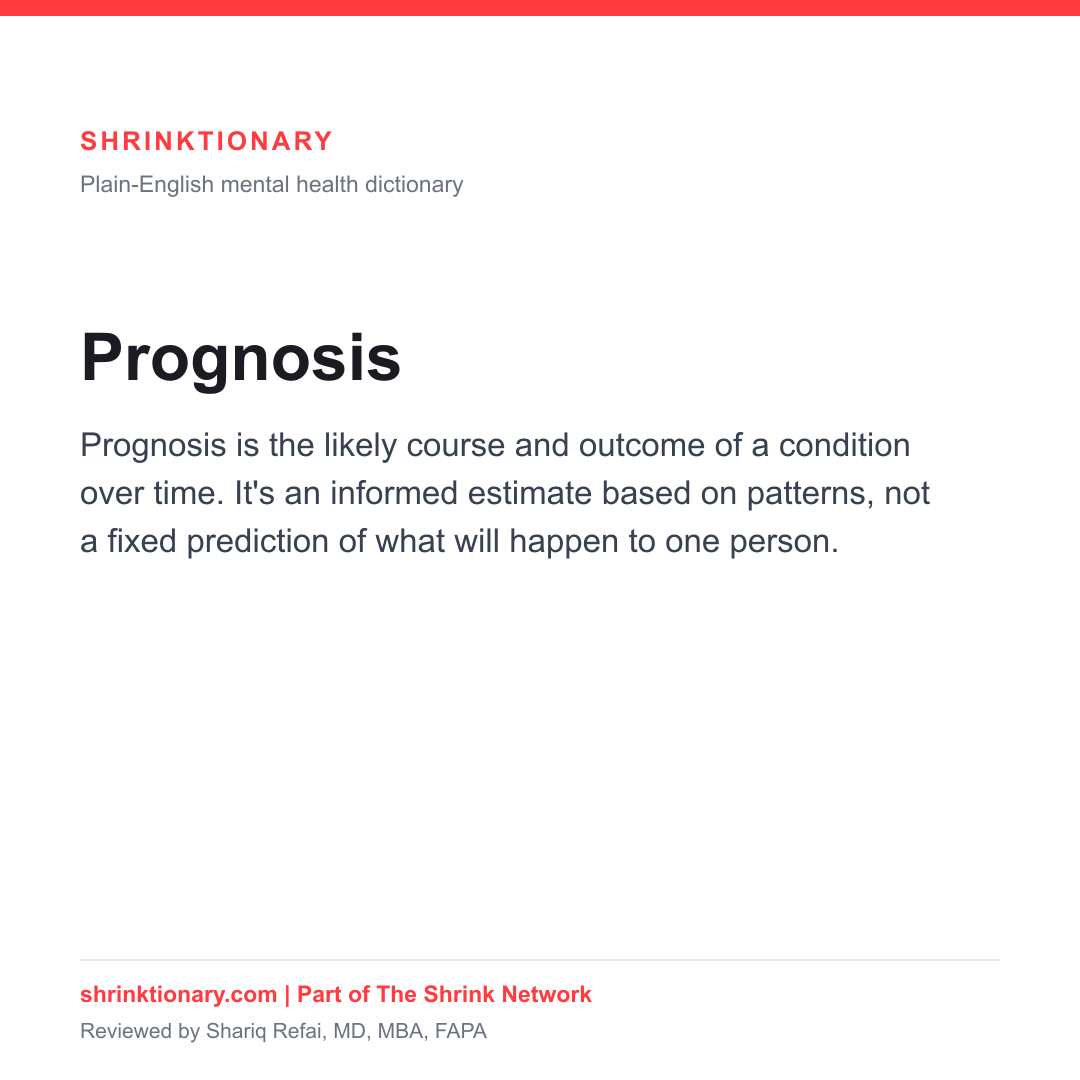
Prognosis is a clinician’s best estimate of how a condition is likely to unfold over time. It covers questions like how long symptoms might last, how fully a person is likely to recover, and how likely symptoms are to come back. For a mental health condition, prognosis might describe whether someone is expected to reach full recovery, manage ongoing symptoms, or have a course that comes and goes.
A prognosis is built from patterns seen across many people with the same condition. Clinicians draw on research, treatment response, and the specifics of one person’s situation to shape it. It’s an informed forecast, not a guarantee.
Why prognosis matters
Prognosis helps set realistic expectations and guide decisions. It can shape how aggressively a condition is treated, how closely someone is monitored, and how a person plans the months ahead. Knowing that many conditions improve a lot with treatment can also be a source of hope when symptoms feel overwhelming.
Prognosis varies for real reasons. How early a condition is caught, how well someone responds to treatment, whether other conditions are present, the level of support around a person, and individual biology all play a part. Two people with the same diagnosis can have very different paths. That’s why a prognosis is usually framed in ranges and probabilities rather than certainties, and why it can be revised as new information comes in.
What prognosis isn’t
Prognosis isn’t a fixed sentence. It describes what’s likely, not what’s guaranteed, and people often do better or worse than the average. A guarded prognosis doesn’t mean recovery is impossible, and a good prognosis doesn’t mean a person can stop care.
It also isn’t the same as a diagnosis. A diagnosis names what the condition is right now. A prognosis is about where things are likely headed. The two are related but answer different questions.
Related terms you’ll see next
Remission describes a point where symptoms have dropped below the level needed for a diagnosis. Relapse is the return of symptoms after improvement. Differential diagnosis is how a clinician decides which condition is present in the first place.
Where you’ll see it
You’ll most often hear about prognosis during an evaluation or while planning treatment, when a clinician explains what to expect from the road ahead. If a prognosis sounds discouraging, it can help to ask what would improve it, since factors like sticking with treatment and building support often shift the outlook. Treat it as a working estimate that can change, not a final verdict.
When this word matters
The distinction matters during evaluation and treatment planning, since a prognosis describes where things are likely headed, not what's guaranteed, and it can shift as new information comes in. It's easy to mistake it for a fixed sentence or to confuse it with the diagnosis, which names the condition right now.
Commonly confused with
Frequently asked questions
What does prognosis mean?
Prognosis is a clinician's best estimate of how a condition is likely to unfold over time, covering questions like how long symptoms might last and how fully a person is likely to recover. It's an informed forecast built from patterns seen across many people, not a guarantee.
What's the difference between a diagnosis and a prognosis?
A diagnosis names what the condition is right now, while a prognosis is about where things are likely headed. The two are related but answer different questions.
Can a prognosis change?
Yes. A prognosis is a working estimate that can be revised as new information comes in, and it isn't a fixed sentence. Factors like catching a condition early, sticking with treatment, and building support often shift the outlook.
Related terms
Sources
- Mental Health Topics , National Institute of Mental Health
- Understanding Medical Research , MedlinePlus (U.S. National Library of Medicine)
Use or cite this definition
Free to reuse with attribution. Paste the block into your own page, or grab a citation.
Embed on your site
<blockquote>
<p><strong>Prognosis:</strong> Prognosis is the likely course and outcome of a condition over time. It's an informed estimate based on patterns, not a fixed prediction of what will happen to one person.</p>
<p>— <a href="https://shrinktionary.com/terms/prognosis/">Shrinktionary</a>, a plain-English mental health dictionary, medically reviewed by a board certified psychiatrist.</p>
</blockquote>Cite (APA)
Refai, S. (2026). Prognosis. Shrinktionary. https://shrinktionary.com/terms/prognosis/
Cite (MLA)
"Prognosis." Shrinktionary, https://shrinktionary.com/terms/prognosis/. Accessed September 29, 2026.
Your next step in The Shrink Network
You are here: Shrinktionary, the language layer of The Shrink Network.
Each site in the network has one job. No matter where you enter, we help you find the next step that makes sense.
Want to understand more first?
See how this connects to everything else in the Term Web →
Take it with you
Free printable references you can save or share. For education, not medical advice.