What burnout actually is
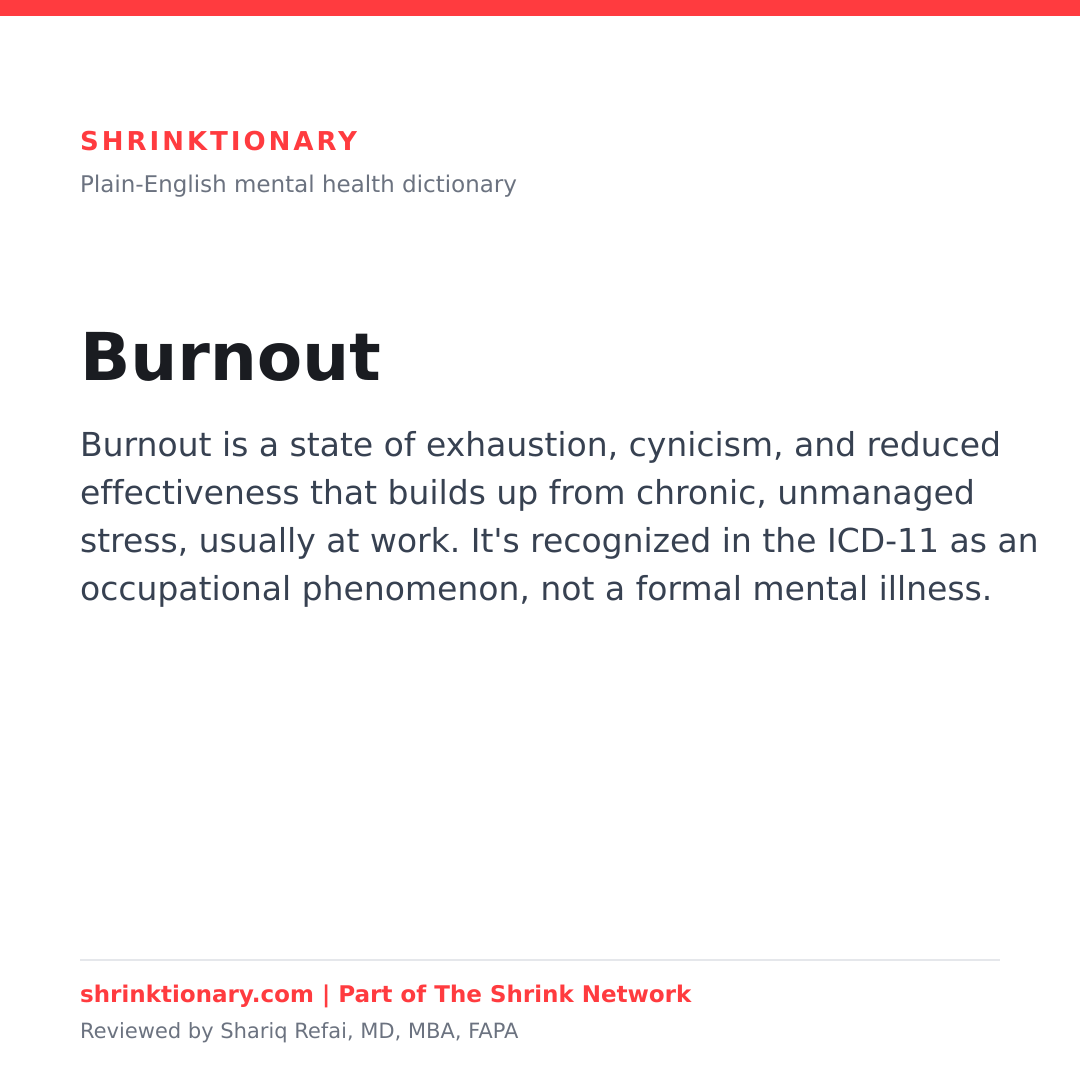
Burnout is what happens when chronic stress, usually tied to work or a demanding role, goes on without enough recovery. It builds up over time rather than appearing in a single moment. The World Health Organization describes it in the ICD-11 along three lines: deep exhaustion, growing mental distance or cynicism toward the job, and a sense that you’re getting less done than you used to.
The ICD-11 frames burnout as an occupational phenomenon, something that arises specifically from the workplace, rather than a standalone medical diagnosis. That distinction matters, because it points to the role and its demands, not just the person, as part of the problem.
What burnout can feel like in practice
Burnout often starts quietly. You feel drained even after a weekend off. Tasks that used to feel manageable now feel heavy. You become more irritable, more detached, or more numb toward work you once cared about. Concentration slips and small things take more effort than they should.
People experiencing burnout sometimes describe feeling like they’re running on empty, going through the motions without much left to give. Physical signs like headaches, sleep trouble, and frequent illness can come along with it. Left unaddressed, burnout can spill into the rest of life and raise the risk of depression and anxiety.
What burnout isn’t
Burnout isn’t a formal psychiatric diagnosis in the DSM, and it isn’t simply being tired after a hard week. Ordinary fatigue usually lifts with rest. Burnout is the kind of exhaustion that rest alone doesn’t fix, because the underlying stress keeps going.
It also isn’t the same as depression, though the two can overlap and look alike. Burnout is tied specifically to work and tends to ease when the work situation changes, while depression touches many areas of life regardless of the job. A clinician can help tell them apart.
Related terms you’ll see next
Anhedonia, the loss of pleasure or interest, can show up in both burnout and depression. Depression shares several features with burnout and sometimes develops from it. Executive function often suffers when you’re burned out.
When to seek professional care
If exhaustion, cynicism, or a sense of not coping have lasted for weeks and rest isn’t helping, it’s worth talking with a professional. This is especially true if you notice low mood, hopelessness, trouble sleeping, or loss of interest in things outside work, which can signal depression rather than burnout alone. A clinician can help sort out what’s happening and what kind of support would help.
When this word matters
It matters when chronic, unmanaged stress at work builds into exhaustion, cynicism, and a sense of getting less done, which the ICD-11 treats as an occupational phenomenon rather than a mental illness. Telling it apart from depression matters because depression spreads beyond work and may need different care.
Commonly confused with
Frequently asked questions
Is burnout a mental illness?
No. The World Health Organization recognizes burnout in the ICD-11 as an occupational phenomenon, not a formal psychiatric diagnosis in the DSM. That framing points to the role and its demands, not just the person, as part of the problem.
What's the difference between burnout and depression?
Burnout is tied specifically to work and tends to ease when the work situation changes, while depression touches many areas of life regardless of the job. The two can overlap and look alike, so a clinician can help tell them apart.
Why doesn't rest fix burnout?
Ordinary fatigue usually lifts with rest, but burnout is the kind of exhaustion that rest alone doesn't fix, because the underlying chronic stress keeps going.
Related terms
Compare
Sources
- Caring for Your Mental Health , National Institute of Mental Health
- Burn-out an occupational phenomenon: International Classification of Diseases , World Health Organization
Use or cite this definition
Free to reuse with attribution. Paste the block into your own page, or grab a citation.
Embed on your site
<blockquote>
<p><strong>Burnout:</strong> Burnout is a state of exhaustion, cynicism, and reduced effectiveness that builds up from chronic, unmanaged stress, usually at work. It's recognized in the ICD-11 as an occupational phenomenon, not a formal mental illness.</p>
<p>— <a href="https://shrinktionary.com/terms/burnout/">Shrinktionary</a>, a plain-English mental health dictionary, medically reviewed by a board certified psychiatrist.</p>
</blockquote>Cite (APA)
Refai, S. (2026). Burnout. Shrinktionary. https://shrinktionary.com/terms/burnout/
Cite (MLA)
"Burnout." Shrinktionary, https://shrinktionary.com/terms/burnout/. Accessed September 29, 2026.
See also on ShrinkDaily
For a three-minute daily lesson on this idea, read the daily concept on burnout.
Your next step in The Shrink Network
You are here: Shrinktionary, the language layer of The Shrink Network.
Each site in the network has one job. No matter where you enter, we help you find the next step that makes sense.
Want to understand more first?
See how this connects to everything else in the Term Web →
Take it with you
Free printable references you can save or share. For education, not medical advice.