What depression actually is
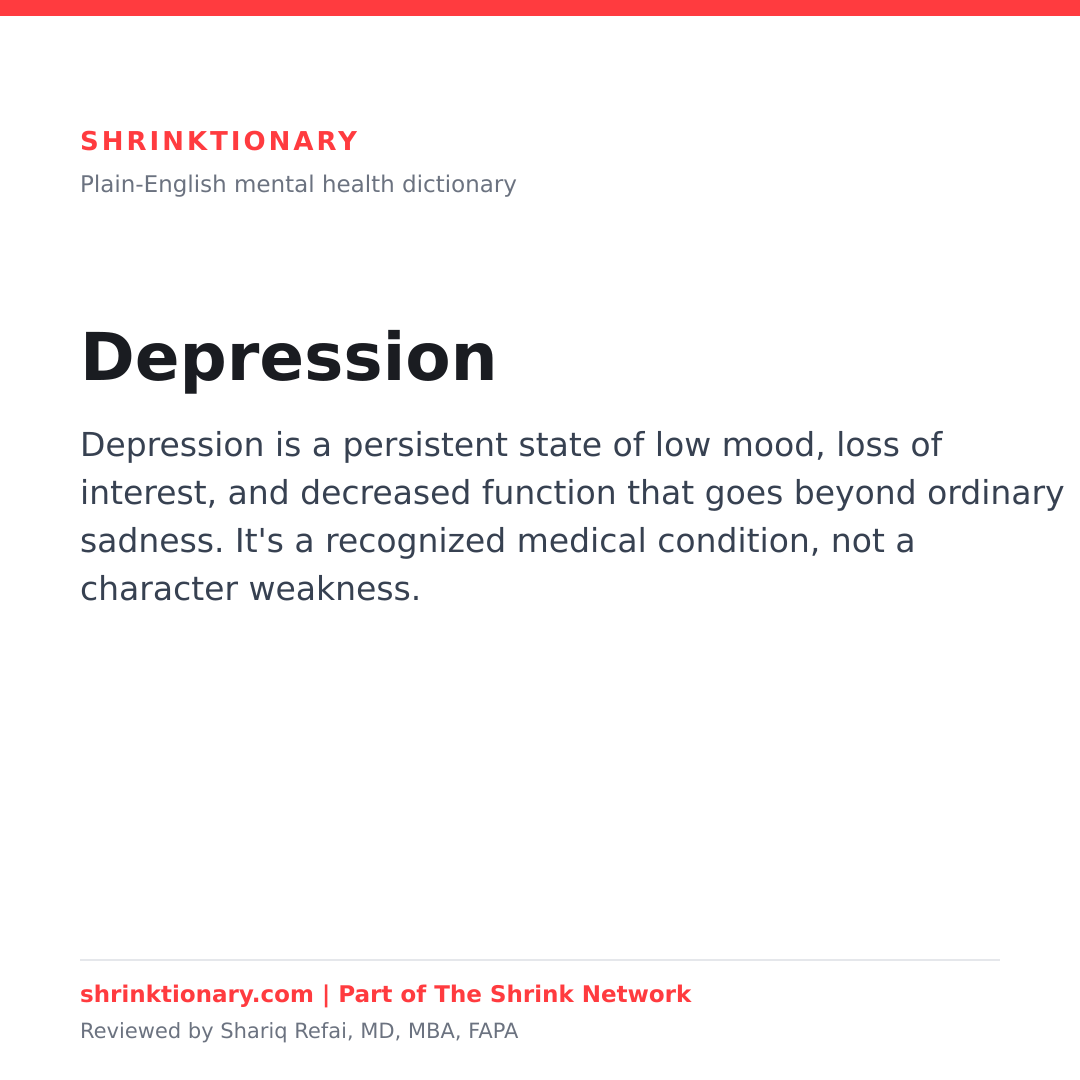
Depression is more than feeling sad. It’s a persistent state in which mood is low, interest in things you used to enjoy fades, energy drops, sleep and appetite shift, and ordinary tasks feel heavy. To meet criteria for major depressive disorder, these symptoms have to be present most of the day, nearly every day, for at least two weeks, and they have to interfere with function.
It’s a recognized medical condition. The brain’s mood-regulating circuits, the body’s stress response, sleep, hormones, and life circumstances all play a role. Depression isn’t a sign that something is wrong with your character. It’s a sign that something specific is happening in a system that can be treated.
What depression can feel like
People describe it as flat, gray, heavy, or empty more often than they describe it as sad. Things that used to be enjoyable feel like nothing. Decisions get harder. Concentration drops. Sleep changes, often more than expected, or much less. Appetite changes. The body feels tired even after rest. Many people describe thinking that runs in negative loops.
In severe depression, thoughts about death, dying, or not wanting to be alive can show up. Those thoughts deserve immediate attention and a conversation with a professional.
What depression isn’t
Depression isn’t laziness, isn’t weakness, and isn’t a “phase you should snap out of.” It also isn’t always triggered by an event. Some depressions follow a clear loss or stressor. Others arrive without one.
Related terms you’ll see next
Anhedonia is the loss-of-pleasure piece of depression. Rumination is the thinking-in-circles piece. SSRIs are the most commonly prescribed first-line medications. Behavioral activation is one of the most evidence-based behavioral treatments.
When to seek professional care
If low mood, low interest, or low function have lasted more than two weeks, talk to a clinician. If thoughts about death or self-harm are present, talk to someone today. Effective treatments exist, and most people who get evaluated and treated do get better.
For a longer look at the different kinds of depression and how each one is treated, see depression types, symptoms, and treatment on shrinkMD. shrinkMD is part of The Shrink Network, founded by Shariq Refai, MD.
If you’re in crisis, call or text 988 in the United States.
When evaluation may help
Not everyone reading about depression needs treatment. If it's getting in the way of your day, your sleep, your work, or your relationships, or if it isn't easing on its own, a professional evaluation is a reasonable next step. Most people start with their primary care doctor or a therapist. A psychiatrist is the right call when medication may be involved or the picture is complicated, though waits can be long.
We keep an honest, no-commission rundown of the options, from primary care to telepsychiatry to crisis lines, on one page.
If you're in crisis or thinking about suicide, call or text 988 in the US, or go to the nearest emergency room.
When this word matters
Low mood crosses into clinically meaningful depression when it lasts most of the day nearly every day for at least two weeks and interferes with function, which is the threshold for major depressive disorder. The distinction matters because conditions like bipolar disorder and adjustment disorder can look similar but need different treatment.
Commonly confused with
Frequently asked questions
What is the difference between depression and sadness?
Depression is more than feeling sad. It's a persistent state where mood is low, interest fades, energy drops, and sleep and appetite shift for most of the day, nearly every day, for at least two weeks, in a way that interferes with function.
Can depression go away on its own?
Some episodes ease over time, but effective treatments exist, and most people who get evaluated and treated do get better. If low mood, low interest, or low function have lasted more than two weeks, it's worth talking to a clinician.
Is depression always caused by something?
No. Some depressions follow a clear loss or stressor, while others arrive without one. It's a recognized medical condition, not laziness, weakness, or a phase to snap out of.
Related terms
In these language clusters
Compare
Sources
- Depression , National Institute of Mental Health
- Major Depressive Disorder , MedlinePlus, U.S. National Library of Medicine
- Diagnostic and Statistical Manual of Mental Disorders, Fifth Edition, Text Revision (DSM-5-TR) , American Psychiatric Association
Use or cite this definition
Free to reuse with attribution. Paste the block into your own page, or grab a citation.
Embed on your site
<blockquote>
<p><strong>Depression:</strong> Depression is a persistent state of low mood, loss of interest, and decreased function that goes beyond ordinary sadness. It's a recognized medical condition, not a character weakness.</p>
<p>— <a href="https://shrinktionary.com/terms/depression/">Shrinktionary</a>, a plain-English mental health dictionary, medically reviewed by a board certified psychiatrist.</p>
</blockquote>Cite (APA)
Refai, S. (2026). Depression. Shrinktionary. https://shrinktionary.com/terms/depression/
Cite (MLA)
"Depression." Shrinktionary, https://shrinktionary.com/terms/depression/. Accessed September 29, 2026.
Your next step in The Shrink Network
You are here: Shrinktionary, the language layer of The Shrink Network.
Each site in the network has one job. No matter where you enter, we help you find the next step that makes sense.
Want to understand more first?
See how this connects to everything else in the Term Web →
Take it with you
Free printable references you can save or share. For education, not medical advice.