Overthinking pathway
Step 1 of 5 through The Shrink Network.
What rumination actually is
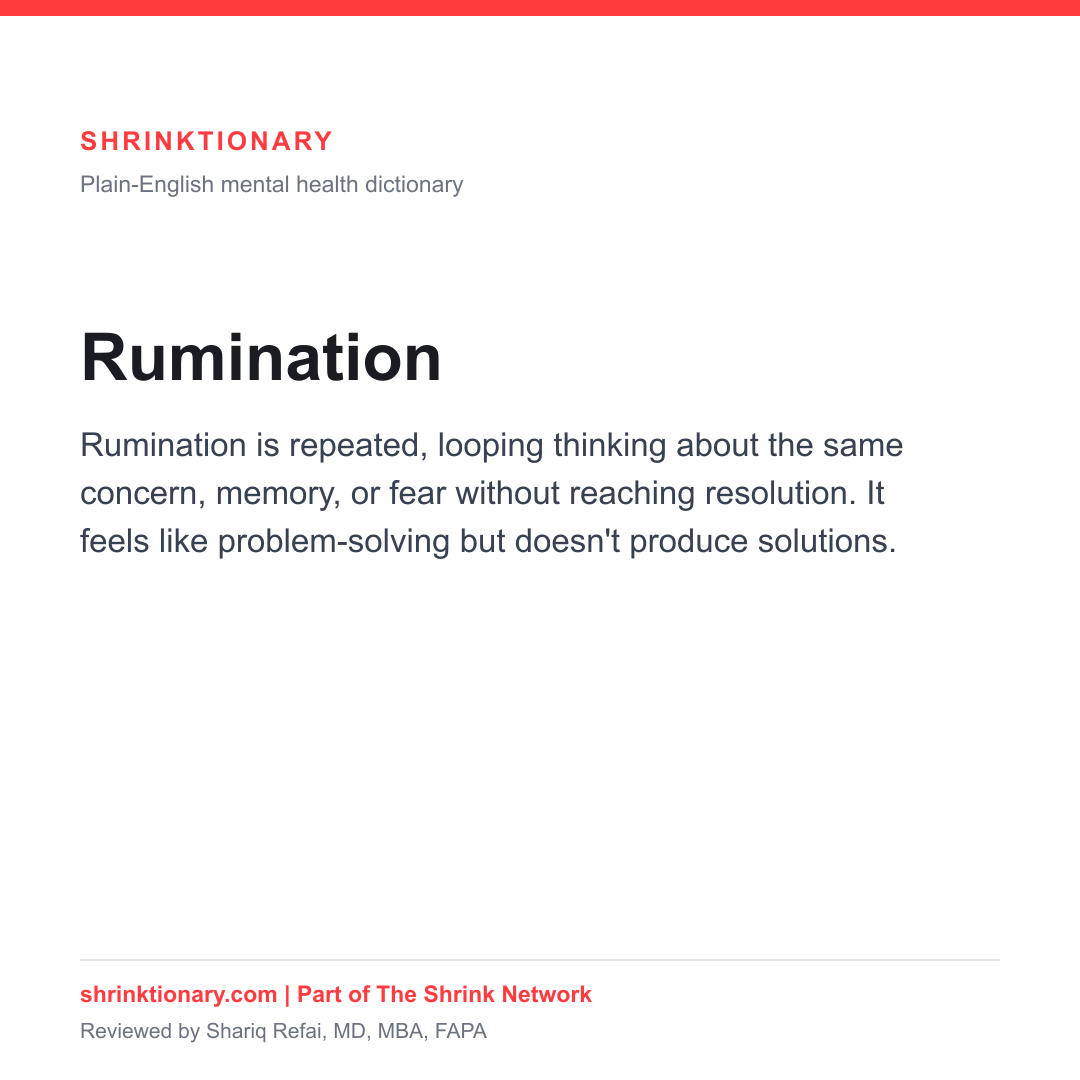
Rumination is the mind running the same loop again and again without getting anywhere. The thought comes back. You think it through. It comes back again. You think it through again. Nothing resolves. Nothing changes. The loop just runs.
Shrinkopedia has the fuller explainer on rumination if you want more on why the loop feels productive when it isn’t, and what actually breaks it.
Researchers describe it as a cognitive pattern of repetitive, passive focus on distress, its causes, and its consequences. It shows up in anxiety, in depression, in OCD, and in plain ordinary stress. It’s especially common at night, when there are no other inputs to crowd it out, which is part of why rumination and poor sleep so often feed each other. The pattern tends to strengthen the longer it runs, because each lap deepens the sense that the concern is unsolved and needs still more attention. It also narrows attention onto the negative, so a single setback can start to feel like proof of a much larger problem.
What rumination can feel like
It often disguises itself as problem-solving. “I just need to think this through one more time.” But problem-solving produces a next step. Rumination produces another lap of the same loop. The tell is that the conclusion is always uncertain, the worry stays, and the next session of thinking starts from the same place.
Rumination can be retrospective (replaying something that happened) or prospective (rehearsing something that might happen). Depression tends toward the first, chewing on regret, mistakes, and what went wrong. Anxiety tends toward the second, rehearsing what could go wrong next. Both feel necessary in the moment, and both tend to lower mood, drain focus, and pull attention away from the present the longer they run. People often ruminate in the shower, on a commute, or lying awake, the quiet stretches where nothing else is competing for attention.
What rumination isn’t
Rumination isn’t reflection, which has a clear endpoint and produces insight. It isn’t planning, which produces action. It’s also close to but distinct from worry, which leans toward future threats, where rumination often circles the past as well. And it isn’t unique to mental health conditions. Most people ruminate sometimes, especially after a loss or a stressful event. It becomes a clinical concern when it’s frequent, time-consuming, hard to stop, and tied to lasting low mood, anxiety, or impaired function. A rough gauge is whether the thinking is still going in circles well after any useful conclusion could have been reached.
Related terms you’ll see next
Overthinking is the everyday word people use for rumination. Intrusive thoughts are unwanted thoughts that rumination can latch onto and replay. Behavioral activation is one of the better-evidenced strategies for breaking the loop, since gentle action tends to interrupt the passive spin that rumination lives in.
When to seek professional care
If rumination is keeping you awake, interfering with focus, or feeding low mood, an evaluation can help. Targeted therapy approaches, including certain forms of CBT built specifically to address repetitive thinking, reduce rumination directly. These often teach people to notice the loop early, label it, and shift attention or take a small action instead of trying to think their way out. Many people see meaningful improvement once they learn to catch the pattern and step out of it rather than feed it.
When this word matters
Rumination becomes clinically meaningful when the looping is repetitive, hard to stop, and feeds low mood or worry instead of leading anywhere. It's common in depression, generalized anxiety, and OCD, and it's worth distinguishing from genuine problem-solving, which actually reaches a conclusion.
Commonly confused with
Frequently asked questions
What is the difference between rumination and problem-solving?
Problem-solving produces a next step, while rumination produces another lap of the same loop. The tell with rumination is that the worry stays, the conclusion is always uncertain, and the next round of thinking starts from the same place.
Is rumination a mental illness?
Rumination itself isn't a disorder, and most people ruminate sometimes. It becomes a clinical concern when it's frequent, time-consuming, and tied to lasting low mood, anxiety, or trouble functioning.
How can I stop ruminating?
Behavioral activation is one of the better-evidenced strategies for breaking the loop, and targeted therapy approaches can reduce rumination directly. If it's keeping you awake or feeding low mood, an evaluation can help and many people see meaningful improvement.
Related terms
In these language clusters
Compare
Sources
- Rumination: A Cycle of Negative Thinking , American Psychological Association
- Rethinking Rumination , Nolen-Hoeksema, Wisco, and Lyubomirsky, Perspectives on Psychological Science
Use or cite this definition
Free to reuse with attribution. Paste the block into your own page, or grab a citation.
Embed on your site
<blockquote>
<p><strong>Rumination:</strong> Rumination is repeated, looping thinking about the same concern, memory, or fear without reaching resolution. It feels like problem-solving but doesn't produce solutions.</p>
<p>— <a href="https://shrinktionary.com/terms/rumination/">Shrinktionary</a>, a plain-English mental health dictionary, medically reviewed by a board certified psychiatrist.</p>
</blockquote>Cite (APA)
Refai, S. (2026). Rumination. Shrinktionary. https://shrinktionary.com/terms/rumination/
Cite (MLA)
"Rumination." Shrinktionary, https://shrinktionary.com/terms/rumination/. Accessed September 29, 2026.
Your next step in The Shrink Network
You are here: Shrinktionary, the language layer of The Shrink Network.
Each site in the network has one job. No matter where you enter, we help you find the next step that makes sense.
Want to understand more first?
See how this connects to everything else in the Term Web →
Take it with you
Free printable references you can save or share. For education, not medical advice.