What overthinking actually is
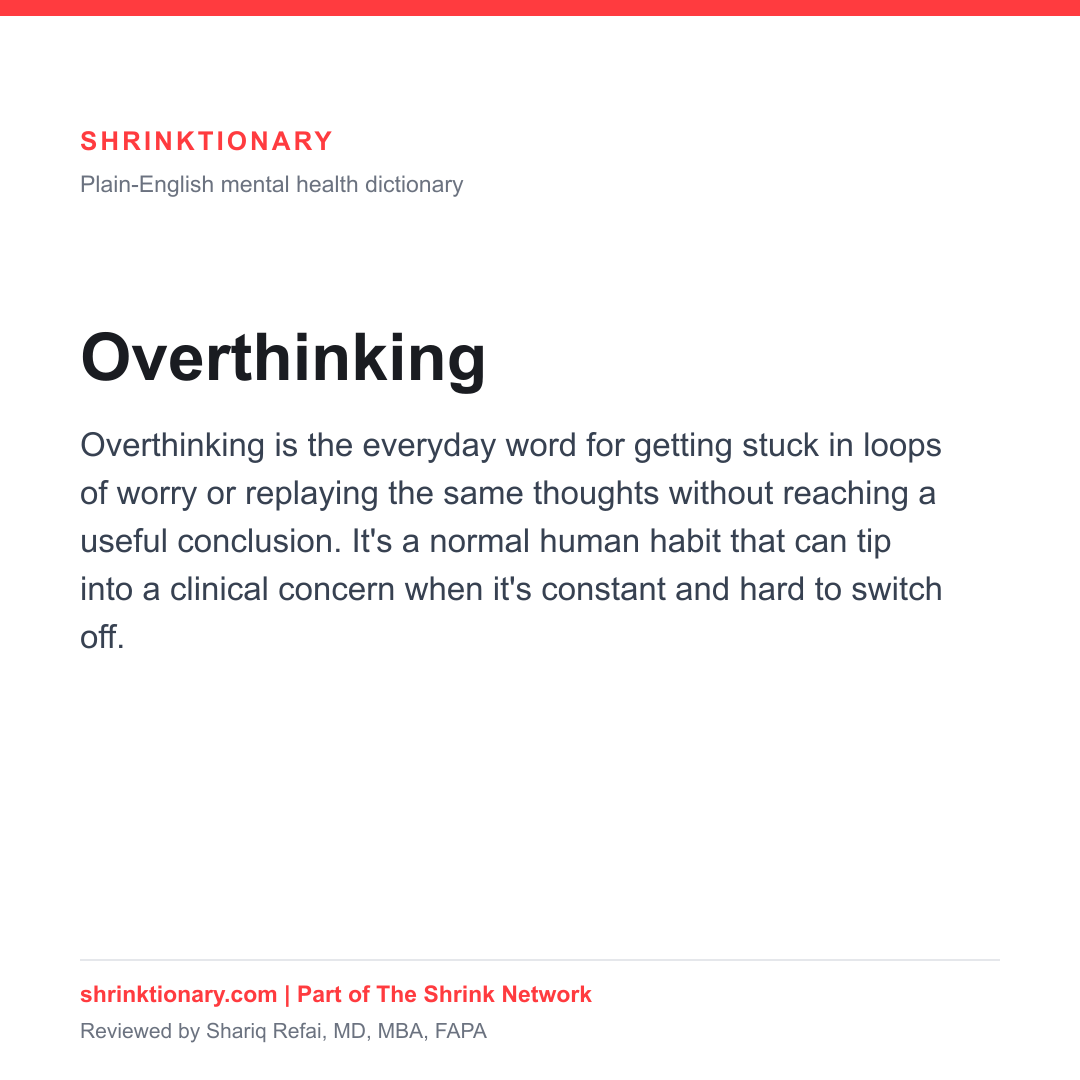
Overthinking is the plain-English name for getting stuck in your own head. It’s the experience of turning a situation over and over, replaying a conversation, or spinning through worst-case scenarios without landing anywhere useful. The thinking feels productive, but it usually just goes in circles.
In clinical language, overthinking maps onto two patterns. One is rumination, which tends to look backward, chewing on past events and what went wrong. The other is worry, which tends to look forward, anxiously rehearsing what might go wrong next. Both share the same trap: lots of mental effort, very little resolution.
A bit of overthinking is part of being human, especially before a big decision or a stressful event. It becomes worth paying attention to when it’s frequent, hard to stop, and starts to wear on mood, sleep, or daily life.
What overthinking can feel like
People describe overthinking as a mind that won’t switch off. The same thought returns no matter how many times it’s been examined. Small choices can feel paralyzing because every option gets analyzed to exhaustion, a pattern sometimes called analysis paralysis.
It often gets louder at night, when there are fewer distractions. Many people say they know the loop isn’t helping but can’t seem to step out of it. That stuck, churning quality is the hallmark of overthinking, and it can leave a person mentally tired without anything actually being solved.
What overthinking isn’t
Overthinking isn’t the same as careful thinking or healthy reflection. Useful thinking moves toward a decision or an insight and then stops. Overthinking keeps circling long after it has stopped being helpful.
It also isn’t a personal failing or a sign that someone is weak-willed. And on its own, it isn’t a diagnosis. Overthinking is an everyday word, not a clinical label. It points toward conditions like anxiety or depression when it becomes constant, distressing, and tough to control, but the habit by itself is something nearly everyone does.
Related terms you’ll see next
When to seek professional care
Overthinking is worth professional attention when it’s persistent and hard to switch off, when it disrupts your sleep, focus, or mood, or when it comes wrapped in constant worry or a steady low mood. Those are signs it may be connected to anxiety or depression rather than just a busy mind.
If you’re trying to work out which one you’re dealing with, see overthinking vs anxiety and how to stop the cycle on shrinkMD. shrinkMD is part of The Shrink Network, founded by Shariq Refai, MD.
The good news is that the loops respond well to treatment. Cognitive behavioral therapy, in particular, gives people practical tools to interrupt the cycle and relate to their thoughts differently. If overthinking ever spirals into thoughts of self-harm, reach out for support right away. If you’re in crisis, call or text 988 in the United States.
When this word matters
Overthinking tips into a clinical concern when it becomes constant, hard to switch off, and starts disrupting sleep or daily life, which is when it may reflect anxiety or depression rather than an ordinary habit.
Commonly confused with
Frequently asked questions
What's the difference between overthinking and rumination?
Overthinking is the plain-English term for getting stuck in mental loops, and it maps onto two clinical patterns. Rumination tends to look backward at past events and what went wrong, while worry tends to look forward at what might go wrong next.
Is overthinking a mental illness?
On its own, no. Overthinking is an everyday word, not a diagnosis. It points toward conditions like anxiety or depression when it becomes constant, distressing, and tough to control.
How do you stop overthinking?
The loops respond well to treatment, and cognitive behavioral therapy in particular gives people practical tools to interrupt the cycle and relate to their thoughts differently. It's worth professional attention when it's persistent and disrupts sleep, focus, or mood.
Related terms
In these language clusters
Compare
Sources
- Anxiety Disorders , National Institute of Mental Health
- Anxiety Disorders , American Psychiatric Association
Use or cite this definition
Free to reuse with attribution. Paste the block into your own page, or grab a citation.
Embed on your site
<blockquote>
<p><strong>Overthinking:</strong> Overthinking is the everyday word for getting stuck in loops of worry or replaying the same thoughts without reaching a useful conclusion. It's a normal human habit that can tip into a clinical concern when it's constant and hard to switch off.</p>
<p>— <a href="https://shrinktionary.com/terms/overthinking/">Shrinktionary</a>, a plain-English mental health dictionary, medically reviewed by a board certified psychiatrist.</p>
</blockquote>Cite (APA)
Refai, S. (2026). Overthinking. Shrinktionary. https://shrinktionary.com/terms/overthinking/
Cite (MLA)
"Overthinking." Shrinktionary, https://shrinktionary.com/terms/overthinking/. Accessed September 29, 2026.
Your next step in The Shrink Network
You are here: Shrinktionary, the language layer of The Shrink Network.
Each site in the network has one job. No matter where you enter, we help you find the next step that makes sense.
Want to understand more first?
See how this connects to everything else in the Term Web →
Take it with you
Free printable references you can save or share. For education, not medical advice.