What catastrophizing actually is
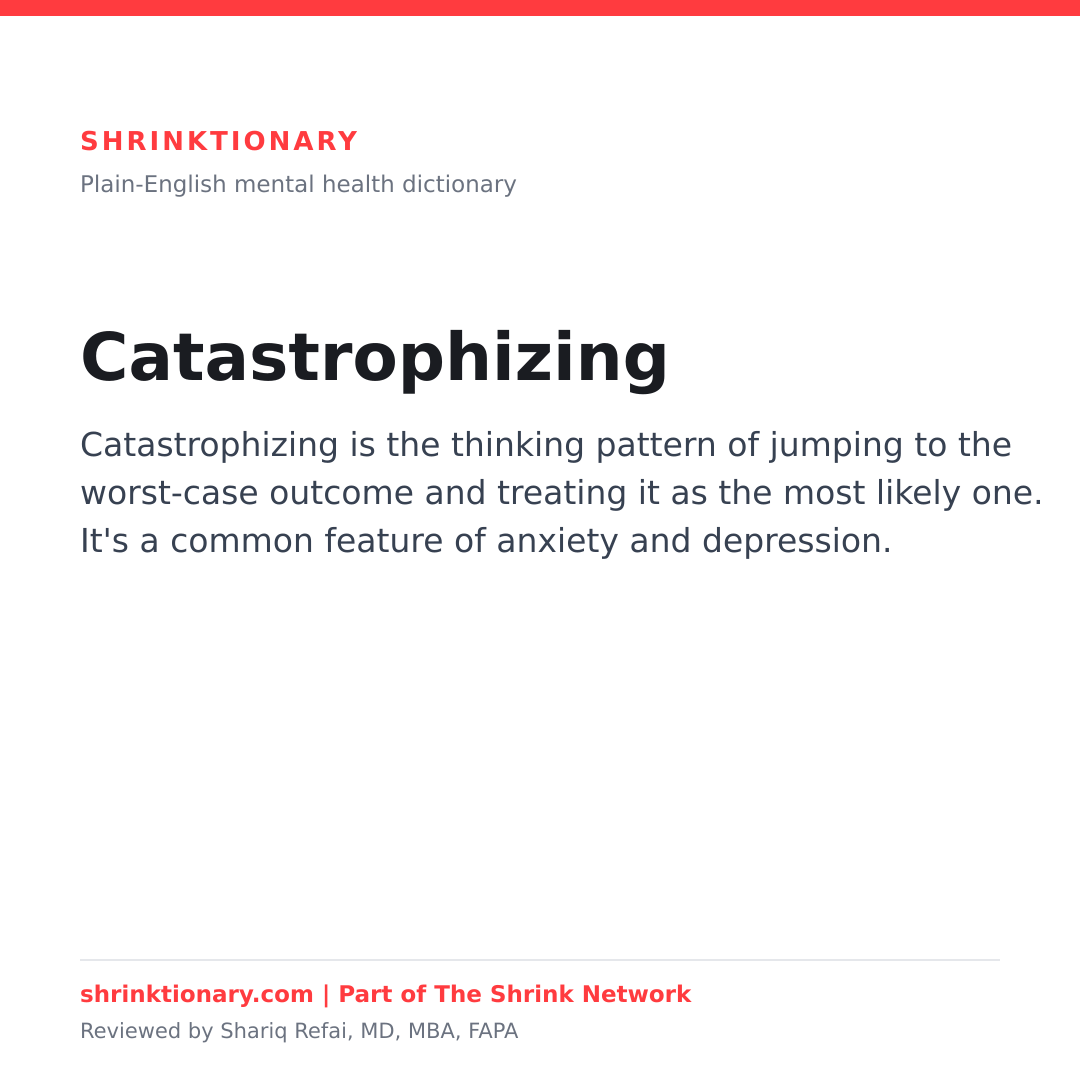
Catastrophizing is a specific thinking pattern. The mind takes a possibility, runs it to the worst-case outcome, and then treats that outcome as if it’s the most likely one. “My boss didn’t reply to my email” becomes “I’m getting fired.” “My chest feels tight” becomes “I’m having a heart attack.” “I made a mistake at work” becomes “I’m going to lose everything.” The leap skips over the far more likely ordinary explanations and lands on the worst one available.
It’s one of the cognitive patterns CBT calls a cognitive distortion. It tends to show up under anxiety, under depression, under sleep loss, and under physical pain. It’s not unique to mental illness, but it’s more common and more intense when one of those conditions is present. It’s also a common driver of panic, because a small bodily sensation gets read as a sign of disaster, which raises the alarm, which produces more sensations to misread.
What catastrophizing can feel like
In the moment, the worst-case feels obvious, almost certain. The brain has already done the math and the answer is bad. Other possibilities don’t get airtime. The body responds to the worst-case story as if it were happening, which is why catastrophizing so often fuels physical anxiety symptoms like a racing heart, tight chest, and a flood of dread. Because the body reacts as though the disaster is real, the fear can feel like evidence that the worst case is genuinely coming.
People often only recognize the pattern after the fact, when the predicted catastrophe didn’t happen. Even then, the next round of catastrophizing about the next thing feels just as certain. That is part of why it’s sticky: the relief when the disaster fails to arrive rarely transfers to the next worry, and the mind quietly credits the vigilance rather than the odds. A useful signpost is the phrase “what if,” which so often opens the slide toward the worst version of events.
What catastrophizing isn’t
Catastrophizing isn’t being prepared, isn’t being realistic about risk, and isn’t a useful tool for safety planning. It’s the difference between considering bad outcomes accurately and treating the worst one as if it’s already true. Genuine planning ends with a step you can take, while catastrophizing usually ends with more fear and no clear action. It also isn’t a character flaw, since it’s a learned mental habit that most people fall into under enough stress.
Related terms you’ll see next
Anxiety is the condition catastrophizing most consistently shows up in. Rumination often follows catastrophizing, looping on the worst-case once it’s been generated. Worry is the everyday cousin, and cognitive distortion is the broader category catastrophizing belongs to, alongside patterns like all-or-nothing thinking and mind reading.
When to seek professional care
If catastrophizing is interfering with sleep, decisions, or relationships, an evaluation is worth it. CBT is the most-studied treatment, and it works by helping you catch the worst-case story, check it against the actual evidence, weigh how likely it really is, and build a more realistic read of what’s ahead. Most people see real change with it, and the skill tends to hold up once it’s practiced.
When this word matters
It matters when the jump to the worst case becomes a steady habit that fuels anxiety, panic, or low mood, since it's one of the cognitive distortions CBT works to reshape. It tends to get stronger under anxiety, depression, sleep loss, and pain.
Commonly confused with
Frequently asked questions
What is catastrophizing a symptom of?
Catastrophizing is a cognitive distortion that tends to show up under anxiety, depression, sleep loss, and physical pain. It isn't unique to mental illness, but it's more common and more intense when one of those conditions is present.
Is catastrophizing the same as being prepared?
No. It isn't being prepared or realistic about risk. It's the difference between considering bad outcomes accurately and treating the worst one as if it's already true.
How do you stop catastrophizing?
If catastrophizing is interfering with sleep, decisions, or relationships, CBT is the most-studied treatment, and most people see real change with it.
Related terms
In these language clusters
Compare
Sources
- What is Cognitive Behavioral Therapy? , American Psychological Association
- Investigation of Cognitive Distortions in Panic Disorder, Generalized Anxiety Disorder and Social Anxiety Disorder , Psychiatry Investigation (PubMed Central)
Use or cite this definition
Free to reuse with attribution. Paste the block into your own page, or grab a citation.
Embed on your site
<blockquote>
<p><strong>Catastrophizing:</strong> Catastrophizing is the thinking pattern of jumping to the worst-case outcome and treating it as the most likely one. It's a common feature of anxiety and depression.</p>
<p>— <a href="https://shrinktionary.com/terms/catastrophizing/">Shrinktionary</a>, a plain-English mental health dictionary, medically reviewed by a board certified psychiatrist.</p>
</blockquote>Cite (APA)
Refai, S. (2026). Catastrophizing. Shrinktionary. https://shrinktionary.com/terms/catastrophizing/
Cite (MLA)
"Catastrophizing." Shrinktionary, https://shrinktionary.com/terms/catastrophizing/. Accessed September 29, 2026.
See also on ShrinkDaily
For a three-minute daily lesson on this idea, read the daily concept on catastrophizing.
Your next step in The Shrink Network
You are here: Shrinktionary, the language layer of The Shrink Network.
Each site in the network has one job. No matter where you enter, we help you find the next step that makes sense.
Want to understand more first?
See how this connects to everything else in the Term Web →
Take it with you
Free printable references you can save or share. For education, not medical advice.