What anxiety actually is
Anxiety is the nervous system reacting to a threat that hasn’t happened yet. Heart rate climbs. Breathing shortens. Attention narrows. Thinking races. That’s the body doing exactly what it evolved to do when something might be dangerous.
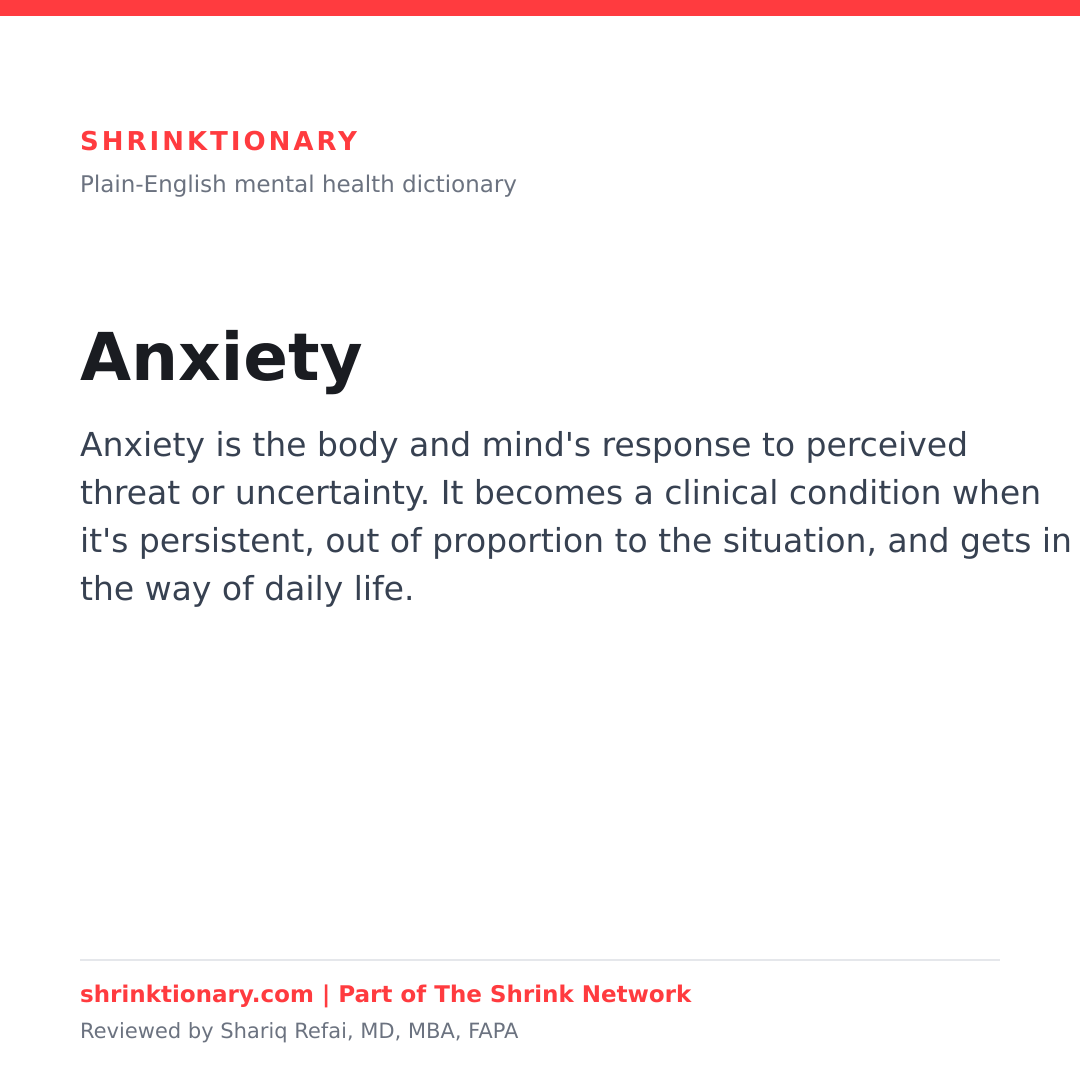
In ordinary doses, anxiety is useful. It pushes you to prepare for the meeting, check the locks, slow down at the intersection. It becomes a clinical concern when it’s persistent, when it’s bigger than the situation calls for, and when it gets in the way of work, relationships, sleep, or daily function.
What anxiety can feel like
People describe it differently. Some feel it mostly in the body: tight chest, churning stomach, restless legs, jaw tension, the sense that they can’t take a full breath. Some feel it mostly in the head: looping worries, can’t-shut-it-off thinking, the conviction that something bad is about to happen. Most people feel both.
It often shows up before there’s a clear reason. The body senses a threat before the mind names one. That’s why anxiety can feel mysterious or “out of nowhere,” even though the nervous system is doing exactly what it’s wired to do.
What anxiety isn’t
Anxiety isn’t a character flaw, isn’t a sign you’re broken, and isn’t something you should be able to talk yourself out of. It also isn’t the same thing as stress. Stress is the response to a real, current demand. Anxiety can show up without a current demand and stay after the demand is gone.
Related terms you’ll see next
A panic attack is a sudden surge of anxiety with strong physical symptoms. Rumination is the looping-thinking form of anxiety. Hypervigilance is the always-on scanning for danger. Intrusive thoughts are unwanted thoughts that anxiety amplifies.
When to seek professional care
If anxiety is interfering with sleep, work, relationships, or how you feel most days, an evaluation with a licensed clinician is the right next step. Many treatments work well. Most people improve. There’s no need to wait until things get worse.
When evaluation may help
Not everyone reading about anxiety needs treatment. If it's getting in the way of your day, your sleep, your work, or your relationships, or if it isn't easing on its own, a professional evaluation is a reasonable next step. Most people start with their primary care doctor or a therapist. A psychiatrist is the right call when medication may be involved or the picture is complicated, though waits can be long.
We keep an honest, no-commission rundown of the options, from primary care to telepsychiatry to crisis lines, on one page.
If you're in crisis or thinking about suicide, call or text 988 in the US, or go to the nearest emergency room.
When this word matters
Everyday anxiety is normal and even helpful, but it crosses into clinically meaningful when it's persistent, out of proportion to the situation, and gets in the way of daily life. It appears across many conditions, from generalized anxiety and panic disorder to social anxiety and phobias.
Commonly confused with
Frequently asked questions
When does anxiety become a disorder?
In ordinary doses, anxiety is useful and helps you prepare. It becomes a clinical concern when it's persistent, bigger than the situation calls for, and gets in the way of work, relationships, sleep, or daily function.
What's the difference between stress and anxiety?
Stress is the response to a real, current demand. Anxiety can show up without a current demand and stay after the demand is gone.
Can anxiety be treated?
Yes. If anxiety is interfering with sleep, work, relationships, or how you feel most days, an evaluation with a licensed clinician is the right next step. Many treatments work well, and most people improve.
Related terms
In these language clusters
Compare
Sources
- Anxiety Disorders , National Institute of Mental Health
- Anxiety Disorders , American Psychiatric Association
- Diagnostic and Statistical Manual of Mental Disorders, Fifth Edition, Text Revision (DSM-5-TR) , American Psychiatric Association
Use or cite this definition
Free to reuse with attribution. Paste the block into your own page, or grab a citation.
Embed on your site
<blockquote>
<p><strong>Anxiety:</strong> Anxiety is the body and mind's response to perceived threat or uncertainty. It becomes a clinical condition when it's persistent, out of proportion to the situation, and gets in the way of daily life.</p>
<p>— <a href="https://shrinktionary.com/terms/anxiety/">Shrinktionary</a>, a plain-English mental health dictionary, medically reviewed by a board certified psychiatrist.</p>
</blockquote>Cite (APA)
Refai, S. (2026). Anxiety. Shrinktionary. https://shrinktionary.com/terms/anxiety/
Cite (MLA)
"Anxiety." Shrinktionary, https://shrinktionary.com/terms/anxiety/. Accessed September 29, 2026.
Your next step in The Shrink Network
You are here: Shrinktionary, the language layer of The Shrink Network.
Each site in the network has one job. No matter where you enter, we help you find the next step that makes sense.
Want to understand more first?
See how this connects to everything else in the Term Web →
Take it with you
Free printable references you can save or share. For education, not medical advice.