What hypervigilance actually is
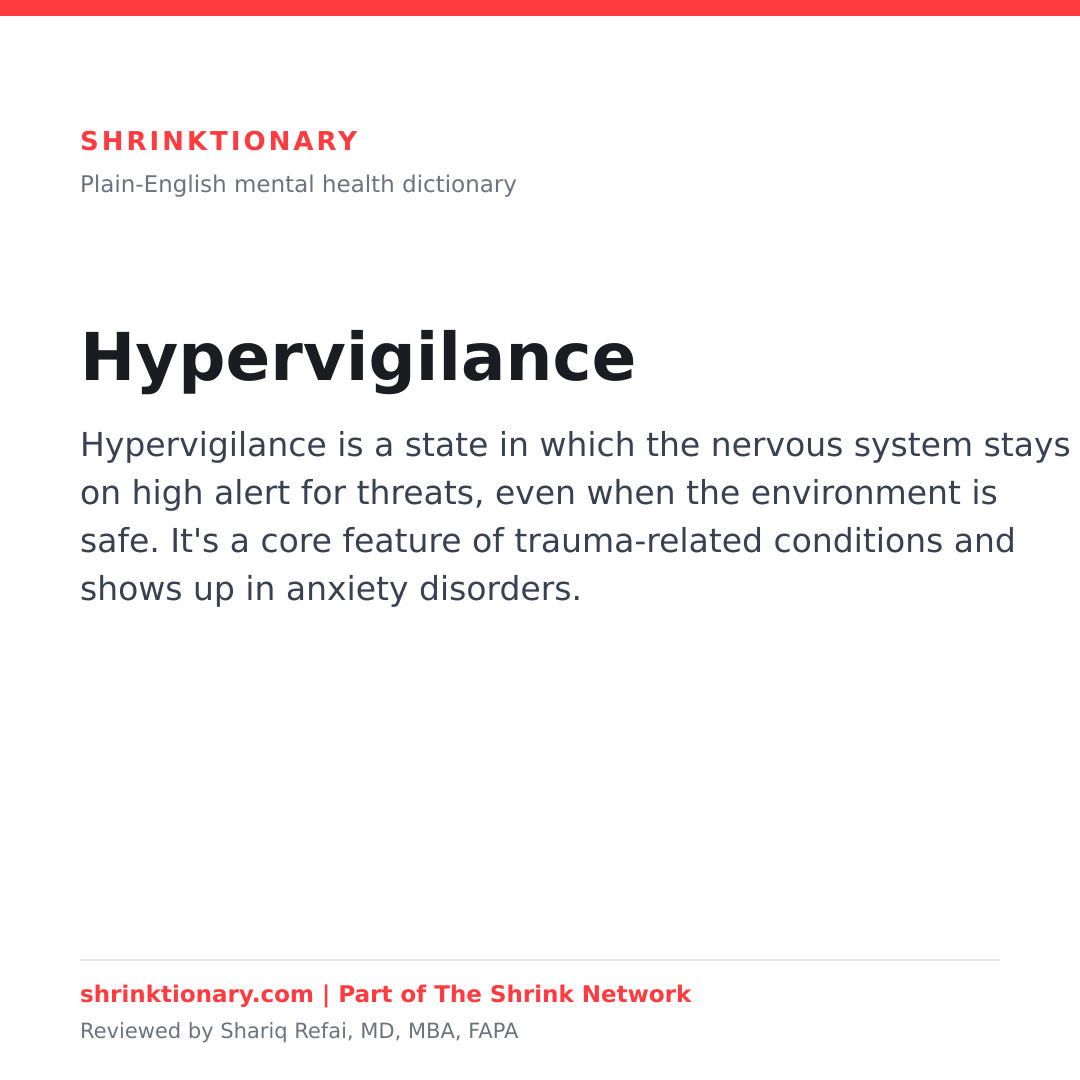
Hypervigilance is the nervous system stuck in scan mode. Attention is wide open. The body is primed. Small sounds, sudden movements, and ordinary changes in the environment register as potential threats. The system that’s supposed to detect danger and then stand down has stopped standing down.
For more depth, Shrinkopedia carries the full explainer on hypervigilance, including why the alarm stays on and what tends to bring it back down.
It’s a normal short-term response to a real threat. The fight-or-flight response floods the body with stress hormones, sharpens the senses, and readies the muscles to act. After the threat passes, the system is supposed to reset. In conditions like PTSD, generalized anxiety, and panic disorder, the reset doesn’t happen reliably. The body stays in alert even when nothing is wrong, and the threshold for what counts as a threat drops lower and lower. Over time the brain learns that safety can’t be trusted, so it keeps the alarm running just in case.
What hypervigilance can feel like
People describe it as never being able to fully relax. Eyes scanning the room. Choosing the seat that faces the door. Shoulders up. Sleep light. Startle response easy to trigger. Crowds feel exhausting. Quiet moments don’t feel safe. Even at home, even in bed, the nervous system isn’t all the way off.
It often comes with poor sleep, difficulty concentrating, anxiety, irritability, and the sense that something bad could happen at any time, even without a clear reason. Some people also feel physically wound up, with a fast heartbeat, tense muscles, and a stomach that won’t settle. Over months, staying braced like this is physically draining and can leave a person tired, quick to react, and worn down by a threat that never actually arrives. It can also shrink a person’s world, as places, situations, and people that feel too unpredictable get quietly avoided.
What hypervigilance isn’t
Hypervigilance isn’t a personality trait, isn’t paranoia in the clinical sense, and isn’t a sign that you’re “too sensitive.” Paranoia involves fixed false beliefs about being targeted, while hypervigilance is a broad, physical state of alertness that the person can often recognize as out of proportion to what’s actually happening. It’s also more than everyday carefulness, since it runs even in places and moments that are genuinely safe. It’s a measurable change in how the threat-detection system is operating, and it can change in the other direction with the right treatment.
Related terms you’ll see next
Fight-or-flight is the underlying physiology. PTSD is the condition hypervigilance is most strongly associated with. Dissociation is what the same nervous system sometimes does when alert gets too costly and the mind checks out instead. Anxiety is the broader family of experiences hypervigilance often travels with.
When to seek professional care
If you’re scanning for danger most of the time, sleeping poorly because the system won’t settle, or feeling unsafe in environments that should feel safe, an evaluation can help. It’s especially worth reaching out when the alertness is tied to a past trauma or is making it hard to work, sleep, or be around people. Several therapies effectively reduce hypervigilance, especially trauma-focused approaches like certain forms of CBT and exposure-based work that teach the nervous system, gradually and safely, that it can stand down again.
When this word matters
Hypervigilance matters when the nervous system stays on alert in safe settings, disrupting sleep and leaving you unable to relax. It's a core feature of PTSD and shows up in generalized anxiety and panic disorder.
Commonly confused with
Frequently asked questions
What does hypervigilance feel like?
People describe never being able to fully relax. Eyes scanning the room, shoulders up, light sleep, and an easily triggered startle response. It often comes with poor sleep, irritability, and a sense that something bad could happen at any time.
Is hypervigilance the same as paranoia?
No. It isn't paranoia in the clinical sense, a personality trait, or a sign you're too sensitive. It's a measurable change in how the threat-detection system is operating.
Can hypervigilance be treated?
Yes. It can change in the other direction with the right treatment. Several therapies effectively reduce it, especially trauma-focused approaches.
Related terms
In these language clusters
Compare
Sources
- Post-Traumatic Stress Disorder , National Institute of Mental Health
- Diagnostic and Statistical Manual of Mental Disorders, Fifth Edition, Text Revision (DSM-5-TR) , American Psychiatric Association
Use or cite this definition
Free to reuse with attribution. Paste the block into your own page, or grab a citation.
Embed on your site
<blockquote>
<p><strong>Hypervigilance:</strong> Hypervigilance is a state in which the nervous system stays on high alert for threats, even when the environment is safe. It's a core feature of trauma-related conditions and shows up in anxiety disorders.</p>
<p>— <a href="https://shrinktionary.com/terms/hypervigilance/">Shrinktionary</a>, a plain-English mental health dictionary, medically reviewed by a board certified psychiatrist.</p>
</blockquote>Cite (APA)
Refai, S. (2026). Hypervigilance. Shrinktionary. https://shrinktionary.com/terms/hypervigilance/
Cite (MLA)
"Hypervigilance." Shrinktionary, https://shrinktionary.com/terms/hypervigilance/. Accessed September 29, 2026.
Your next step in The Shrink Network
You are here: Shrinktionary, the language layer of The Shrink Network.
Each site in the network has one job. No matter where you enter, we help you find the next step that makes sense.
Want to understand more first?
See how this connects to everything else in the Term Web →
Take it with you
Free printable references you can save or share. For education, not medical advice.