What fight-or-flight actually is
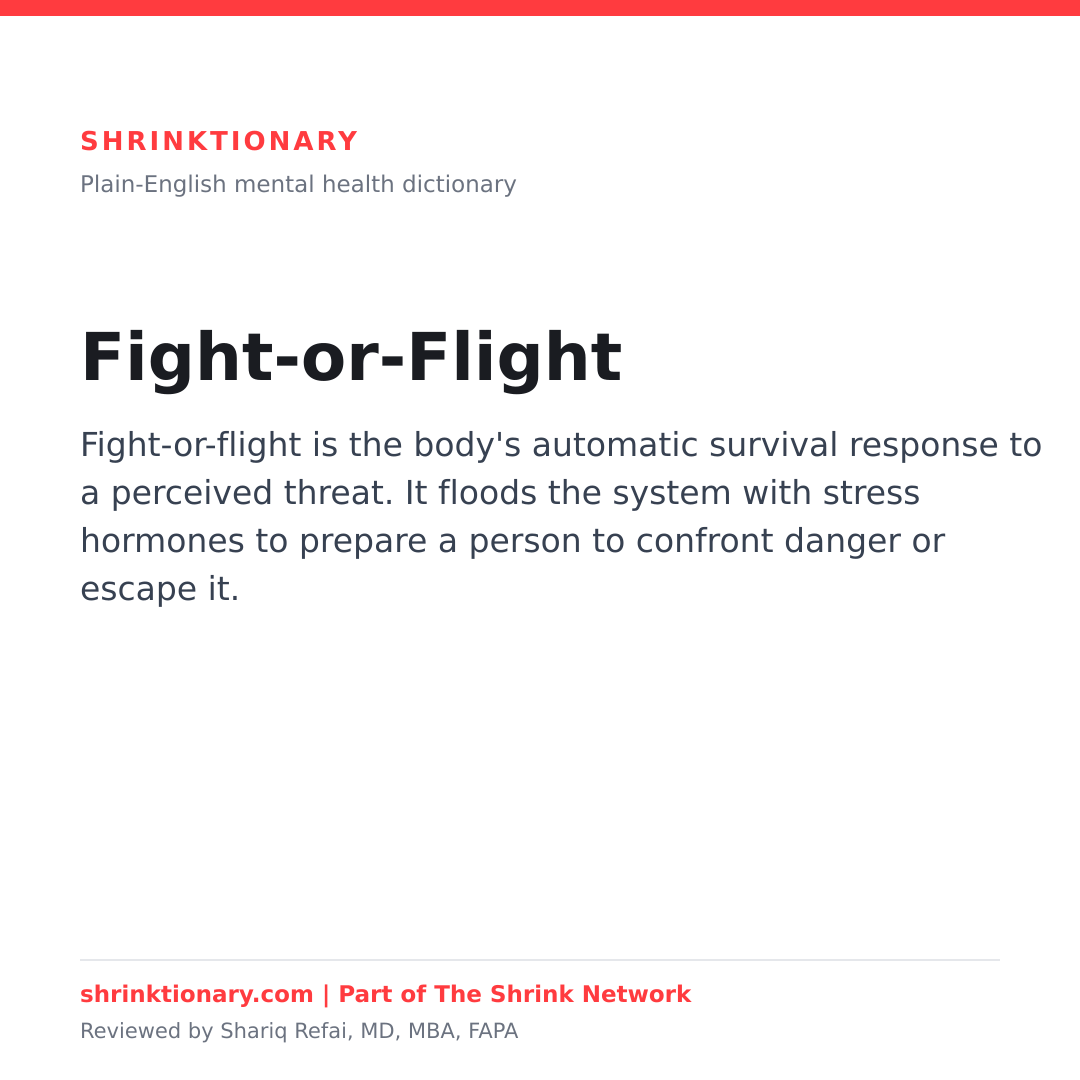
Fight-or-flight is the body’s built-in emergency response to danger. When the brain senses a threat, it triggers a rapid cascade of changes designed for one purpose, survival. This response is automatic and ancient, shared across many animals, and it can fire long before a person consciously decides anything.
The brain’s alarm center, the amygdala, signals the release of stress hormones like adrenaline and cortisol. These hormones speed up the heart, quicken breathing, tense the muscles, and sharpen the senses. Blood shifts toward the large muscles, getting the body ready to either confront the threat or run from it.
Many people add a third option to the name, the freeze response, where a person becomes momentarily still or unable to act. All of these are normal, hardwired reactions meant to protect us.
What fight-or-flight looks like in practice
In the moment, fight-or-flight can feel like a pounding heart, fast breathing, sweating, trembling, a dry mouth, or a jolt of energy. These are not signs that something is wrong with the body. They are the body working exactly as designed.
The problem is that this system cannot always tell the difference between a real physical danger and a stressful but safe situation, like a work presentation or a tense email. In anxiety and panic, the alarm fires when there is no actual threat, producing intense physical symptoms that can be frightening on their own.
In panic attacks, the response can come on suddenly and feel overwhelming. In conditions like PTSD, the system can become overly sensitive, triggering easily and staying switched on.
What fight-or-flight isn’t
Fight-or-flight is not a sign of weakness or a malfunction. It is a protective survival mechanism that everyone has. The discomfort it brings is the cost of a system built to keep us alive.
It is also not the same as anxiety itself. Fight-or-flight is the underlying physical response. Anxiety disorders involve this response firing too often, too strongly, or at the wrong times.
And the physical symptoms it produces, while intense, are not usually dangerous in themselves. Understanding that can make the sensations feel less alarming.
Related terms you’ll see next
Hypervigilance, Panic attack, Anxiety, and PTSD often come up alongside fight-or-flight.
When to seek professional care
The fight-or-flight response is normal, but when it fires often enough to disrupt daily life, that is worth attention. If panic, constant tension, or a sense of being always on alert is interfering with work, sleep, or relationships, a mental health professional can help. Effective treatments exist, including therapy and, in some cases, medication.
When this word matters
Fight-or-flight matters when the alarm fires without a real threat, producing intense physical symptoms in anxiety and panic, or staying overly sensitive in PTSD. The symptoms are the body working as designed, not a sign something is wrong with it.
Commonly confused with
Frequently asked questions
What happens in the body during fight-or-flight?
The amygdala signals the release of stress hormones like adrenaline and cortisol. These speed up the heart, quicken breathing, tense the muscles, and sharpen the senses to get the body ready to confront or escape a threat.
Is the fight-or-flight response dangerous?
The response itself isn't a sign of weakness or a malfunction, it's a protective survival mechanism. The physical symptoms it produces, while intense, aren't usually dangerous in themselves.
Is fight-or-flight the same as anxiety?
No. Fight-or-flight is the underlying physical response. Anxiety disorders involve this response firing too often, too strongly, or at the wrong times, such as during a safe but stressful situation.
Related terms
In these language clusters
Compare
Sources
- Anxiety Disorders , National Institute of Mental Health
- Anxiety , MedlinePlus
Use or cite this definition
Free to reuse with attribution. Paste the block into your own page, or grab a citation.
Embed on your site
<blockquote>
<p><strong>Fight-or-Flight:</strong> Fight-or-flight is the body's automatic survival response to a perceived threat. It floods the system with stress hormones to prepare a person to confront danger or escape it.</p>
<p>— <a href="https://shrinktionary.com/terms/fight-or-flight/">Shrinktionary</a>, a plain-English mental health dictionary, medically reviewed by a board certified psychiatrist.</p>
</blockquote>Cite (APA)
Refai, S. (2026). Fight-or-Flight. Shrinktionary. https://shrinktionary.com/terms/fight-or-flight/
Cite (MLA)
"Fight-or-Flight." Shrinktionary, https://shrinktionary.com/terms/fight-or-flight/. Accessed September 29, 2026.
Your next step in The Shrink Network
You are here: Shrinktionary, the language layer of The Shrink Network.
Each site in the network has one job. No matter where you enter, we help you find the next step that makes sense.
Want to understand more first?
See how this connects to everything else in the Term Web →
Take it with you
Free printable references you can save or share. For education, not medical advice.