What dopamine actually is
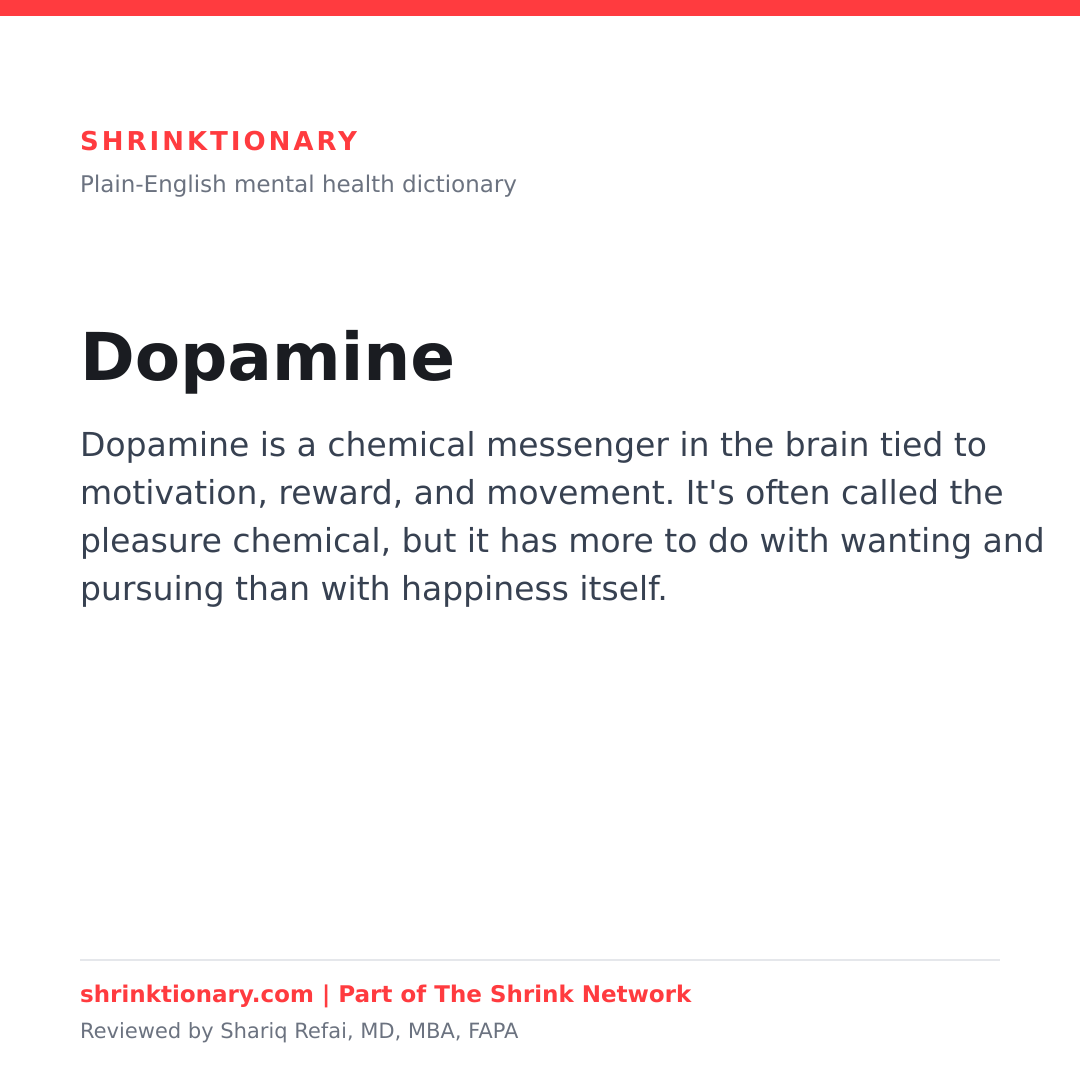
Dopamine is a neurotransmitter, a chemical that brain cells use to communicate. It plays a central role in motivation, reward, learning, and movement. When something turns out better than expected, dopamine signaling helps the brain take note and learn to seek that thing again.
Like serotonin, dopamine has a popular nickname, the pleasure chemical. Researchers tend to describe its role more precisely as being about wanting and pursuing, the drive to go after a reward, rather than the feeling of pleasure once the reward arrives. Those two experiences are related but not identical.
Dopamine is involved in many systems. It helps coordinate movement, which is why conditions affecting dopamine pathways can also affect physical motion. It is also tied to attention, focus, and the brain’s reward circuits.
See it in action: follow the dopamine story across four brain pathways.
What dopamine looks like in practice
Dopamine shows up across several mental health conditions. In ADHD, differences in dopamine signaling are part of the picture, and some treatments work by adjusting dopamine and related chemicals. In schizophrenia, overactivity in certain dopamine pathways is linked to some symptoms, and many antipsychotic medications act on dopamine.
Loss of motivation and reduced ability to feel pleasure, called anhedonia, can also involve dopamine systems, which is why it appears in conversations about depression.
In everyday life, dopamine is part of why people feel pulled toward rewarding activities, whether that is finishing a task, eating a favorite food, or checking a phone. It helps drive the pursuit, not just the enjoyment.
What dopamine isn’t
Dopamine is not simply the pleasure chemical. It is more closely tied to motivation and the drive to seek rewards than to the feeling of pleasure itself.
It is also not something that can be reliably hacked, detoxed, or reset through trends that promise a dopamine fast or quick fix. The popular idea that you can drain and refill your dopamine on demand does not match how the brain actually works.
And a single condition is rarely caused by dopamine alone being too high or too low. Mental health conditions involve many interacting systems, not one chemical out of balance.
Related terms you’ll see next
Serotonin, Anhedonia, Executive function, and ADHD often come up alongside dopamine.
When to seek professional care
Curiosity about dopamine often connects to real concerns about focus, motivation, or mood. If problems with attention, drive, or the ability to enjoy things are interfering with daily life, a mental health professional can help. Conditions linked to dopamine systems, such as ADHD, are diagnosed and treated by qualified clinicians, and any related medication decisions belong with a prescriber.
When this word matters
The wanting-versus-liking distinction matters when reading popular claims, since dopamine drives the pursuit of a reward more than the pleasure of getting it, and ideas like a dopamine detox don't match how the brain works. It's involved in ADHD, schizophrenia, and motivation, but no single condition comes from dopamine alone.
Commonly confused with
Frequently asked questions
Is dopamine the pleasure chemical?
Not exactly. Researchers describe its role as being more about wanting and pursuing, the drive to go after a reward, than about the feeling of pleasure once the reward arrives. Those experiences are related but not identical.
Does a dopamine detox or dopamine fast work?
Dopamine can't be reliably hacked, detoxed, or reset through trends that promise a quick fix. The popular idea that you can drain and refill your dopamine on demand doesn't match how the brain actually works.
What conditions are linked to dopamine?
Dopamine signaling is part of the picture in ADHD, some symptoms of schizophrenia, and the loss of motivation and pleasure seen in depression. A single condition is rarely caused by dopamine alone being too high or too low.
Related terms
In these language clusters
Sources
- Mental Health Topics , National Institute of Mental Health
- Attention Deficit Hyperactivity Disorder (ADHD) , National Institute of Mental Health
Use or cite this definition
Free to reuse with attribution. Paste the block into your own page, or grab a citation.
Embed on your site
<blockquote>
<p><strong>Dopamine:</strong> Dopamine is a chemical messenger in the brain tied to motivation, reward, and movement. It's often called the pleasure chemical, but it has more to do with wanting and pursuing than with happiness itself.</p>
<p>— <a href="https://shrinktionary.com/terms/dopamine/">Shrinktionary</a>, a plain-English mental health dictionary, medically reviewed by a board certified psychiatrist.</p>
</blockquote>Cite (APA)
Refai, S. (2026). Dopamine. Shrinktionary. https://shrinktionary.com/terms/dopamine/
Cite (MLA)
"Dopamine." Shrinktionary, https://shrinktionary.com/terms/dopamine/. Accessed September 29, 2026.
Your next step in The Shrink Network
You are here: Shrinktionary, the language layer of The Shrink Network.
Each site in the network has one job. No matter where you enter, we help you find the next step that makes sense.
Want to understand more first?
See how this connects to everything else in the Term Web →
Take it with you
Free printable references you can save or share. For education, not medical advice.