What ADHD actually is
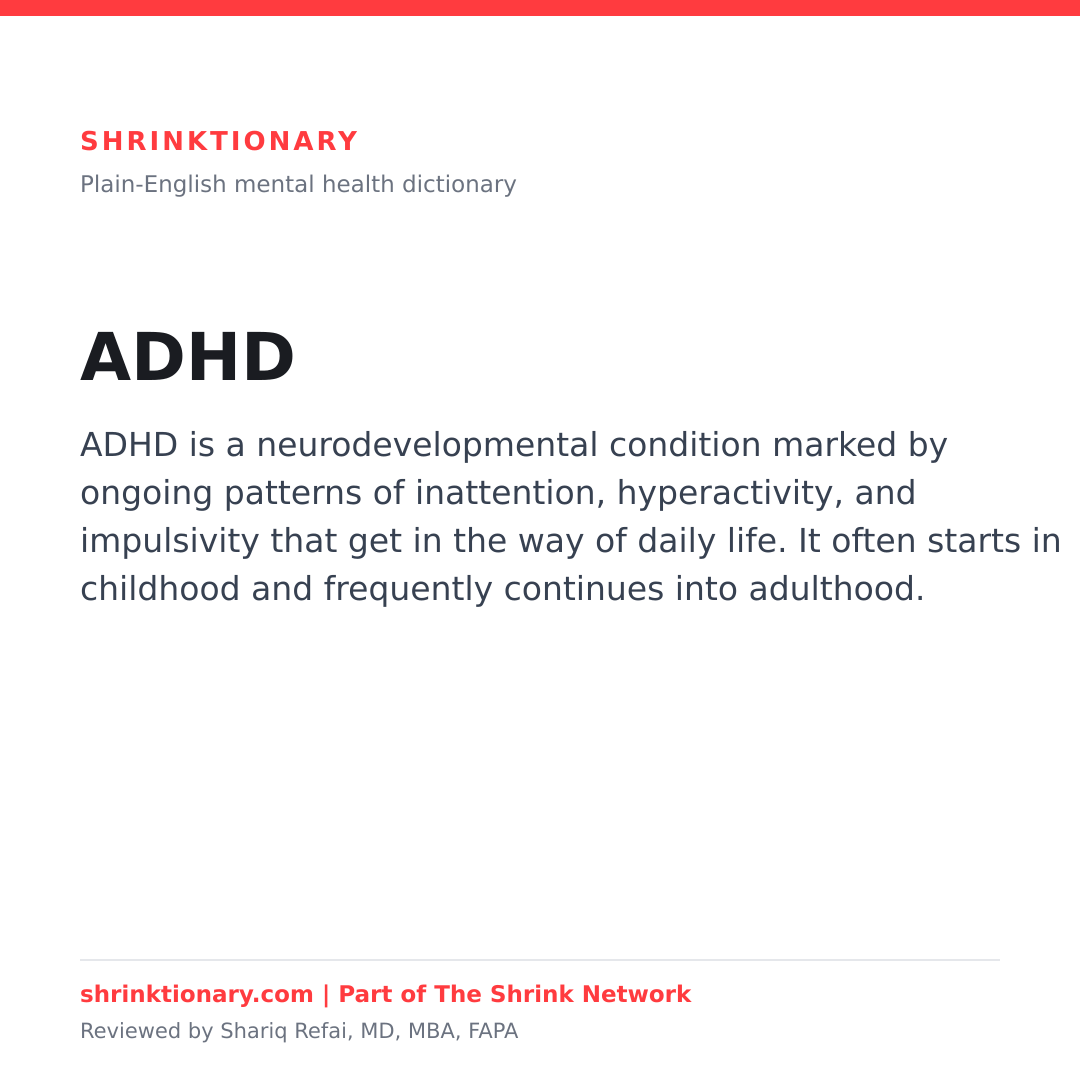
ADHD is a neurodevelopmental condition, which means it shapes how the brain develops and works from early on. It shows up as a steady pattern of inattention, hyperactivity, impulsivity, or some mix of these, strong enough to get in the way of school, work, relationships, or everyday tasks.
A lot of the difficulty traces back to executive function, the brain’s set of management skills for planning, starting tasks, holding information in mind, and resisting distraction. ADHD isn’t a problem with intelligence or effort. It’s a difference in how these regulation systems work.
ADHD doesn’t end at childhood. Symptoms often change shape over the years, with visible hyperactivity fading while inattention, restlessness, and trouble with organization continue into adulthood for many people.
What ADHD can feel like
From the inside, ADHD can feel like a brain with no good brakes and no good filter. Attention swings from scattered to locked-on, sometimes hyperfocusing on one thing while everything else falls away. Time slips. Tasks that seem simple feel strangely hard to begin.
Other people describe a constant hum of restlessness, blurting things out, jumping between ideas, or making fast decisions and regretting them later. Many adults with ADHD also carry years of frustration from being told they just need to try harder.
What ADHD isn’t
ADHD isn’t laziness, low intelligence, or a lack of discipline. People with ADHD often work harder than anyone to keep up, which is part of why it’s so exhausting.
It also isn’t just being energetic or occasionally distracted. Everyone loses focus sometimes. ADHD is a persistent pattern that’s present across different settings and causes real impairment, not an off day. And it isn’t caused by bad parenting or too much screen time, even though those myths are common.
Related terms you’ll see next
When to seek professional care
It’s worth talking to a professional when inattention, restlessness, or impulsivity have been present for a long time and are getting in the way of work, school, relationships, or self-esteem. A proper evaluation looks at history across the lifespan, not just a single moment.
ADHD is also commonly diagnosed alongside anxiety and depression, so a clinician can help sort out what’s driving what. Effective treatments exist, and getting an accurate picture is the first step toward the right support.
When evaluation may help
Not everyone reading about adhd needs treatment. If it's getting in the way of your day, your sleep, your work, or your relationships, or if it isn't easing on its own, a professional evaluation is a reasonable next step. Most people start with their primary care doctor or a therapist. A psychiatrist is the right call when medication may be involved or the picture is complicated, though waits can be long.
We keep an honest, no-commission rundown of the options, from primary care to telepsychiatry to crisis lines, on one page.
If you're in crisis or thinking about suicide, call or text 988 in the US, or go to the nearest emergency room.
When this word matters
The pattern crosses into clinically meaningful when inattention, hyperactivity, or impulsivity is persistent, started in childhood, and clearly disrupts school, work, or relationships across more than one setting. It often appears alongside anxiety, depression, and learning differences.
Commonly confused with
Frequently asked questions
Is ADHD a real mental health condition?
Yes. ADHD is a neurodevelopmental condition that shapes how the brain develops and works from early on, marked by ongoing inattention, hyperactivity, or impulsivity that interferes with daily life. It isn't laziness or a lack of discipline.
Does ADHD go away in adulthood?
ADHD doesn't simply end at childhood. Symptoms often change shape over time, with visible hyperactivity fading while inattention, restlessness, and trouble with organization continue into adulthood for many people.
Is ADHD caused by too much screen time or bad parenting?
No. ADHD is a difference in how the brain's regulation systems work, not something caused by parenting or screens, even though those myths are common.
Related terms
Compare
Sources
- Attention-Deficit/Hyperactivity Disorder (ADHD) , National Institute of Mental Health
- Attention Deficit Hyperactivity Disorder , MedlinePlus
- Diagnostic and Statistical Manual of Mental Disorders, Fifth Edition, Text Revision (DSM-5-TR) , American Psychiatric Association
Use or cite this definition
Free to reuse with attribution. Paste the block into your own page, or grab a citation.
Embed on your site
<blockquote>
<p><strong>ADHD:</strong> ADHD is a neurodevelopmental condition marked by ongoing patterns of inattention, hyperactivity, and impulsivity that get in the way of daily life. It often starts in childhood and frequently continues into adulthood.</p>
<p>— <a href="https://shrinktionary.com/terms/adhd/">Shrinktionary</a>, a plain-English mental health dictionary, medically reviewed by a board certified psychiatrist.</p>
</blockquote>Cite (APA)
Refai, S. (2026). ADHD. Shrinktionary. https://shrinktionary.com/terms/adhd/
Cite (MLA)
"ADHD." Shrinktionary, https://shrinktionary.com/terms/adhd/. Accessed September 29, 2026.
Your next step in The Shrink Network
You are here: Shrinktionary, the language layer of The Shrink Network.
Each site in the network has one job. No matter where you enter, we help you find the next step that makes sense.
Want to understand more first?
See how this connects to everything else in the Term Web →
Take it with you
Free printable references you can save or share. For education, not medical advice.