What serotonin actually is
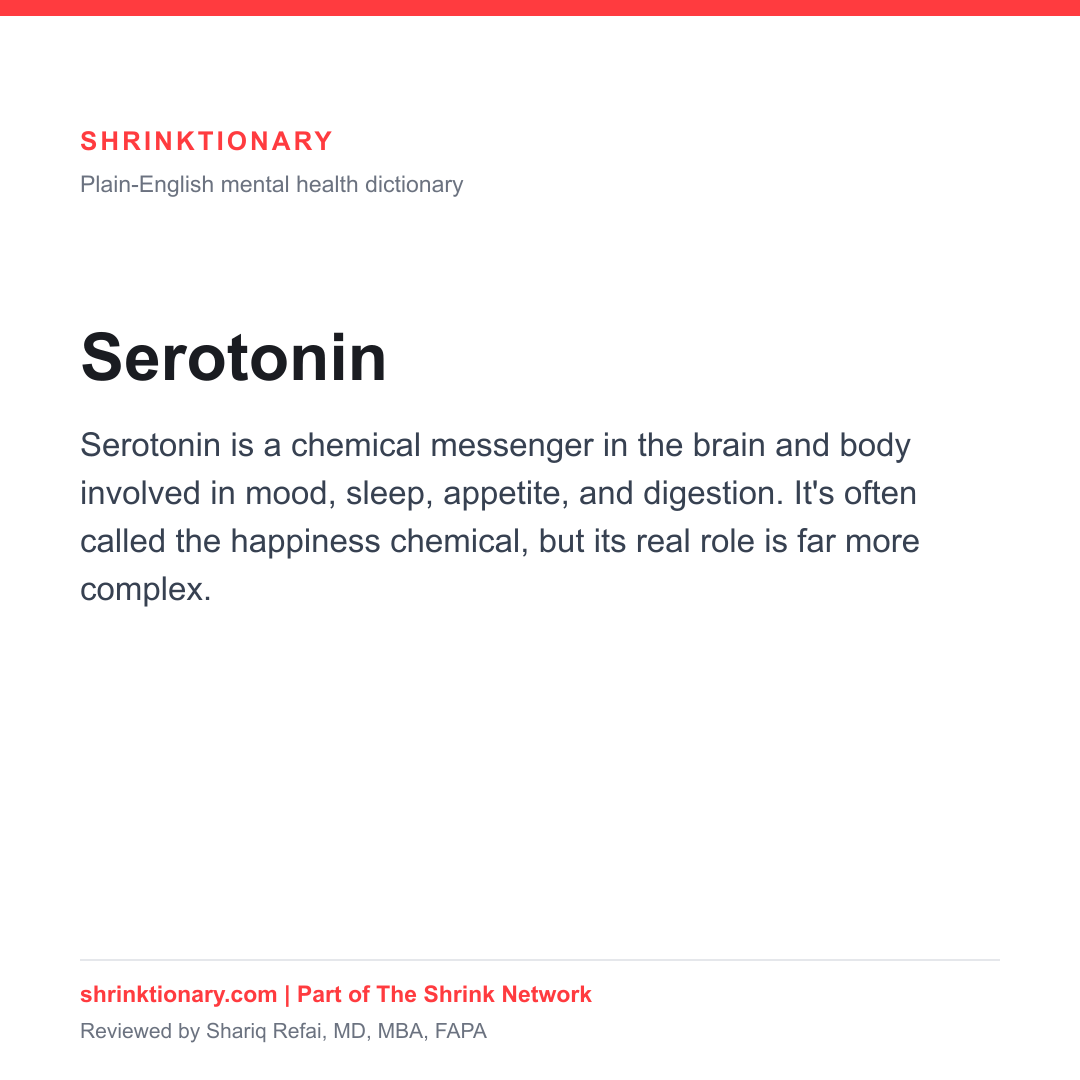
Serotonin is a neurotransmitter, a chemical that nerve cells use to send signals to one another. In the brain it plays a part in mood, sleep, appetite, and many other functions. Most of the body’s serotonin actually lives in the gut, where it helps regulate digestion, which is a clue to how broad its role really is.
Because some antidepressants act on serotonin, it has picked up the nickname the happiness chemical. That label is catchy but misleading. Serotonin does not simply equal happiness, and mood is shaped by many interacting systems, not one chemical.
Scientists still do not fully understand exactly how serotonin relates to conditions like depression and anxiety. What is clear is that the picture is far more complicated than a single chemical being too high or too low.
See it in action: watch serotonin at the synapse, with and without a medication.
What serotonin looks like in practice
Serotonin comes up most often in conversations about medication. SSRIs, or selective serotonin reuptake inhibitors, slow the reabsorption of serotonin between nerve cells, leaving more of it available. SNRIs act on serotonin along with another chemical, norepinephrine.
These medications can help many people with depression, anxiety, OCD, and other conditions, even though the exact reason they work is not fully mapped out. The effect usually builds over weeks, which suggests that simply raising serotonin levels is not the whole story.
In everyday terms, serotonin is one ingredient in a complex recipe that shapes how people feel and function, not a dial that can be turned up to produce happiness on demand.
What serotonin isn’t
Serotonin is not the chemical of happiness, despite the popular phrase. Mood depends on many neurotransmitters, brain circuits, life circumstances, and more, not on serotonin alone.
It is also not proven that depression is simply caused by a serotonin deficiency. That older idea, sometimes called the chemical imbalance theory, is now seen as an oversimplification. Antidepressants can help, but that does not confirm a single, simple cause.
And serotonin is not something a person can reliably control through any one food, supplement, or trick. Its biology is intertwined with the whole body.
Related terms you’ll see next
Dopamine, SSRI, SNRI, and Depression often come up alongside serotonin.
When to seek professional care
Questions about serotonin usually point to deeper questions about mood, anxiety, or medication, and those are best explored with a professional. If symptoms of depression or anxiety are affecting daily life, a doctor or mental health clinician can help sort out the options. Decisions about any medication that acts on serotonin belong with a prescriber.
When this word matters
The distinction matters because serotonin is a chemical messenger involved in mood, sleep, appetite, and digestion, not simply a happiness chemical, and mood depends on many interacting systems. The oversimplified low serotonin causes depression story is more catchy than accurate.
Commonly confused with
Frequently asked questions
Is serotonin really the happiness chemical?
No, that label is catchy but misleading. Mood depends on many neurotransmitters, brain circuits, and life circumstances, not on serotonin alone.
Does low serotonin cause depression?
It isn't proven that depression is simply caused by a serotonin deficiency. That older chemical imbalance idea is now seen as an oversimplification, and the picture is far more complicated than one chemical being too high or too low.
How do antidepressants affect serotonin?
SSRIs slow the reabsorption of serotonin between nerve cells, leaving more of it available, while SNRIs act on serotonin along with norepinephrine. These medications help many people, even though the exact reason they work isn't fully mapped out, and the effect usually builds over weeks.
Related terms
In these language clusters
Sources
- Mental Health Medications , National Institute of Mental Health
- Antidepressants , MedlinePlus
Use or cite this definition
Free to reuse with attribution. Paste the block into your own page, or grab a citation.
Embed on your site
<blockquote>
<p><strong>Serotonin:</strong> Serotonin is a chemical messenger in the brain and body involved in mood, sleep, appetite, and digestion. It's often called the happiness chemical, but its real role is far more complex.</p>
<p>— <a href="https://shrinktionary.com/terms/serotonin/">Shrinktionary</a>, a plain-English mental health dictionary, medically reviewed by a board certified psychiatrist.</p>
</blockquote>Cite (APA)
Refai, S. (2026). Serotonin. Shrinktionary. https://shrinktionary.com/terms/serotonin/
Cite (MLA)
"Serotonin." Shrinktionary, https://shrinktionary.com/terms/serotonin/. Accessed September 29, 2026.
Your next step in The Shrink Network
You are here: Shrinktionary, the language layer of The Shrink Network.
Each site in the network has one job. No matter where you enter, we help you find the next step that makes sense.
Want to understand more first?
See how this connects to everything else in the Term Web →
Take it with you
Free printable references you can save or share. For education, not medical advice.