What dissociation actually is
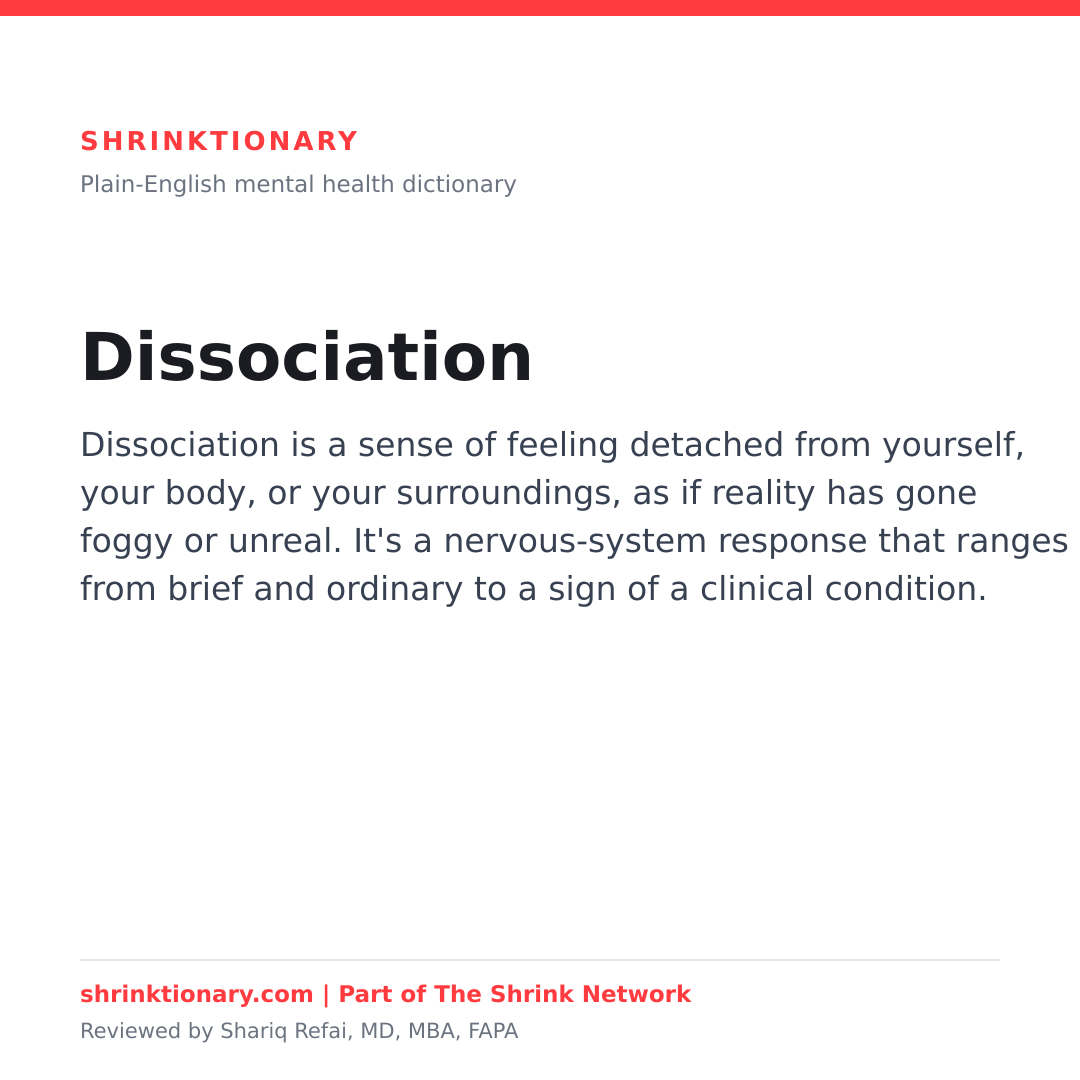
Dissociation is a sense of disconnection, from your own thoughts and feelings, from your body, or from the world around you. It’s the mind’s way of stepping back when things feel like too much, a bit like a circuit breaker that trips to protect the system from overload.
If you want the fuller clinical picture, Shrinkopedia has a longer explainer on dissociation that walks the whole spectrum, from everyday spacing out to the dissociative disorders.
It exists on a spectrum. At the mild, everyday end are things like zoning out on a long drive or losing yourself in a movie. Further along are stronger experiences, like feeling detached from your own body (depersonalization) or feeling that the world looks unreal or dreamlike (derealization). At the far end are dissociative disorders, where these experiences become persistent and disruptive.
Dissociation is closely tied to the nervous system’s threat response. It often shows up during or after overwhelming stress, fear, or trauma, when the brain shifts into a kind of protective autopilot.
What dissociation can feel like
People describe dissociation in different ways. Some say they feel foggy, far away, or like they’re watching themselves from outside their body. Some say the world looks flat, dull, or like a stage set. Others lose track of time or have gaps in their memory of an event.
It can be unsettling precisely because it’s hard to put into words. Many people worry they’re “going crazy” when really their nervous system is doing something protective. The feeling often eases as a person feels safe again.
What dissociation isn’t
Dissociation isn’t the same as psychosis. A person who is dissociating usually knows that the strange, unreal feeling is happening to them, even if they can’t shake it. That awareness is different from losing touch with reality.
It also isn’t a character flaw or a sign of weakness. It’s a common, often automatic response to stress and trauma. Brief dissociation is a normal human experience. It becomes a clinical concern when it’s frequent, intense, or gets in the way of memory, identity, or daily function.
Related terms you’ll see next
When to seek professional care
Occasional zoning out is part of normal life. It’s worth professional attention when dissociation happens often, lasts a long time, or interferes with your memory, your sense of identity, or your ability to function. It also deserves attention when it follows a traumatic experience, since dissociation and PTSD frequently travel together.
A clinician can help figure out what’s driving the experience and offer treatment, including therapy that helps the nervous system feel safe again. If dissociation comes with thoughts of self-harm, reach out for support right away. If you’re in crisis, call or text 988 in the United States.
When this word matters
Brief dissociation like zoning out is a normal human experience, but it becomes a clinical concern when it's frequent, intense, or disrupts memory, identity, or daily function, as in PTSD and dissociative disorders. Preserved awareness that the feeling comes from inside is what separates it from psychosis.
Commonly confused with
Frequently asked questions
What does dissociation feel like?
People describe feeling foggy, far away, or like they're watching themselves from outside their body. Some say the world looks flat or dull, and others lose track of time or have gaps in their memory of an event.
Is dissociation the same as psychosis?
No. A person who is dissociating usually knows the strange, unreal feeling is happening to them, even if they can't shake it. That awareness is different from losing touch with reality.
When does dissociation become a problem?
Brief dissociation, like zoning out on a long drive, is normal. It becomes a clinical concern when it's frequent, intense, or gets in the way of memory, identity, or daily function, or when it follows a traumatic experience.
Related terms
In these language clusters
Compare
Sources
- Mental Disorders , MedlinePlus
- Post-Traumatic Stress Disorder (PTSD) , National Institute of Mental Health
Use or cite this definition
Free to reuse with attribution. Paste the block into your own page, or grab a citation.
Embed on your site
<blockquote>
<p><strong>Dissociation:</strong> Dissociation is a sense of feeling detached from yourself, your body, or your surroundings, as if reality has gone foggy or unreal. It's a nervous-system response that ranges from brief and ordinary to a sign of a clinical condition.</p>
<p>— <a href="https://shrinktionary.com/terms/dissociation/">Shrinktionary</a>, a plain-English mental health dictionary, medically reviewed by a board certified psychiatrist.</p>
</blockquote>Cite (APA)
Refai, S. (2026). Dissociation. Shrinktionary. https://shrinktionary.com/terms/dissociation/
Cite (MLA)
"Dissociation." Shrinktionary, https://shrinktionary.com/terms/dissociation/. Accessed September 29, 2026.
Your next step in The Shrink Network
You are here: Shrinktionary, the language layer of The Shrink Network.
Each site in the network has one job. No matter where you enter, we help you find the next step that makes sense.
Want to understand more first?
See how this connects to everything else in the Term Web →
Take it with you
Free printable references you can save or share. For education, not medical advice.