What cognitive distortion actually is
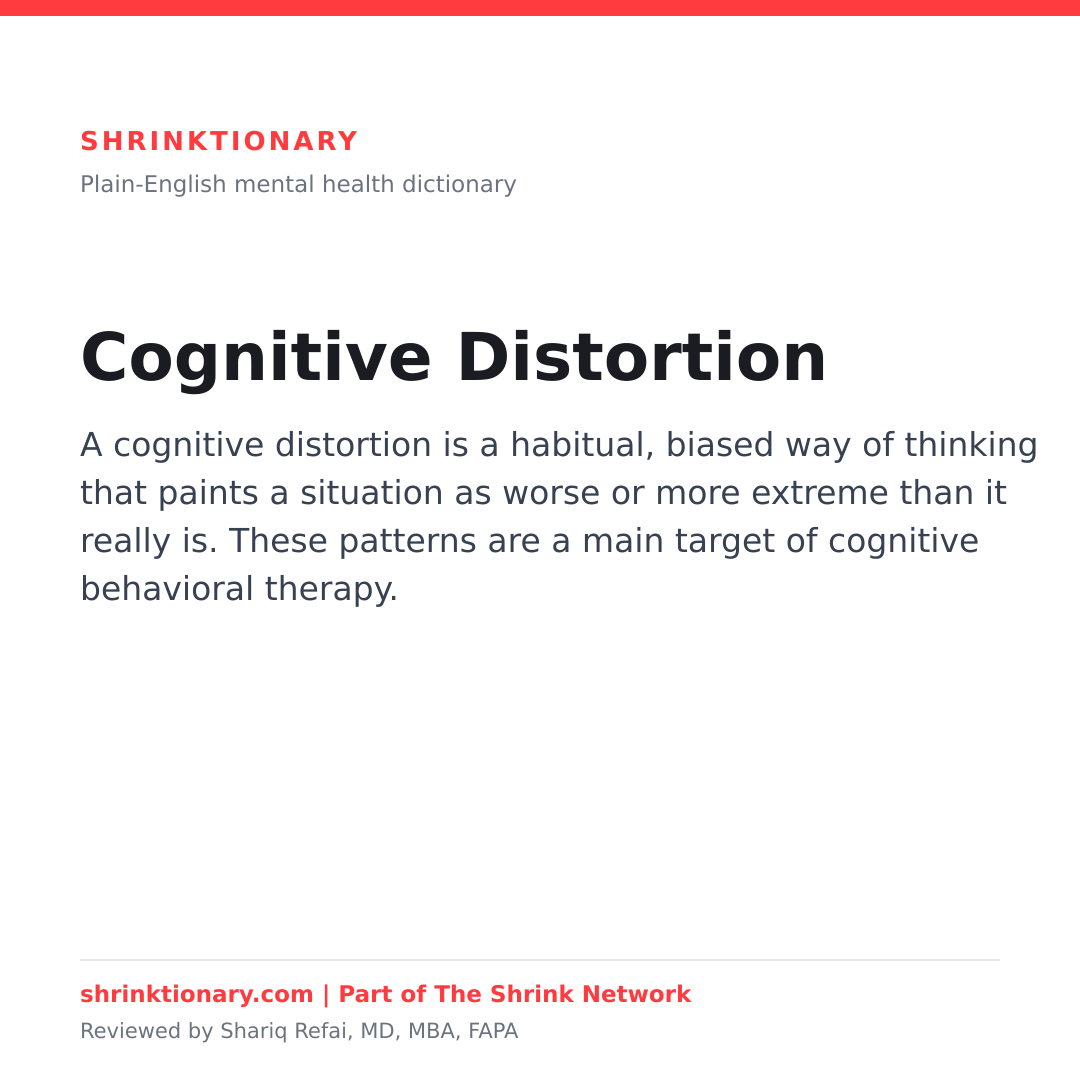
A cognitive distortion is a thinking pattern that systematically twists how you interpret events. The mind takes a shortcut, and the shortcut leads to a conclusion that’s more negative or extreme than the facts support. Everyone uses these shortcuts sometimes, but when they become a habit they can fuel anxiety and low mood.
For the fuller explainer, including where the concept came from in cognitive therapy and the common patterns spelled out one by one, see Shrinkopedia’s entry on cognitive distortions.
Cognitive behavioral therapy gives these patterns names so they’re easier to spot. Common examples include all-or-nothing thinking (seeing things as total success or total failure), catastrophizing (assuming the worst outcome), mind reading (assuming you know what others think), and overgeneralizing (treating one bad event as proof of an endless pattern).
What cognitive distortion can feel like in practice
In the moment, a distorted thought feels like plain truth, not a bias. One mistake at work becomes “I’m terrible at my job.” A friend who doesn’t text back becomes “They must be angry with me.” A single setback becomes “Nothing ever works out.” The thought arrives fast and convincing, and the feeling follows it.
The skill CBT teaches is to slow down and check the thought against the evidence. Is this all-or-nothing? Am I predicting the future? What would I tell a friend in this situation? Catching the pattern and naming it loosens its grip, even if the thought doesn’t disappear right away.
What cognitive distortion isn’t
A cognitive distortion isn’t lying or a sign of poor judgment. These patterns are normal mental habits that everyone falls into, especially when stressed or tired. Having them doesn’t mean something is wrong with you.
It also isn’t the same as a realistic negative thought. Sometimes a worry is accurate and a situation really is bad. The goal of CBT isn’t forced positivity, it’s accuracy, looking clearly at whether a thought matches the facts.
Related terms you’ll see next
Catastrophizing is one of the most common distortions. CBT is the therapy built around identifying and changing these patterns. Rumination and overthinking often feed distorted thinking.
When to seek professional care
You can learn to catch distorted thoughts on your own, but when these patterns keep driving anxiety, low mood, or distress that doesn’t lift, a therapist can help. CBT is well-studied and specifically designed to work with these thinking habits. A clinician can teach the skills and tailor them to what you’re facing.
When this word matters
It matters when biased thinking patterns become habitual and make situations feel worse or more extreme than they are, which is a main target of cognitive behavioral therapy. Everyone has these at times; they're more relevant when they fuel anxiety or depression.
Commonly confused with
Frequently asked questions
What are common examples of cognitive distortions?
Common ones include all-or-nothing thinking, catastrophizing, mind reading, and overgeneralizing. CBT gives these patterns names so they're easier to spot in the moment.
Are cognitive distortions a sign of mental illness?
No. These are normal mental habits that everyone falls into, especially when stressed or tired. Having them doesn't mean something is wrong with you, though when they become a habit they can fuel anxiety and low mood.
How do you fix cognitive distortions?
The skill CBT teaches is to slow down and check the thought against the evidence, then name the pattern. The goal isn't forced positivity, it's accuracy, and a therapist can teach these skills if the patterns keep driving distress.
Related terms
In these language clusters
Sources
- Psychotherapies , National Institute of Mental Health
- What is Cognitive Behavioral Therapy? , American Psychological Association
Use or cite this definition
Free to reuse with attribution. Paste the block into your own page, or grab a citation.
Embed on your site
<blockquote>
<p><strong>Cognitive Distortion:</strong> A cognitive distortion is a habitual, biased way of thinking that paints a situation as worse or more extreme than it really is. These patterns are a main target of cognitive behavioral therapy.</p>
<p>— <a href="https://shrinktionary.com/terms/cognitive-distortion/">Shrinktionary</a>, a plain-English mental health dictionary, medically reviewed by a board certified psychiatrist.</p>
</blockquote>Cite (APA)
Refai, S. (2026). Cognitive Distortion. Shrinktionary. https://shrinktionary.com/terms/cognitive-distortion/
Cite (MLA)
"Cognitive Distortion." Shrinktionary, https://shrinktionary.com/terms/cognitive-distortion/. Accessed September 29, 2026.
Your next step in The Shrink Network
You are here: Shrinktionary, the language layer of The Shrink Network.
Each site in the network has one job. No matter where you enter, we help you find the next step that makes sense.
Want to understand more first?
See how this connects to everything else in the Term Web →
Take it with you
Free printable references you can save or share. For education, not medical advice.