What CBT actually is
CBT is a short-to-medium-term form of psychotherapy built on a simple idea. Thoughts, feelings, and behaviors influence each other. If you change a behavior, the feeling shifts. If you challenge a thought, the behavior often follows. CBT uses structured techniques to make those changes deliberately.
A typical CBT course runs eight to twenty weekly sessions, with practice between sessions. Each session is goal-directed. You and the therapist identify a target (a fear, a low-mood pattern, a compulsive behavior), build a model of what’s keeping it going, and use techniques to change it.
What CBT looks like in practice
Sessions usually combine three ingredients. First, identifying thoughts that show up in moments of distress and examining whether they’re accurate, helpful, or worth holding. Second, planning behavioral experiments that test what happens when you act differently. Third, structured practice between sessions, sometimes called homework, that builds the new pattern outside the therapy room.
CBT is among the most-researched psychotherapies. It has strong evidence for depression, generalized anxiety, social anxiety, panic disorder, OCD (where a specialized form called exposure and response prevention is used), PTSD, insomnia, and several other conditions.
What CBT isn’t
CBT isn’t unfocused talk therapy, isn’t about reliving childhood, and isn’t a single rigid script. It’s a family of approaches that share the same core logic and adapt to the condition being treated. A clinician who says they “do CBT” should be able to describe the model they’re using and the targets they’re working on.
Related terms you’ll see next
Exposure therapy is a CBT technique that’s the gold standard for anxiety disorders. Behavioral activation is a CBT approach focused on depression. DBT is a related approach developed for emotion regulation and self-harm patterns.
When to seek professional care
CBT is delivered by a licensed therapist with training in the approach. If you’re considering therapy, asking specifically about a clinician’s training in CBT or in the specific protocol for your condition is reasonable and useful.
When this word matters
The label matters when comparing therapy types, since CBT is a structured, evidence-based approach focused on changing unhelpful thoughts and behaviors, which differs from insight-focused or skills-focused methods. It comes up a lot alongside DBT and exposure therapy, which build on or branch from it.
Commonly confused with
Frequently asked questions
How long does CBT take to work?
A typical CBT course runs about eight to twenty weekly sessions, with practice between them. It's a short-to-medium-term therapy, and many people start noticing changes within the first several weeks as they apply the skills.
What is CBT used to treat?
CBT has strong evidence for depression, generalized anxiety, social anxiety, panic disorder, OCD, PTSD, and insomnia, among other conditions. It's one of the most-researched forms of psychotherapy.
What's the difference between CBT and regular talk therapy?
CBT is structured and goal-directed, with specific targets and techniques like thought records and behavioral experiments, plus practice between sessions. It isn't open-ended talk therapy and isn't focused on reliving childhood.
Related terms
In these language clusters
Compare
Sources
- Psychotherapies , National Institute of Mental Health
- What is Cognitive Behavioral Therapy? , American Psychological Association
- Cognitive Behavioral Therapy , Mayo Clinic
Use or cite this definition
Free to reuse with attribution. Paste the block into your own page, or grab a citation.
Embed on your site
<blockquote>
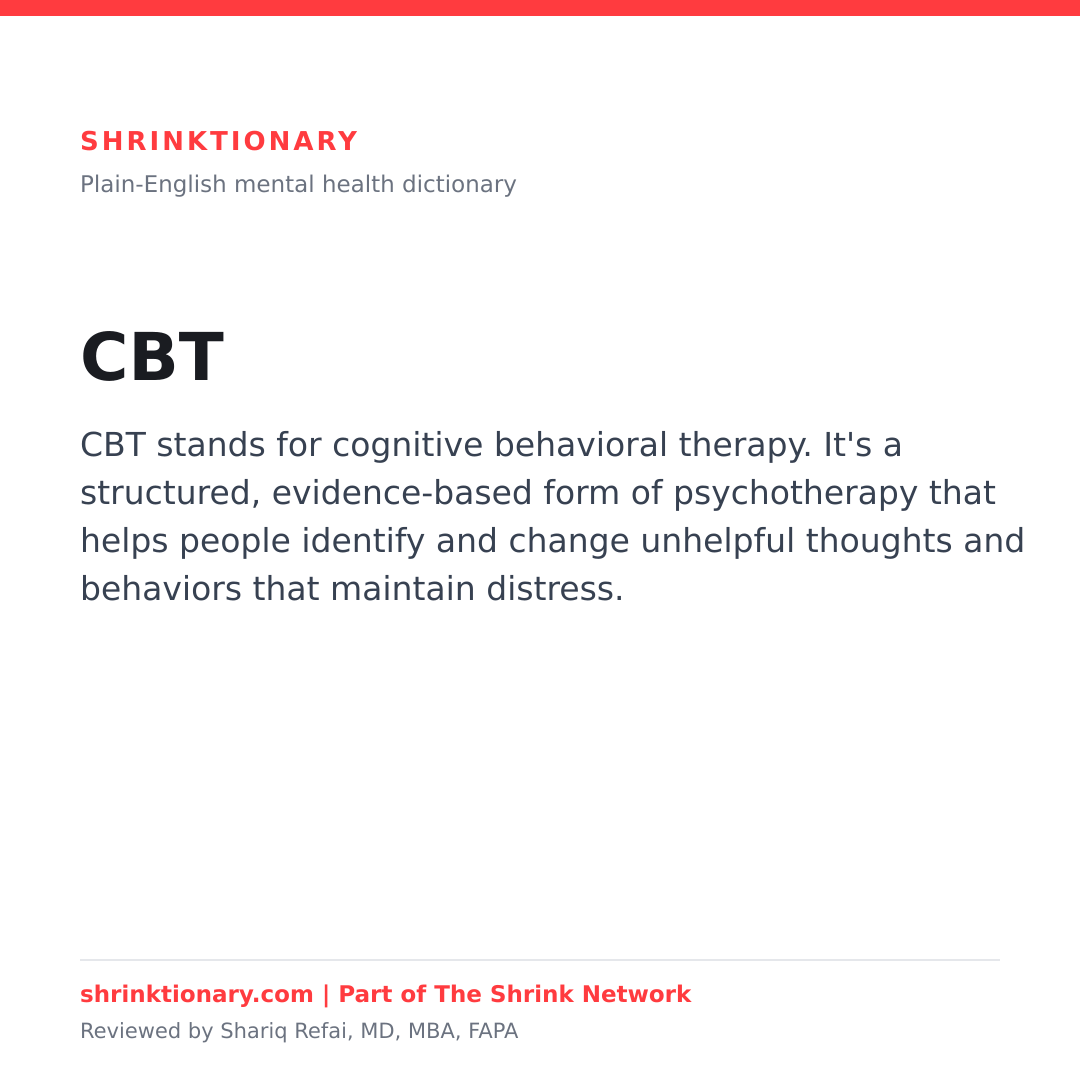
<p><strong>CBT:</strong> CBT stands for cognitive behavioral therapy. It's a structured, evidence-based form of psychotherapy that helps people identify and change unhelpful thoughts and behaviors that maintain distress.</p>
<p>— <a href="https://shrinktionary.com/terms/cbt/">Shrinktionary</a>, a plain-English mental health dictionary, medically reviewed by a board certified psychiatrist.</p>
</blockquote>Cite (APA)
Refai, S. (2026). CBT. Shrinktionary. https://shrinktionary.com/terms/cbt/
Cite (MLA)
"CBT." Shrinktionary, https://shrinktionary.com/terms/cbt/. Accessed September 29, 2026.
Your next step in The Shrink Network
You are here: Shrinktionary, the language layer of The Shrink Network.
Each site in the network has one job. No matter where you enter, we help you find the next step that makes sense.
Want to understand more first?
See how this connects to everything else in the Term Web →
Take it with you
Free printable references you can save or share. For education, not medical advice.