What exposure therapy actually is
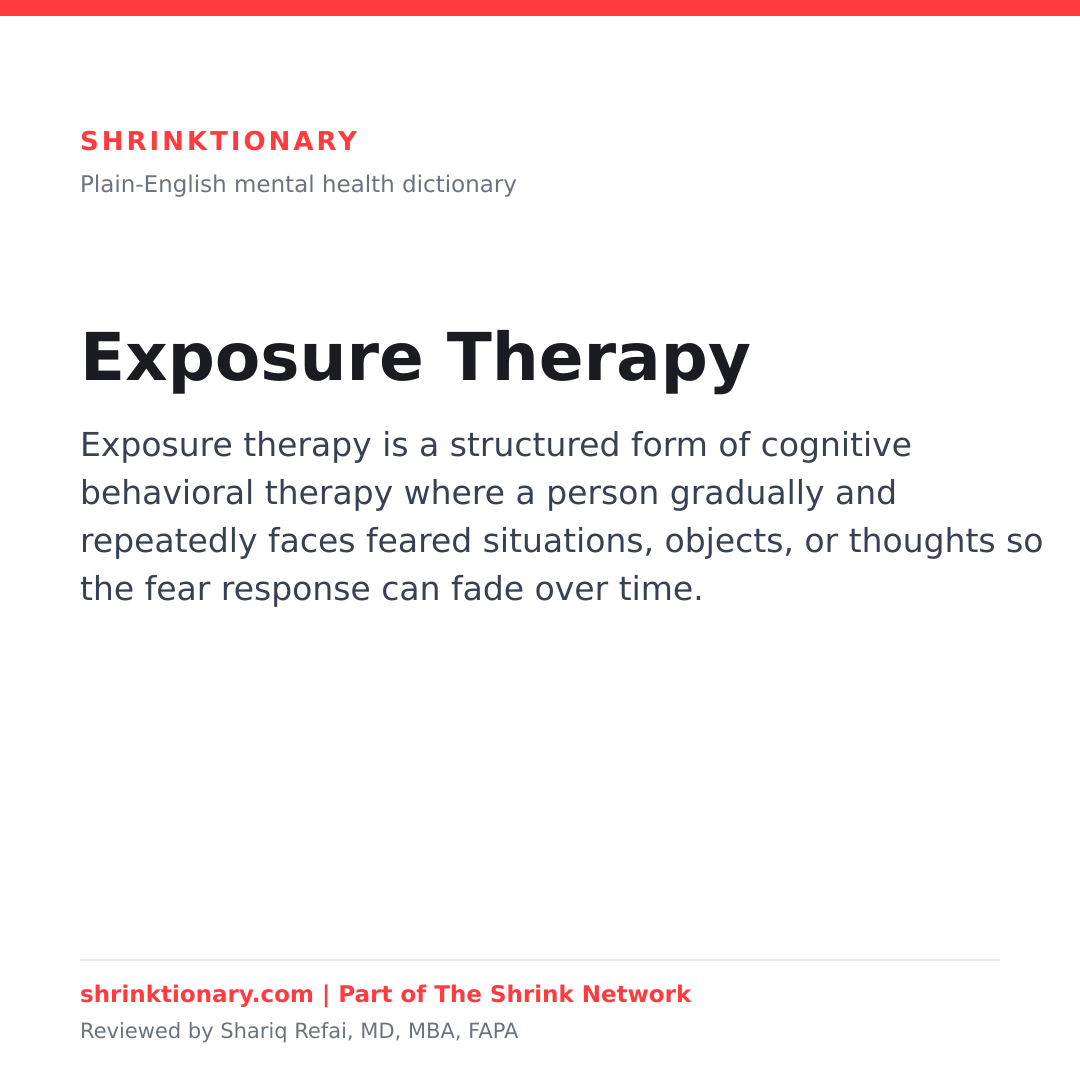
Exposure therapy is a cognitive behavioral technique built on a simple idea. When people avoid the things that scare them, the fear tends to grow. When they face those things in a planned, gradual way, the fear usually shrinks. The brain learns through repeated experience that the feared situation is more manageable than it felt.
A therapist and client usually build a list of feared situations ranked from least to most distressing, sometimes called a fear hierarchy. They start near the bottom and work upward at a pace the person can tolerate. Each step is repeated until the anxiety it triggers drops on its own.
Exposure therapy is considered a first-line, evidence-based treatment for anxiety disorders. A specific version called exposure and response prevention, or ERP, is the gold-standard psychotherapy for OCD.
What exposure therapy looks like in practice
Exposure can take several forms. In vivo exposure means facing a real situation, such as gradually riding an elevator for someone afraid of enclosed spaces. Imaginal exposure means vividly picturing a feared memory or scenario, which is often used in PTSD treatment. Interoceptive exposure means deliberately bringing on physical sensations, like a racing heart, to reduce fear of panic symptoms.
In ERP for OCD, a person faces a trigger that sparks an obsession, then resists the compulsion they would normally use to feel better. Over time, the urge weakens and the distress fades.
The work is collaborative and paced. A good exposure plan never throws someone into their worst fear without preparation. It moves step by step, with the person in control of how fast they go.
What exposure therapy isn’t
Exposure therapy is not about forcing yourself to white-knuckle through terror until you collapse. The goal is learning, not endurance. Steps are chosen so the person can stay engaged rather than flee or shut down.
It is also not the same as simply being exposed to stressful things in daily life. Random, unplanned encounters with fear can actually reinforce avoidance. Structured exposure is deliberate, repeated, and guided.
It is not a quick fix either. Progress often comes over several weeks of consistent practice, including exercises done between sessions.
Related terms you’ll see next
CBT, Fight-or-flight, Hypervigilance, and OCD often come up alongside exposure therapy.
When to seek professional care
Exposure therapy works best when guided by a trained clinician who can build a safe, paced plan. If avoidance of feared situations is shrinking someone’s daily life, a mental health professional can help. People with conditions like OCD, panic disorder, or PTSD especially benefit from working with a therapist experienced in exposure-based methods.
When this word matters
Exposure therapy matters as a first-line, evidence-based treatment for anxiety disorders, with ERP as the gold-standard version for OCD. The distinction is that it's structured, gradual, and paced, not white-knuckling through terror or random stressful encounters that can reinforce avoidance.
Commonly confused with
Frequently asked questions
What is exposure therapy used for?
It's a first-line, evidence-based treatment for anxiety disorders, and a version called exposure and response prevention is the gold-standard psychotherapy for OCD. It's also used in conditions like panic disorder and PTSD.
What are the different types of exposure therapy?
In vivo exposure means facing a real situation, imaginal exposure means vividly picturing a feared memory or scenario, and interoceptive exposure means deliberately bringing on physical sensations like a racing heart.
Is exposure therapy a quick fix?
No. Progress often comes over several weeks of consistent practice, including exercises done between sessions. The work is gradual and paced, with the person in control of how fast they go.
Related terms
In these language clusters
Compare
Sources
- Psychotherapies , National Institute of Mental Health
- What Is Exposure Therapy? , American Psychological Association
Use or cite this definition
Free to reuse with attribution. Paste the block into your own page, or grab a citation.
Embed on your site
<blockquote>
<p><strong>Exposure Therapy:</strong> Exposure therapy is a structured form of cognitive behavioral therapy where a person gradually and repeatedly faces feared situations, objects, or thoughts so the fear response can fade over time.</p>
<p>— <a href="https://shrinktionary.com/terms/exposure-therapy/">Shrinktionary</a>, a plain-English mental health dictionary, medically reviewed by a board certified psychiatrist.</p>
</blockquote>Cite (APA)
Refai, S. (2026). Exposure Therapy. Shrinktionary. https://shrinktionary.com/terms/exposure-therapy/
Cite (MLA)
"Exposure Therapy." Shrinktionary, https://shrinktionary.com/terms/exposure-therapy/. Accessed September 29, 2026.
Your next step in The Shrink Network
You are here: Shrinktionary, the language layer of The Shrink Network.
Each site in the network has one job. No matter where you enter, we help you find the next step that makes sense.
Want to understand more first?
See how this connects to everything else in the Term Web →
Take it with you
Free printable references you can save or share. For education, not medical advice.