What DBT actually is
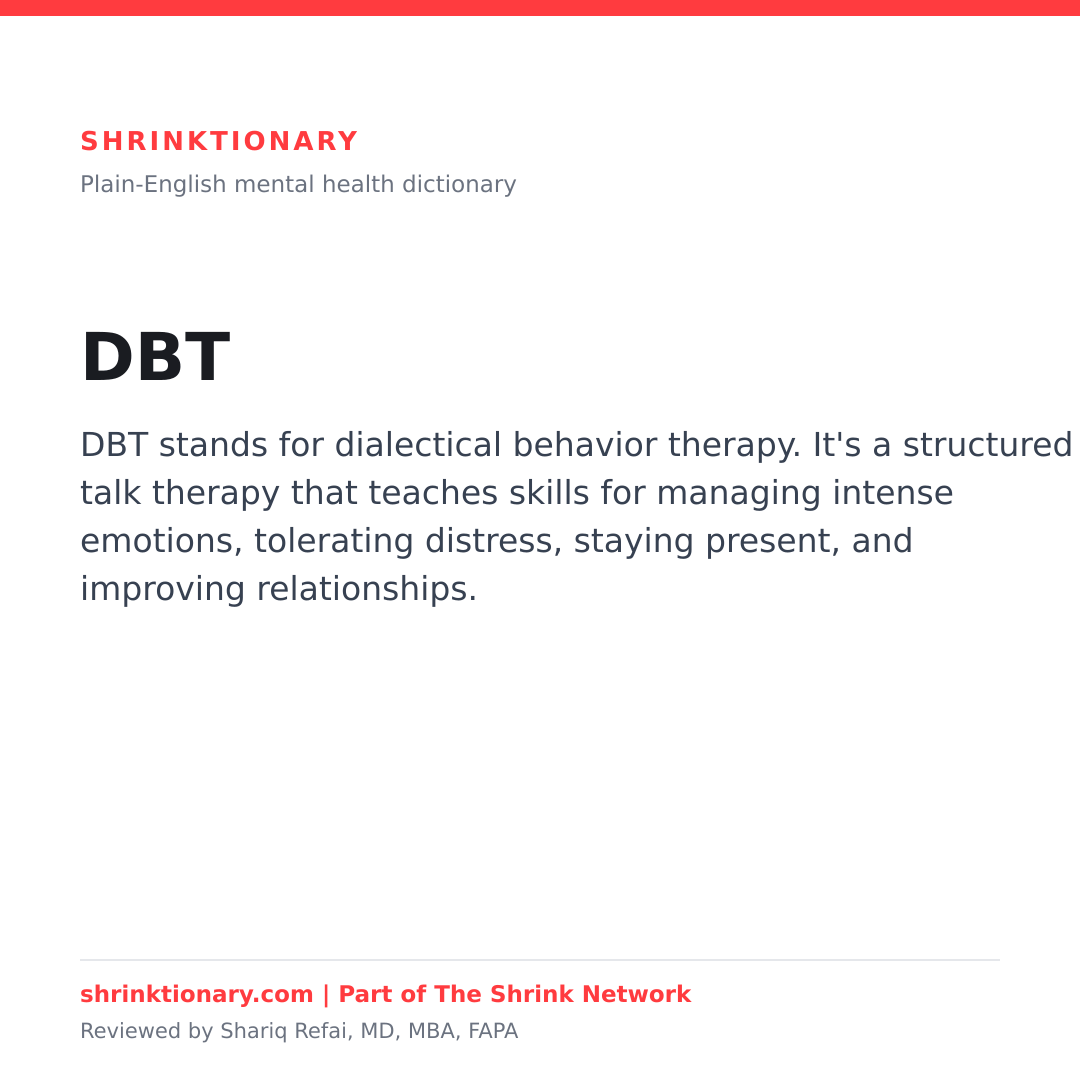
DBT, or dialectical behavior therapy, is a structured form of talk therapy originally developed to help people who experience very intense emotions and have trouble managing them. It grew out of cognitive behavioral therapy but adds a strong focus on acceptance alongside change. The word dialectical points to that balance, holding two ideas at once, accepting yourself as you are while also working to change.
DBT teaches concrete skills across four areas. Mindfulness helps a person stay grounded in the present. Distress tolerance offers ways to get through a crisis without making things worse. Emotion regulation builds tools to understand and shift difficult feelings. Interpersonal effectiveness improves how someone asks for what they need and sets boundaries.
It was first designed for borderline personality disorder and is now used for other conditions involving emotional intensity, self-harm, or chronic suicidal thoughts.
What DBT looks like in practice
Standard DBT usually combines several parts. There are individual therapy sessions, a skills training group that works almost like a class, and often phone coaching so a person can use skills during real-life moments of crisis. Therapists also meet as a team to support each other.
A person might learn a distress tolerance skill for riding out an urge to self-harm, or practice a script for a hard conversation. Homework and practice between sessions are central, since the skills only help when they become habits.
The structure is more involved than many therapies, which reflects how serious the difficulties it targets can be.
What DBT isn’t
DBT is not just a relaxation or coping class. It is a comprehensive, evidence-based treatment with a specific structure and a strong research base for reducing self-harm and emotional crises.
It is also not only for borderline personality disorder. While that is where it began, the skills apply to many people who struggle with overwhelming emotions.
And it is not a sign that someone is too broken to be helped. DBT is often used precisely because a person’s pain is real and intense, and the approach treats that pain with respect rather than judgment.
Related terms you’ll see next
CBT, Behavioral activation, Rumination, and PTSD often appear alongside DBT.
When to seek professional care
DBT is delivered by trained clinicians and works best as a complete program rather than picked apart on your own. If intense emotions, self-harm urges, or relationship turmoil are interfering with daily life, a mental health professional can help find the right fit. Anyone having thoughts of suicide should reach out for immediate support, including the 988 Suicide and Crisis Lifeline in the United States.
When this word matters
The label matters when comparing therapies, since DBT is a structured approach built around skills for managing intense emotions, tolerating distress, staying present, and improving relationships. It's often distinguished from CBT, which it grew out of but extends.
Commonly confused with
Frequently asked questions
What skills does DBT teach?
DBT teaches skills across four areas: mindfulness for staying grounded, distress tolerance for getting through a crisis, emotion regulation for shifting difficult feelings, and interpersonal effectiveness for asking for what you need and setting boundaries.
What is the difference between DBT and CBT?
DBT grew out of CBT but adds a strong focus on acceptance alongside change. It also has a more involved structure, often combining individual therapy, a skills group, and phone coaching.
Is DBT only for borderline personality disorder?
No. It was first designed for borderline personality disorder, but the skills now apply to many people who struggle with overwhelming emotions, self-harm, or chronic suicidal thoughts.
Related terms
In these language clusters
Compare
Sources
- Psychotherapies , National Institute of Mental Health
- Borderline Personality Disorder , National Institute of Mental Health
Use or cite this definition
Free to reuse with attribution. Paste the block into your own page, or grab a citation.
Embed on your site
<blockquote>
<p><strong>DBT:</strong> DBT stands for dialectical behavior therapy. It's a structured talk therapy that teaches skills for managing intense emotions, tolerating distress, staying present, and improving relationships.</p>
<p>— <a href="https://shrinktionary.com/terms/dbt/">Shrinktionary</a>, a plain-English mental health dictionary, medically reviewed by a board certified psychiatrist.</p>
</blockquote>Cite (APA)
Refai, S. (2026). DBT. Shrinktionary. https://shrinktionary.com/terms/dbt/
Cite (MLA)
"DBT." Shrinktionary, https://shrinktionary.com/terms/dbt/. Accessed September 29, 2026.
Your next step in The Shrink Network
You are here: Shrinktionary, the language layer of The Shrink Network.
Each site in the network has one job. No matter where you enter, we help you find the next step that makes sense.
Want to understand more first?
See how this connects to everything else in the Term Web →
Take it with you
Free printable references you can save or share. For education, not medical advice.