What inhibition actually is
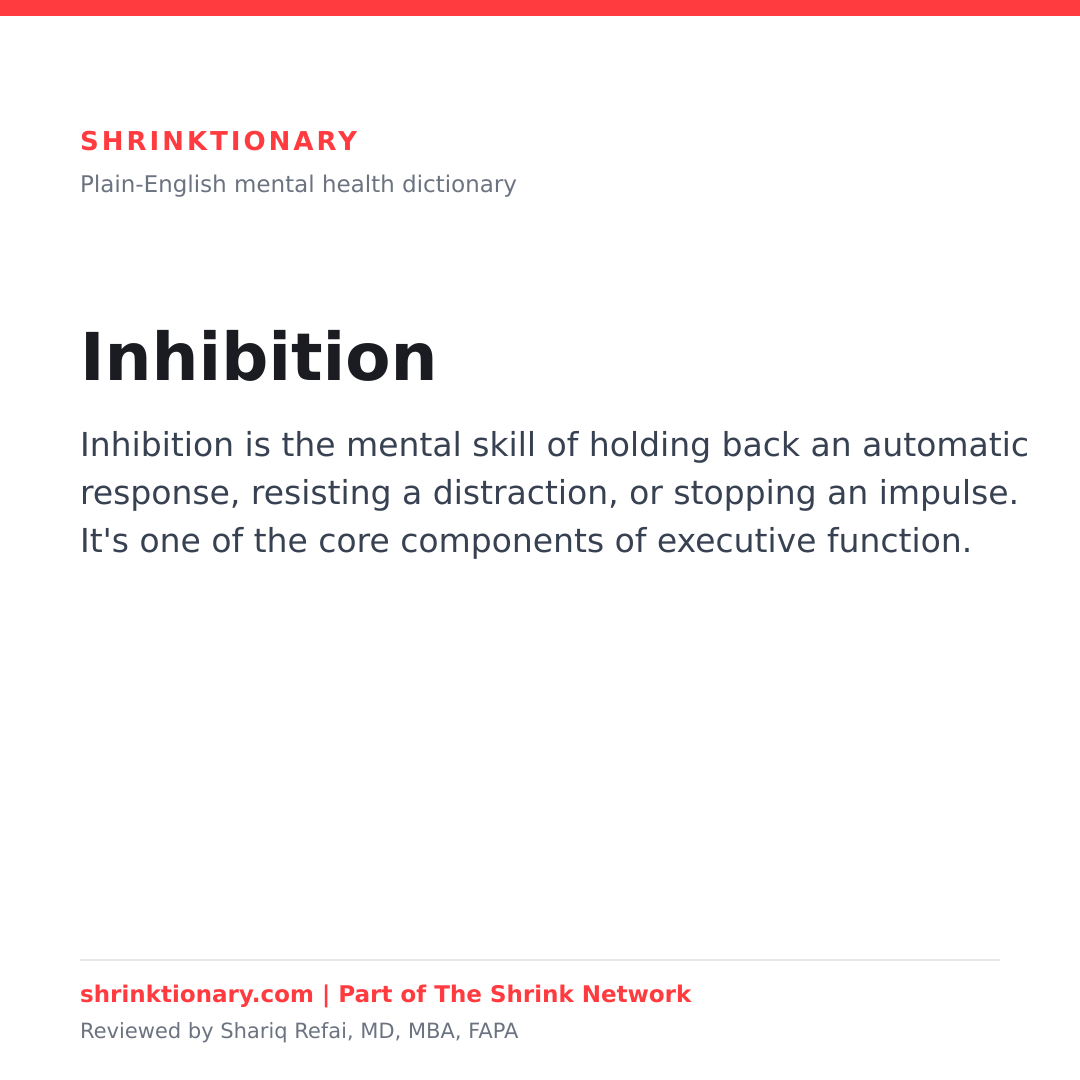
Inhibition is the brain’s brake. It’s the skill that lets you stop an automatic reaction, hold off on a first impulse, and keep your attention on what matters instead of whatever just grabbed it. Researchers count it as one of the three core parts of executive function, alongside working memory and cognitive flexibility.
It’s what keeps you from blurting out the first thing that comes to mind, from checking your phone the instant it buzzes, and from acting on a passing urge. Most of the time it works quietly in the background, which is why it’s easiest to notice when it isn’t working well.
What inhibition looks like in practice
Strong inhibition looks like pausing before reacting, staying on task when something distracting appears, and letting a strong feeling pass without acting on it. Weaker inhibition looks like interrupting, acting before thinking, getting pulled off task by small distractions, and struggling to resist an immediate reward for a bigger later one.
Inhibition develops through childhood and adolescence and can be temporarily weakened by sleep loss, stress, and strong emotion. It’s also a central difference in ADHD, where holding back a response is genuinely harder.
What inhibition isn’t
Inhibition isn’t the same as being shy or “inhibited” in the social sense, and it isn’t a measure of willpower or character. It’s a specific, measurable cognitive skill. Someone can be highly motivated and still find inhibition hard, which is exactly what happens in ADHD.
Related terms you’ll see next
Executive function is the broader set of skills inhibition belongs to. Working memory is the component that holds information in mind while you use it. ADHD is the condition most associated with differences in inhibition.
When to seek professional care
If trouble with impulse control, distraction, or acting before thinking is interfering with school, work, or relationships, an evaluation can clarify what’s contributing. Support, structure, and treatment can all help, depending on the cause.
When this word matters
Inhibition matters when distinguishing the brain's ability to stop an automatic reaction from willpower or shyness. It's a core part of executive function and is a central difference in ADHD, where holding back a response is genuinely harder.
Commonly confused with
Frequently asked questions
What is inhibition in psychology?
Inhibition is the brain's brake. It's the skill that lets you stop an automatic reaction, hold off on an impulse, and keep your attention on what matters. It's one of the three core parts of executive function.
Is inhibition the same as being shy or inhibited socially?
No. It isn't the same as being shy in the social sense, and it isn't a measure of willpower or character. It's a specific, measurable cognitive skill.
How is inhibition related to ADHD?
Inhibition is a central difference in ADHD, where holding back a response is genuinely harder. Someone can be highly motivated and still find inhibition difficult, which is exactly what happens in ADHD.
Related terms
Compare
Sources
- Executive Function & Self-Regulation , Center on the Developing Child, Harvard University
- Attention-Deficit/Hyperactivity Disorder (ADHD) , National Institute of Mental Health
Use or cite this definition
Free to reuse with attribution. Paste the block into your own page, or grab a citation.
Embed on your site
<blockquote>
<p><strong>Inhibition:</strong> Inhibition is the mental skill of holding back an automatic response, resisting a distraction, or stopping an impulse. It's one of the core components of executive function.</p>
<p>— <a href="https://shrinktionary.com/terms/inhibition/">Shrinktionary</a>, a plain-English mental health dictionary, medically reviewed by a board certified psychiatrist.</p>
</blockquote>Cite (APA)
Refai, S. (2026). Inhibition. Shrinktionary. https://shrinktionary.com/terms/inhibition/
Cite (MLA)
"Inhibition." Shrinktionary, https://shrinktionary.com/terms/inhibition/. Accessed September 29, 2026.
Your next step in The Shrink Network
You are here: Shrinktionary, the language layer of The Shrink Network.
Each site in the network has one job. No matter where you enter, we help you find the next step that makes sense.
Want to understand more first?
See how this connects to everything else in the Term Web →
Take it with you
Free printable references you can save or share. For education, not medical advice.