What gaslighting actually is
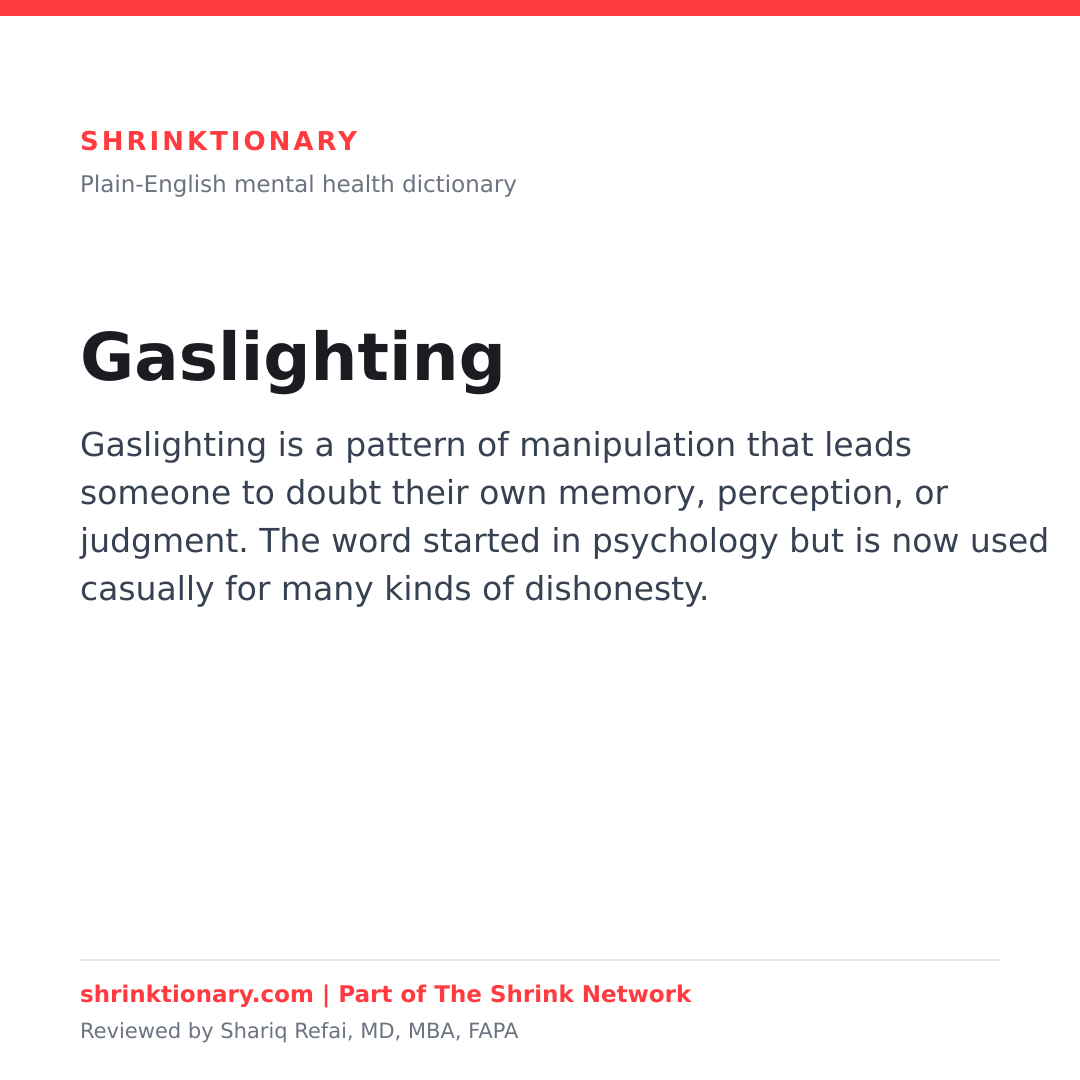
Gaslighting is a form of manipulation in which one person repeatedly causes another to question what they know to be true. Over time, the target starts to distrust their own memory, perception, and judgment. The term comes from a 1938 play, later a film, in which a husband slowly convinces his wife she’s losing her grip on reality.
In its clearest form, gaslighting is a deliberate pattern, not a single argument or honest disagreement. It usually unfolds within a relationship where there’s a power imbalance, such as a partnership, a family, or a workplace, and it works by chipping away at a person’s confidence in their own mind.
What gaslighting can feel like in practice
A person being gaslighted often hears phrases like “that never happened,” “you’re overreacting,” or “you’re imagining things,” even when they have clear reason to believe otherwise. Events get rewritten. Their feelings get dismissed as too sensitive. Slowly, they begin to second-guess their own version of reality.
The effect can be disorienting. People in this situation may feel confused, anxious, and unsure of themselves. They might start writing things down to check their own memory or apologizing for things they didn’t do. This erosion of self-trust can fuel anxiety, hypervigilance, and over time can contribute to trauma-related symptoms.
What gaslighting isn’t
Gaslighting isn’t the same as disagreeing, misremembering, or being wrong. Two people can honestly recall an event differently without either one manipulating the other. Gaslighting involves a sustained effort to make someone doubt their reality, not an ordinary difference of opinion.
The word is also used loosely in everyday speech, sometimes for any lie or any time someone feels unheard. That casual use stretches the term well beyond its clinical meaning. True gaslighting is a pattern of manipulation, not a one-time falsehood or a frustrating conversation.
Related terms you’ll see next
Hypervigilance, a state of being constantly on guard, can develop in people who’ve been manipulated this way. Dissociation is another response that can follow prolonged emotional harm. PTSD can result from ongoing abusive relationships.
When to seek professional care
If you feel persistently confused about your own reality, controlled, or unsafe in a relationship, talking with a professional can help you regain your footing. A therapist can help you sort out what’s happening and rebuild trust in your own judgment. If you’re in danger, contacting a domestic violence hotline or local emergency services is an important step.
When this word matters
Gaslighting matters when it's a sustained, deliberate pattern that erodes a person's trust in their own reality, usually within a relationship that has a power imbalance, and it can fuel anxiety and trauma-related symptoms. It isn't the same as an honest disagreement, misremembering, or simply being wrong.
Commonly confused with
Frequently asked questions
What's the difference between gaslighting and a normal disagreement?
Gaslighting is a sustained effort to make someone doubt their own reality, not an ordinary difference of opinion. Two people can honestly recall an event differently without either one manipulating the other.
Where does the term gaslighting come from?
It comes from a 1938 play, later a film, in which a husband slowly convinces his wife she's losing her grip on reality. The word started in psychology but is now used loosely in everyday speech.
What does gaslighting do to a person over time?
It can be disorienting, leaving people confused, anxious, and unsure of themselves. This erosion of self-trust can fuel anxiety and hypervigilance, and over time can contribute to trauma-related symptoms.
Related terms
Sources
- Coping With Traumatic Events , National Institute of Mental Health
- Domestic Violence and Abuse , MedlinePlus (U.S. National Library of Medicine)
Use or cite this definition
Free to reuse with attribution. Paste the block into your own page, or grab a citation.
Embed on your site
<blockquote>
<p><strong>Gaslighting:</strong> Gaslighting is a pattern of manipulation that leads someone to doubt their own memory, perception, or judgment. The word started in psychology but is now used casually for many kinds of dishonesty.</p>
<p>— <a href="https://shrinktionary.com/terms/gaslighting/">Shrinktionary</a>, a plain-English mental health dictionary, medically reviewed by a board certified psychiatrist.</p>
</blockquote>Cite (APA)
Refai, S. (2026). Gaslighting. Shrinktionary. https://shrinktionary.com/terms/gaslighting/
Cite (MLA)
"Gaslighting." Shrinktionary, https://shrinktionary.com/terms/gaslighting/. Accessed September 29, 2026.
Your next step in The Shrink Network
You are here: Shrinktionary, the language layer of The Shrink Network.
Each site in the network has one job. No matter where you enter, we help you find the next step that makes sense.
Want to understand more first?
See how this connects to everything else in the Term Web →
Take it with you
Free printable references you can save or share. For education, not medical advice.