What a meta-analysis actually is
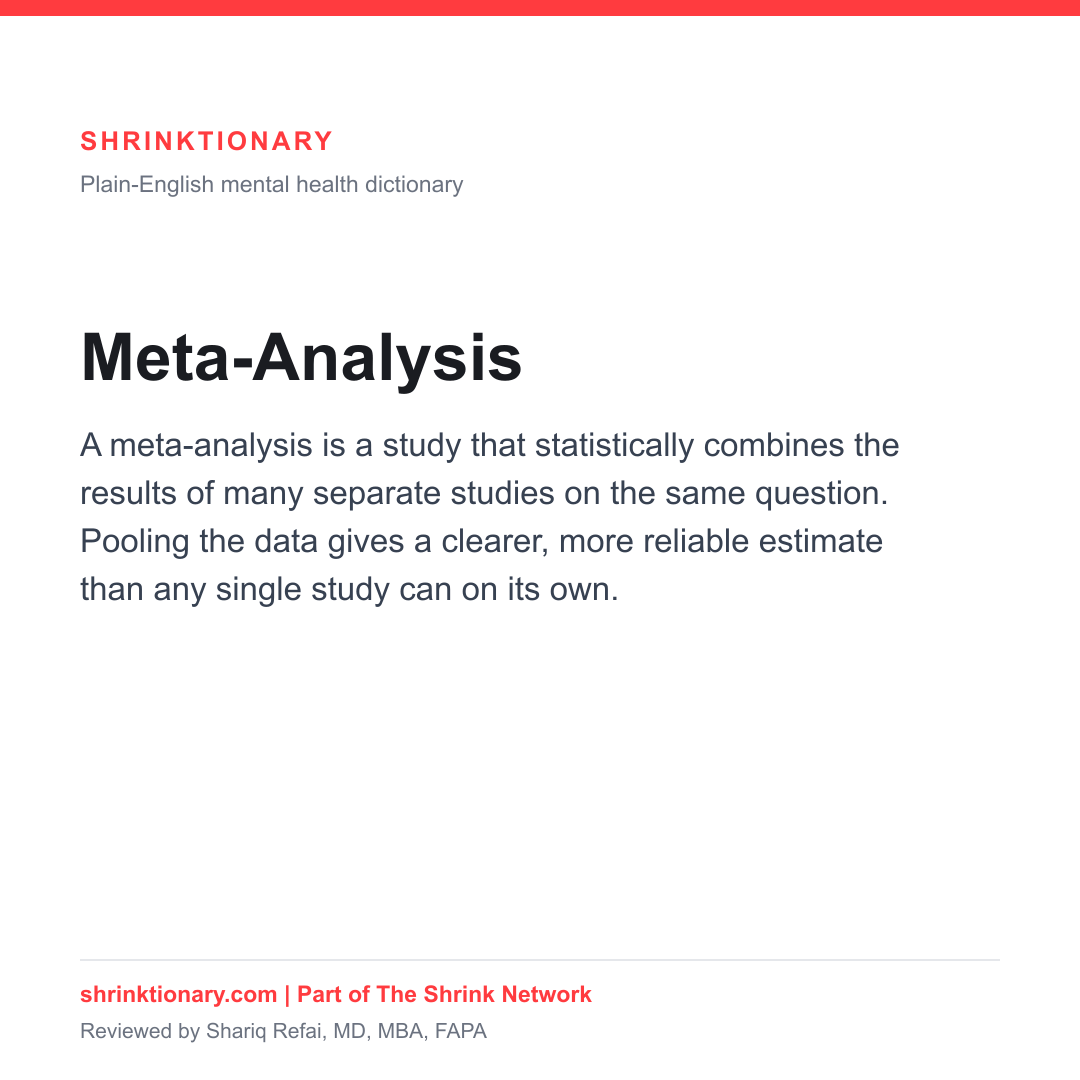
A meta-analysis is a study of studies. Instead of running a new experiment, researchers gather the results of many earlier studies that asked the same question and combine them using statistics. The goal is a single, more precise estimate of how well a treatment works or how strong a relationship is.
Pooling data has real advantages. Small studies often produce noisy or conflicting results, and one study alone may be too limited to settle a question. By combining them, a meta-analysis brings together far more participants, which can reveal an effect that individual studies were too small to show clearly. Meta-analyses often sit at the top of evidence rankings, especially when they pull together well-run randomized controlled trials.
What a meta-analysis looks like in practice
Researchers start by searching thoroughly for every relevant study, including ones with disappointing or negative results. They set rules in advance for which studies to include, then extract the numbers and combine them, giving more weight to larger, higher-quality studies. The output is usually a single summary estimate with a range showing how confident that estimate is.
Groups like Cochrane are known for producing careful systematic reviews and meta-analyses that clinicians and guideline writers rely on. When you see a treatment described as supported by a meta-analysis of multiple trials, that’s generally a stronger claim than one based on a single study.
What a meta-analysis isn’t
A meta-analysis isn’t automatically the truth. Its quality depends entirely on the studies that go into it. If the underlying studies are flawed, biased, or poorly designed, combining them just produces a more confident-looking version of the same flaws. Researchers call this “garbage in, garbage out.”
It also isn’t useful when the studies are too different to compare, mixing very different treatments, doses, or patient groups can produce a number that doesn’t mean much. And if negative studies were never published, a meta-analysis can overstate how well a treatment works. So the method is powerful but not foolproof.
Related terms you’ll see next
Randomized controlled trial is the study design that usually provides the strongest input for a meta-analysis. CBT is a treatment whose effectiveness has been examined in many meta-analyses.
A practical takeaway
When a meta-analysis backs a treatment, it’s usually worth more attention than a single study, because it reflects a wider body of evidence. Still, it pays to notice the quality of the studies behind it and whether the question they answer matches your own. A well-built meta-analysis is one of the most useful tools for separating what’s well-supported from what’s still uncertain.
When this word matters
A meta-analysis matters when weighing how strong the evidence is, since pooling many studies can reveal an effect single studies were too small to show. Its quality depends entirely on the studies it combines, so garbage in means garbage out.
Commonly confused with
Frequently asked questions
What does a meta-analysis mean in a study?
It means researchers statistically combined the results of many separate studies that asked the same question into one more precise estimate. Pooling far more participants can reveal an effect that individual small studies were too limited to show clearly.
Is a meta-analysis better evidence than a single study?
Usually yes, because it reflects a wider body of evidence, especially when it pulls together well-run randomized controlled trials. Still, its quality depends entirely on the studies that go into it, so flawed inputs produce a more confident-looking version of the same flaws.
What's the difference between a meta-analysis and a systematic review?
A systematic review thoroughly searches for and summarizes all relevant studies on a question, while a meta-analysis adds a statistical step that combines their numbers into a single summary estimate. Many systematic reviews, like those from Cochrane, include a meta-analysis.
Related terms
Sources
- Understanding Medical Research , MedlinePlus (U.S. National Library of Medicine)
- About us , Cochrane
Use or cite this definition
Free to reuse with attribution. Paste the block into your own page, or grab a citation.
Embed on your site
<blockquote>
<p><strong>Meta-Analysis:</strong> A meta-analysis is a study that statistically combines the results of many separate studies on the same question. Pooling the data gives a clearer, more reliable estimate than any single study can on its own.</p>
<p>— <a href="https://shrinktionary.com/terms/meta-analysis/">Shrinktionary</a>, a plain-English mental health dictionary, medically reviewed by a board certified psychiatrist.</p>
</blockquote>Cite (APA)
Refai, S. (2026). Meta-Analysis. Shrinktionary. https://shrinktionary.com/terms/meta-analysis/
Cite (MLA)
"Meta-Analysis." Shrinktionary, https://shrinktionary.com/terms/meta-analysis/. Accessed September 29, 2026.
Your next step in The Shrink Network
You are here: Shrinktionary, the language layer of The Shrink Network.
Each site in the network has one job. No matter where you enter, we help you find the next step that makes sense.
Want to understand more first?
See how this connects to everything else in the Term Web →
Take it with you
Free printable references you can save or share. For education, not medical advice.