What a randomized controlled trial actually is
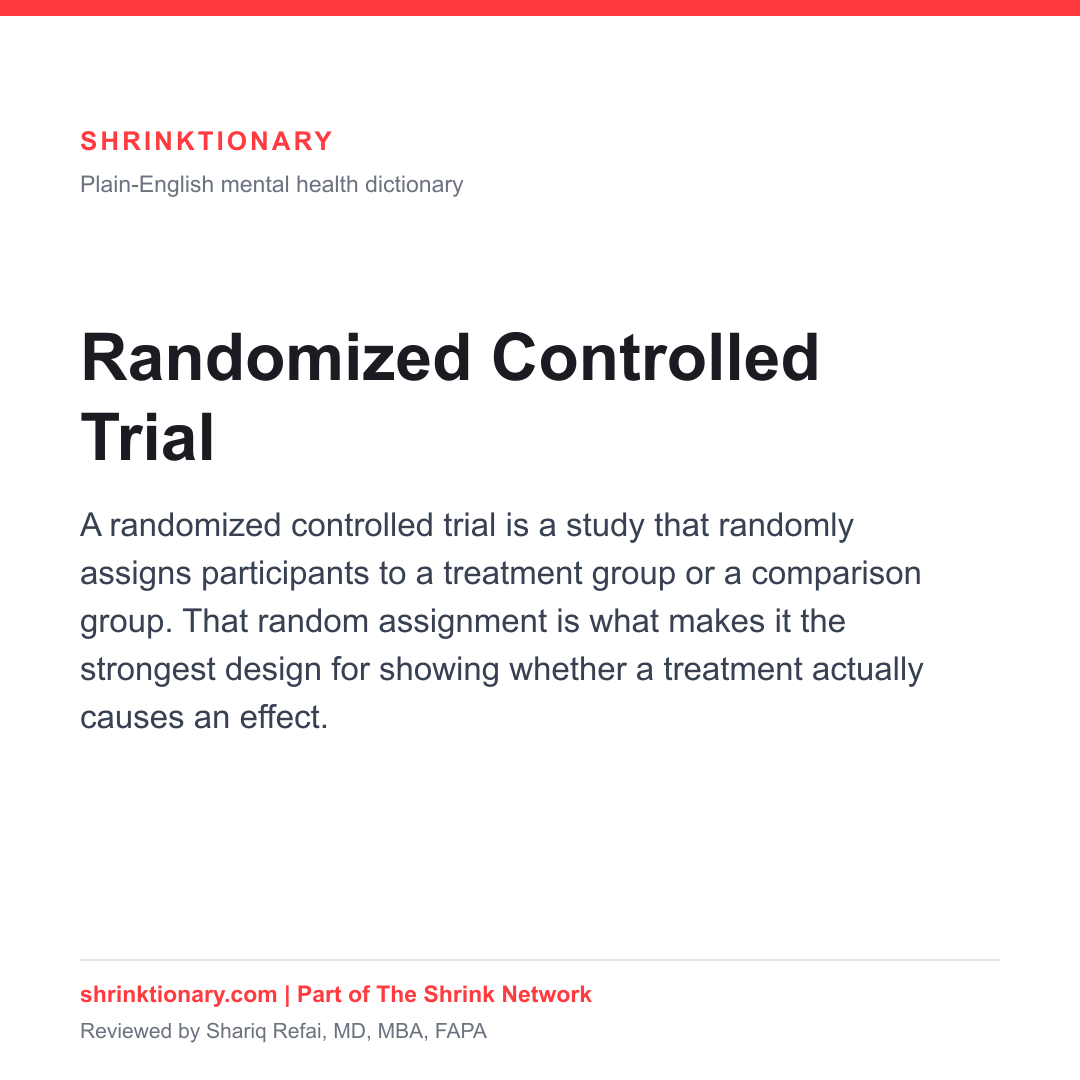
A randomized controlled trial, or RCT, is a study designed to test whether a treatment works. Researchers take a group of participants and randomly assign each person to either receive the treatment or to be in a comparison group, which might get a placebo, no treatment, or the usual standard of care.
The random part is the key. Because people are sorted by chance rather than by choice, the groups tend to be similar in every other way, age, health, and countless factors no one can measure. So if the groups end up different at the end, the treatment is the most likely reason. That’s why the RCT is often called the gold standard for showing cause and effect.
What a randomized controlled trial looks like in practice
In a typical mental health RCT, researchers might compare a new therapy or medication against a placebo or an existing treatment. To reduce bias, many trials are blinded, meaning participants, and sometimes the researchers too, don’t know who’s getting which treatment. This keeps expectations from coloring the results.
At the end, researchers compare outcomes between the groups. If the treatment group improves more than the comparison group by a margin unlikely to be due to chance, that’s evidence the treatment helped. A single well-run RCT carries real weight, and several pointing the same direction carry more.
What a randomized controlled trial isn’t
An RCT isn’t the same as an observational study, where researchers simply watch what happens without assigning treatments. Observational studies can show that two things go together, but they can’t rule out other explanations the way randomization can.
A single RCT also isn’t the final word. Trials vary in quality, size, and how well they apply to people outside the study. A small trial, a short one, or one with a narrow group of participants may not tell the whole story. Strong conclusions usually rest on several trials that agree.
Related terms you’ll see next
Meta-analysis is a method for combining the results of many trials into one overall estimate. CBT is an example of a treatment whose evidence base rests heavily on randomized controlled trials.
A practical takeaway
When you read that a treatment “works,” it helps to ask what kind of evidence sits behind the claim. Results from randomized controlled trials, especially several that agree, are far more dependable than testimonials or single observations. Knowing the difference makes you a sharper reader of health information.
When this word matters
The distinction matters when judging evidence, because random assignment to treatment or comparison groups is what lets an RCT show a treatment actually caused an effect rather than just being linked to it. It's the single study design that supports cause-and-effect claims most strongly, which is why it's called the gold standard.
Commonly confused with
Frequently asked questions
What is a randomized controlled trial?
It's a study that randomly assigns each participant to either receive a treatment or be in a comparison group that might get a placebo, no treatment, or usual care. The random assignment is what makes it the strongest design for showing whether a treatment actually causes an effect.
Why is randomization important in a trial?
Because people are sorted by chance rather than by choice, the groups tend to be similar in every other way, including factors no one can measure. So if the groups end up different at the end, the treatment is the most likely reason, which is why RCTs are called the gold standard for cause and effect.
What's the difference between an RCT and an observational study?
In an observational study researchers simply watch what happens without assigning treatments, so it can show that two things go together but can't rule out other explanations. Randomization in an RCT can, though a single trial isn't the final word and strong conclusions usually rest on several trials that agree.
Related terms
Sources
- Understanding Medical Research , MedlinePlus (U.S. National Library of Medicine)
- Clinical Trials , National Institute of Mental Health
- About us , Cochrane
Use or cite this definition
Free to reuse with attribution. Paste the block into your own page, or grab a citation.
Embed on your site
<blockquote>
<p><strong>Randomized Controlled Trial:</strong> A randomized controlled trial is a study that randomly assigns participants to a treatment group or a comparison group. That random assignment is what makes it the strongest design for showing whether a treatment actually causes an effect.</p>
<p>— <a href="https://shrinktionary.com/terms/randomized-controlled-trial/">Shrinktionary</a>, a plain-English mental health dictionary, medically reviewed by a board certified psychiatrist.</p>
</blockquote>Cite (APA)
Refai, S. (2026). Randomized Controlled Trial. Shrinktionary. https://shrinktionary.com/terms/randomized-controlled-trial/
Cite (MLA)
"Randomized Controlled Trial." Shrinktionary, https://shrinktionary.com/terms/randomized-controlled-trial/. Accessed September 29, 2026.
Your next step in The Shrink Network
You are here: Shrinktionary, the language layer of The Shrink Network.
Each site in the network has one job. No matter where you enter, we help you find the next step that makes sense.
Want to understand more first?
See how this connects to everything else in the Term Web →
Take it with you
Free printable references you can save or share. For education, not medical advice.