What mood stabilizer actually is
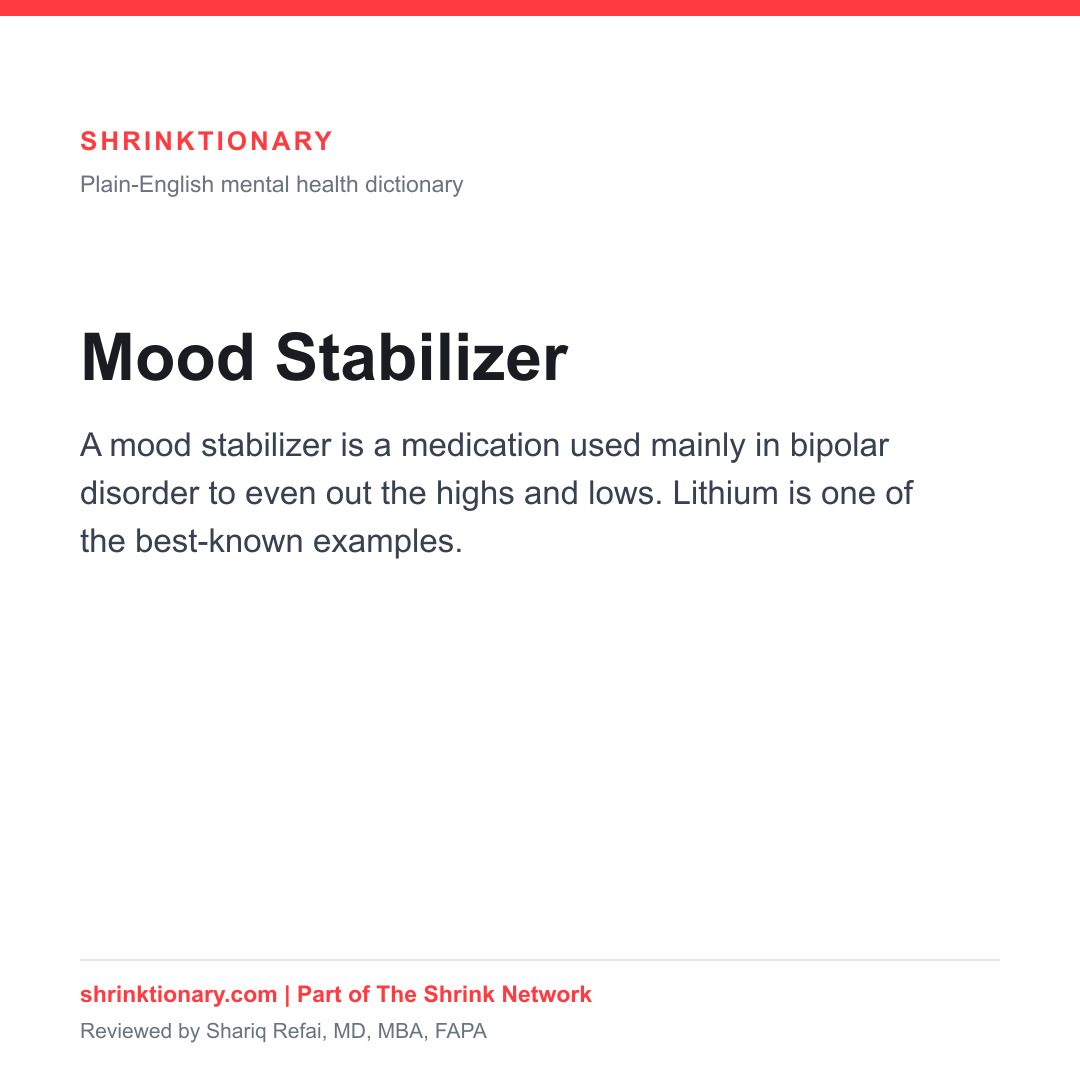
A mood stabilizer is a class of medication used to keep mood from swinging too high or too low. It’s the backbone of treatment for bipolar disorder, where a person cycles between manic or elevated episodes and depressive ones. The goal isn’t to flatten emotion. It’s to smooth out the extremes so daily life becomes steadier and more predictable.
The category covers a few different kinds of medicine. Lithium is the classic example and one of the oldest. Some anti-seizure medications also work as mood stabilizers, and certain antipsychotics are used in a similar role. Which one fits depends on the person’s pattern of episodes, other health conditions, and how they respond, and that choice belongs with a prescriber.
See it in action: see how mood stabilizers work in the brain.
What to expect
Mood stabilizers usually work over weeks, not hours. Some help calm an acute manic episode faster, while the steadier, long-term benefit of preventing future episodes builds with time and consistent use. Because of that, people often stay on them for the long haul, even when they feel well.
Some mood stabilizers, lithium in particular, need regular blood tests to keep the level in a safe and effective range and to check on the kidneys and thyroid. None of this is something to manage alone. People shouldn’t start, adjust, or stop a mood stabilizer on their own, since stopping suddenly can trigger a relapse. Every change goes through the prescriber.
What mood stabilizer isn’t
A mood stabilizer isn’t a sedative or a tranquilizer, even if some can cause drowsiness. It works on the swing of mood over time rather than just calming a person down in the moment.
It also isn’t only an antidepressant. In bipolar disorder, antidepressants used alone can sometimes push a person toward mania, which is part of why mood stabilizers play such a central role. And it isn’t a sign of weakness to need one. For many people with bipolar disorder, a mood stabilizer is what makes a stable, full life possible.
Related terms you’ll see next
When to seek professional care
Anyone with big swings in mood, energy, or sleep, or with episodes of feeling unusually high, irritable, or invincible, should talk with a doctor or mental health professional. Bipolar disorder is treatable, and the right medication can make a real difference. A prescriber can decide whether a mood stabilizer fits and can handle the monitoring it needs. If a person has thoughts of harming themselves or others, get help right away by calling 911, or call or text 988 in the US to reach the Suicide and Crisis Lifeline.
When this word matters
The label matters because mood stabilizers are aimed at evening out both the highs and the lows of bipolar disorder, which is a different goal than lifting mood with an antidepressant or calming agitation with an antipsychotic.
Commonly confused with
Frequently asked questions
What is a mood stabilizer used for?
It's mainly used in bipolar disorder to keep mood from swinging too high or too low. The goal isn't to flatten emotion, it's to smooth out the extremes so daily life becomes steadier.
Is lithium a mood stabilizer?
Yes, lithium is the classic example and one of the oldest mood stabilizers. Some anti-seizure medications also work in this role, and certain antipsychotics are used similarly.
Why does lithium require regular blood tests?
Lithium needs monitoring to keep the level in a safe and effective range and to check on the kidneys and thyroid. People shouldn't start, adjust, or stop a mood stabilizer on their own, since stopping suddenly can trigger a relapse, so every change goes through the prescriber.
Related terms
In these language clusters
Compare
Sources
- Mental Health Medications , National Institute of Mental Health
- Bipolar Disorder , National Institute of Mental Health
Use or cite this definition
Free to reuse with attribution. Paste the block into your own page, or grab a citation.
Embed on your site
<blockquote>
<p><strong>Mood Stabilizer:</strong> A mood stabilizer is a medication used mainly in bipolar disorder to even out the highs and lows. Lithium is one of the best-known examples.</p>
<p>— <a href="https://shrinktionary.com/terms/mood-stabilizer/">Shrinktionary</a>, a plain-English mental health dictionary, medically reviewed by a board certified psychiatrist.</p>
</blockquote>Cite (APA)
Refai, S. (2026). Mood Stabilizer. Shrinktionary. https://shrinktionary.com/terms/mood-stabilizer/
Cite (MLA)
"Mood Stabilizer." Shrinktionary, https://shrinktionary.com/terms/mood-stabilizer/. Accessed September 29, 2026.
Your next step in The Shrink Network
You are here: Shrinktionary, the language layer of The Shrink Network.
Each site in the network has one job. No matter where you enter, we help you find the next step that makes sense.
Want to understand more first?
See how this connects to everything else in the Term Web →
Take it with you
Free printable references you can save or share. For education, not medical advice.