What bipolar disorder actually is
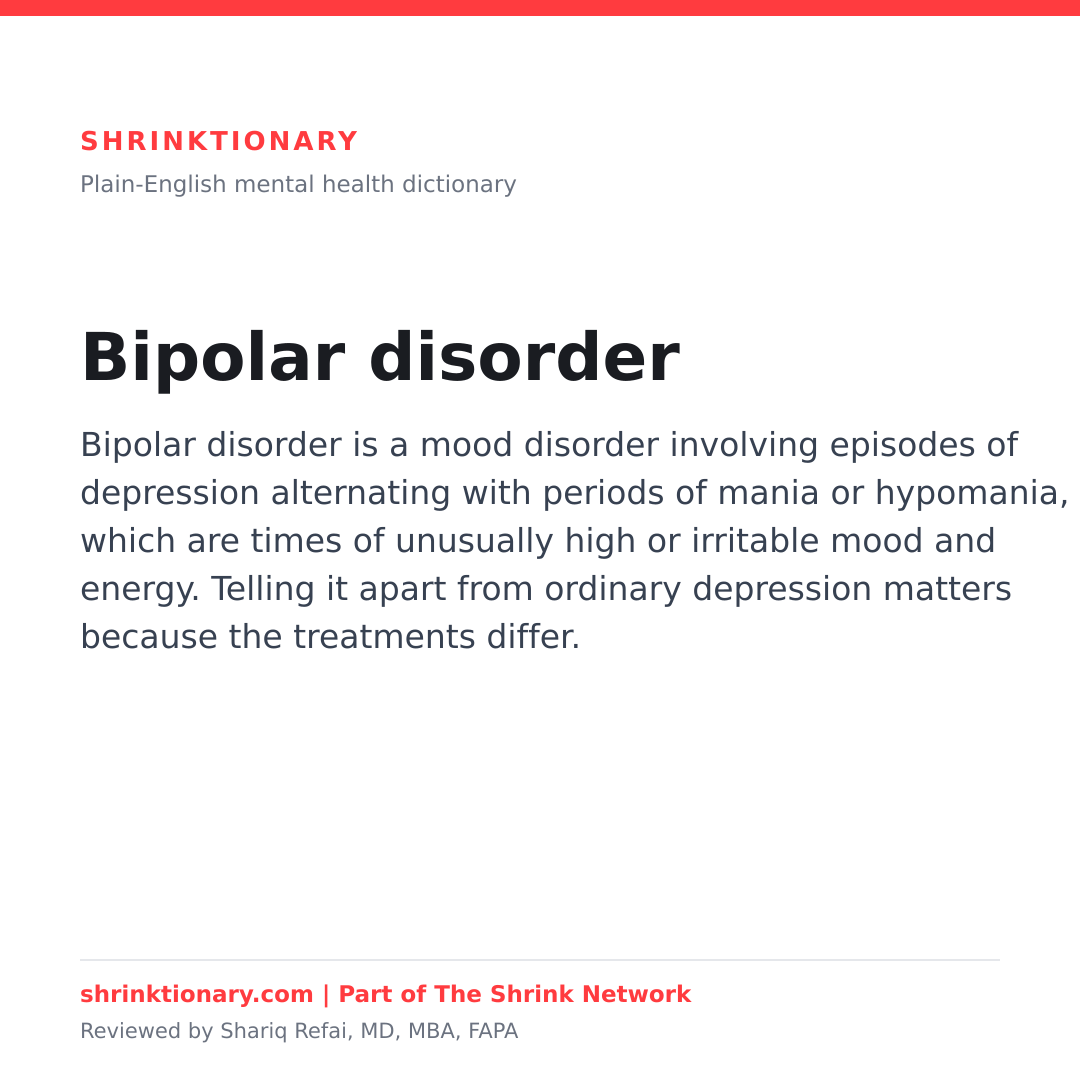
Bipolar disorder is a mood disorder defined by shifts between two kinds of episodes. On one side are depressive episodes, with low mood, loss of interest, low energy, and the other features of depression. On the other side are periods of mania or hypomania, where mood and energy run unusually high or irritable.
During a manic episode, a person may feel euphoric or on top of the world, need far less sleep, talk rapidly, have racing thoughts, and act on impulse in ways that are out of character, such as overspending or taking risks. Mania is severe enough to disrupt life and sometimes requires hospitalization, while hypomania is a milder version that’s noticeable but less impairing. By clinical definition, a manic episode lasts at least a week, and a hypomanic episode at least four days.
The pattern of episodes varies. Some people have long stretches of stable mood between episodes, while others cycle more frequently. The distinction between mania and hypomania is part of how clinicians separate the different forms of bipolar disorder.
What bipolar disorder can feel like
During depressive episodes, the experience can mirror clinical depression, with heaviness, hopelessness, and difficulty doing everyday things. During manic or hypomanic periods, people may feel energized, creative, and unstoppable at first, which is part of why these episodes can be hard to recognize as a problem in the moment.
The shifts can be disorienting for the person and confusing for the people around them. After a manic episode, many feel regret or exhaustion as they take stock of decisions made while their judgment was altered. Sleep is often one of the earliest things to change in either direction.
What bipolar disorder isn’t
Bipolar disorder isn’t ordinary mood swings or simply being moody. The mood changes are distinct episodes that last days to weeks and represent a clear shift from someone’s usual functioning.
It also isn’t the same as major depressive disorder, even though the depressive episodes can look identical. The presence of mania or hypomania is what sets bipolar disorder apart, and that difference matters a great deal for treatment. Some medications used for unipolar depression can be problematic in bipolar disorder, which is why an accurate diagnosis is so important.
Related terms you’ll see next
Depression describes the low-mood side of bipolar disorder. Major depressive disorder is the unipolar condition that bipolar disorder must be distinguished from. Insomnia and changes in sleep are often early signs of an episode. Dopamine is one of the brain chemicals studied in mood regulation.
When to seek professional care
If you’ve noticed periods of unusually high energy, reduced need for sleep, and impulsive behavior, especially alongside episodes of depression, an evaluation is worthwhile. A clinician can sort out whether the pattern fits bipolar disorder, which guides treatment in an important way. Bipolar disorder is manageable with care. If you’re having thoughts of suicide or self-harm, seek help right away. If you’re in crisis, call or text 988 in the United States.
When evaluation may help
Not everyone reading about bipolar disorder needs treatment. If it's getting in the way of your day, your sleep, your work, or your relationships, or if it isn't easing on its own, a professional evaluation is a reasonable next step. Most people start with their primary care doctor or a therapist. A psychiatrist is the right call when medication may be involved or the picture is complicated, though waits can be long.
We keep an honest, no-commission rundown of the options, from primary care to telepsychiatry to crisis lines, on one page.
If you're in crisis or thinking about suicide, call or text 988 in the US, or go to the nearest emergency room.
When this word matters
It becomes clinically meaningful when mood swings into distinct episodes of mania or hypomania, not just everyday ups and downs, since that pattern changes treatment and rules out plain depression. It's most relevant when sorting bipolar from major depression, ADHD, or borderline personality disorder.
Commonly confused with
Frequently asked questions
What's the difference between bipolar disorder and depression?
Depressive episodes can look identical in both, but bipolar disorder also involves periods of mania or hypomania, times of unusually high or irritable mood and energy. That difference matters a great deal, because some medications used for ordinary depression can be problematic in bipolar disorder.
What's the difference between mania and hypomania?
Mania is severe enough to disrupt life and sometimes requires hospitalization, and by clinical definition lasts at least a week. Hypomania is a milder version that's noticeable but less impairing and lasts at least four days.
Can bipolar disorder be managed?
Yes. Bipolar disorder is manageable with care. An accurate diagnosis is important because it guides treatment in a meaningful way.
Related terms
In these language clusters
Compare
Sources
- Bipolar Disorder , National Institute of Mental Health
- Bipolar Disorder , MedlinePlus
- Diagnostic and Statistical Manual of Mental Disorders, Fifth Edition, Text Revision (DSM-5-TR) , American Psychiatric Association
Use or cite this definition
Free to reuse with attribution. Paste the block into your own page, or grab a citation.
Embed on your site
<blockquote>
<p><strong>Bipolar disorder:</strong> Bipolar disorder is a mood disorder involving episodes of depression alternating with periods of mania or hypomania, which are times of unusually high or irritable mood and energy. Telling it apart from ordinary depression matters because the treatments differ.</p>
<p>— <a href="https://shrinktionary.com/terms/bipolar-disorder/">Shrinktionary</a>, a plain-English mental health dictionary, medically reviewed by a board certified psychiatrist.</p>
</blockquote>Cite (APA)
Refai, S. (2026). Bipolar disorder. Shrinktionary. https://shrinktionary.com/terms/bipolar-disorder/
Cite (MLA)
"Bipolar disorder." Shrinktionary, https://shrinktionary.com/terms/bipolar-disorder/. Accessed September 29, 2026.
Your next step in The Shrink Network
You are here: Shrinktionary, the language layer of The Shrink Network.
Each site in the network has one job. No matter where you enter, we help you find the next step that makes sense.
Want to understand more first?
See how this connects to everything else in the Term Web →
Take it with you
Free printable references you can save or share. For education, not medical advice.