What insomnia actually is
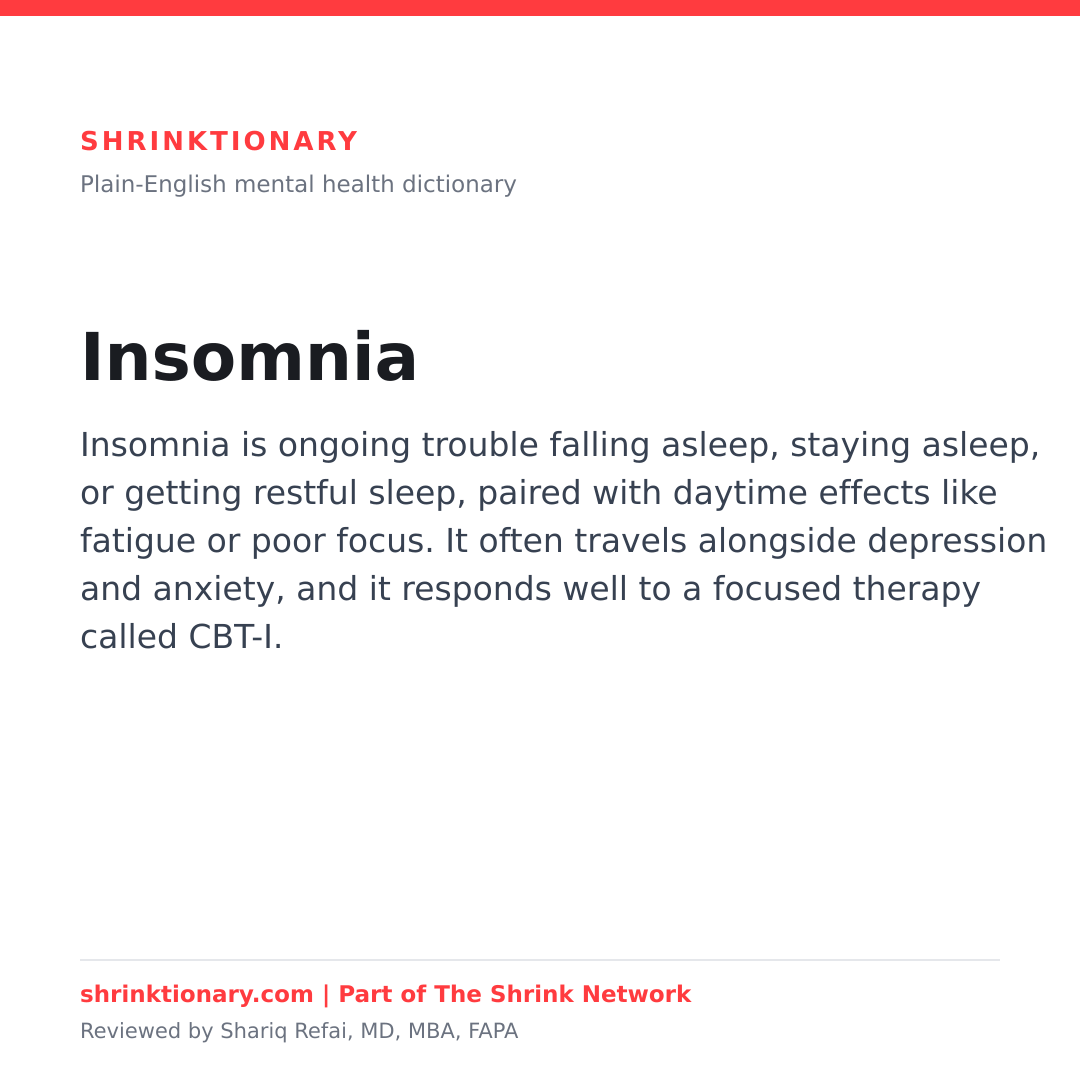
Insomnia is ongoing difficulty with sleep despite having the chance to sleep. That can mean trouble falling asleep, waking up through the night, waking too early, or sleep that just doesn’t feel restful. The key piece is that it spills into the daytime, showing up as fatigue, low mood, irritability, or trouble concentrating.
Clinicians often separate short-term insomnia, which lasts days to a few weeks and usually has a clear trigger, from chronic insomnia, which happens at least three nights a week for three months or more. Chronic insomnia can take on a life of its own, where the worry about not sleeping becomes part of what keeps a person awake.
Insomnia and mental health are tightly linked. It frequently overlaps with depression and anxiety, sometimes as a symptom, sometimes as a contributor, often as both at once.
What insomnia can feel like
Many people describe lying in bed with a tired body and a wired mind. Thoughts loop. The clock becomes the enemy. The harder they try to sleep, the more sleep slips away, which is one of the cruel ironies of insomnia.
Daytime can feel just as rough. People report dragging through tasks, foggy thinking, short tempers, and a creeping dread as bedtime approaches. Over time, the bed itself can start to feel like a place of frustration rather than rest.
What insomnia isn’t
Insomnia isn’t simply staying up late or choosing to skip sleep. It’s the experience of wanting and trying to sleep but not being able to. That distinction matters, because insomnia is about the gap between opportunity and ability.
It also isn’t a sign of weakness or something a person can just push through with willpower. And it isn’t only solved by sleeping pills. The most effective long-term treatment is a structured therapy called CBT-I, which changes the thoughts and habits that keep insomnia going.
Related terms you’ll see next
When to seek professional care
It’s worth talking to a professional when sleep problems happen several nights a week, stick around for weeks or more, and affect how you feel or function during the day. It’s also worth attention when insomnia comes with low mood, anxiety, or thoughts that won’t quiet down, since treating those together tends to work best.
Cognitive behavioral therapy for insomnia, known as CBT-I, is considered a first-line treatment and often works better over time than medication alone. A clinician can help sort out the causes and build a plan. If sleeplessness comes with thoughts of self-harm, reach out right away. If you’re in crisis, call or text 988 in the United States.
When this word matters
Sleep trouble crosses into insomnia when it happens several nights a week despite the chance to sleep, lasts for weeks, and spills into daytime functioning. It's tightly linked with depression and anxiety, and CBT-I is the first-line treatment.
Commonly confused with
Frequently asked questions
What's the difference between short-term and chronic insomnia?
Short-term insomnia lasts days to a few weeks and usually has a clear trigger. Chronic insomnia happens at least three nights a week for three months or more, and the worry about not sleeping can become part of what keeps a person awake.
What is the most effective treatment for insomnia?
Cognitive behavioral therapy for insomnia, known as CBT-I, is considered a first-line treatment and often works better over time than medication alone. It changes the thoughts and habits that keep insomnia going.
Is insomnia just choosing to stay up late?
No. Insomnia is the experience of wanting and trying to sleep but not being able to. It isn't a sign of weakness or something a person can just push through with willpower.
Related terms
Sources
- Insomnia , MedlinePlus
- Mental Health Topics , National Institute of Mental Health
Use or cite this definition
Free to reuse with attribution. Paste the block into your own page, or grab a citation.
Embed on your site
<blockquote>
<p><strong>Insomnia:</strong> Insomnia is ongoing trouble falling asleep, staying asleep, or getting restful sleep, paired with daytime effects like fatigue or poor focus. It often travels alongside depression and anxiety, and it responds well to a focused therapy called CBT-I.</p>
<p>— <a href="https://shrinktionary.com/terms/insomnia/">Shrinktionary</a>, a plain-English mental health dictionary, medically reviewed by a board certified psychiatrist.</p>
</blockquote>Cite (APA)
Refai, S. (2026). Insomnia. Shrinktionary. https://shrinktionary.com/terms/insomnia/
Cite (MLA)
"Insomnia." Shrinktionary, https://shrinktionary.com/terms/insomnia/. Accessed September 29, 2026.
Your next step in The Shrink Network
You are here: Shrinktionary, the language layer of The Shrink Network.
Each site in the network has one job. No matter where you enter, we help you find the next step that makes sense.
Want to understand more first?
See how this connects to everything else in the Term Web →
Take it with you
Free printable references you can save or share. For education, not medical advice.