What antipsychotic actually is
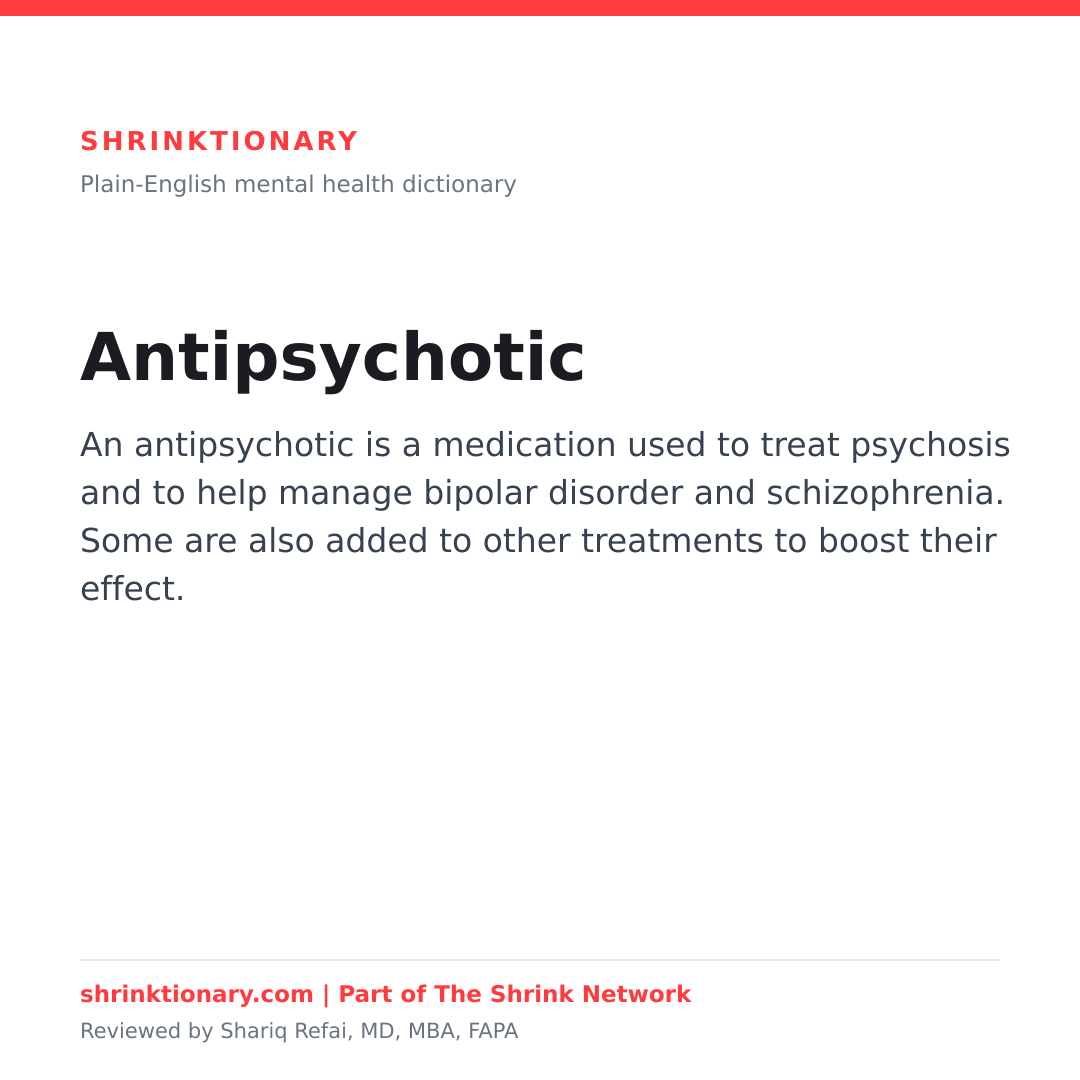
An antipsychotic is a class of medication that helps treat psychosis, the state where a person loses some contact with reality through hallucinations or delusions. These medicines mostly work by adjusting dopamine activity in the brain, and some affect serotonin too. By calming that overactive signaling, they can reduce hallucinations, disordered thinking, and severe agitation.
Antipsychotics treat more than schizophrenia. Prescribers also use them in bipolar disorder, both for manic episodes and sometimes for maintenance, and they’re often added alongside an antidepressant when depression hasn’t responded to treatment on its own. The specific choice depends on the diagnosis, the symptoms, and a person’s health history, and that’s a decision for a prescriber to make.
See it in action: see an antipsychotic at the synapse.
What to expect
Antipsychotics fall into two broad groups. The older ones are called typical or first-generation antipsychotics. The newer ones are called atypical or second-generation antipsychotics, and they’re the more common starting choice today. The two groups differ mostly in their side effect profiles rather than in whether they work.
How quickly someone notices change varies. Agitation and sleep can improve within days, while the fuller effect on hallucinations or mood can take weeks. Side effects matter with this class, so prescribers usually monitor things like weight, blood sugar, and movement over time. People shouldn’t start, switch, or stop an antipsychotic on their own, since stopping suddenly can trigger a return of symptoms. Any change goes through the prescriber.
What antipsychotic isn’t
An antipsychotic isn’t a sedative whose only job is to knock someone out, even though some can cause drowsiness. The point is to treat specific symptoms, not simply to dull a person.
It also isn’t only for schizophrenia, and being prescribed one doesn’t mean a person has lost touch with reality. Many people take a low dose as an add-on for mood conditions. And it isn’t a quick fix. Like most psychiatric medications, it works best as part of a broader plan that can include therapy and regular follow-up.
Related terms you’ll see next
When to seek professional care
Anyone experiencing hallucinations, delusions, severe mood swings, or thoughts that feel out of their control should reach out to a doctor or mental health professional. These are treatable, and earlier help tends to lead to better outcomes. A prescriber can decide whether an antipsychotic fits and can watch for side effects along the way. If a person or someone they love is in immediate danger, call 911, or call or text 988 in the US to reach the Suicide and Crisis Lifeline.
When this word matters
The distinction matters because antipsychotics treat psychosis and bipolar disorder but are also added to other treatments to boost their effect, so the same drug can be used for very different reasons. It also matters for side effects to watch, like akathisia and tardive dyskinesia.
Commonly confused with
Frequently asked questions
Are antipsychotics only for schizophrenia?
No. Prescribers also use antipsychotics in bipolar disorder, both for manic episodes and sometimes for maintenance, and they're often added alongside an antidepressant when depression hasn't responded on its own. Being prescribed one doesn't mean a person has lost touch with reality.
What's the difference between typical and atypical antipsychotics?
Typical or first-generation antipsychotics are the older ones, while atypical or second-generation antipsychotics are newer and the more common starting choice today. The two groups differ mostly in their side effect profiles rather than in whether they work.
Can you stop taking an antipsychotic suddenly?
No. Stopping suddenly can trigger a return of symptoms, so people shouldn't start, switch, or stop on their own. Any change goes through the prescriber, who can also monitor things like weight, blood sugar, and movement.
Related terms
In these language clusters
Sources
- Mental Health Medications , National Institute of Mental Health
Use or cite this definition
Free to reuse with attribution. Paste the block into your own page, or grab a citation.
Embed on your site
<blockquote>
<p><strong>Antipsychotic:</strong> An antipsychotic is a medication used to treat psychosis and to help manage bipolar disorder and schizophrenia. Some are also added to other treatments to boost their effect.</p>
<p>— <a href="https://shrinktionary.com/terms/antipsychotic/">Shrinktionary</a>, a plain-English mental health dictionary, medically reviewed by a board certified psychiatrist.</p>
</blockquote>Cite (APA)
Refai, S. (2026). Antipsychotic. Shrinktionary. https://shrinktionary.com/terms/antipsychotic/
Cite (MLA)
"Antipsychotic." Shrinktionary, https://shrinktionary.com/terms/antipsychotic/. Accessed September 29, 2026.
Your next step in The Shrink Network
You are here: Shrinktionary, the language layer of The Shrink Network.
Each site in the network has one job. No matter where you enter, we help you find the next step that makes sense.
Want to understand more first?
See how this connects to everything else in the Term Web →
Take it with you
Free printable references you can save or share. For education, not medical advice.