What schizophrenia actually is
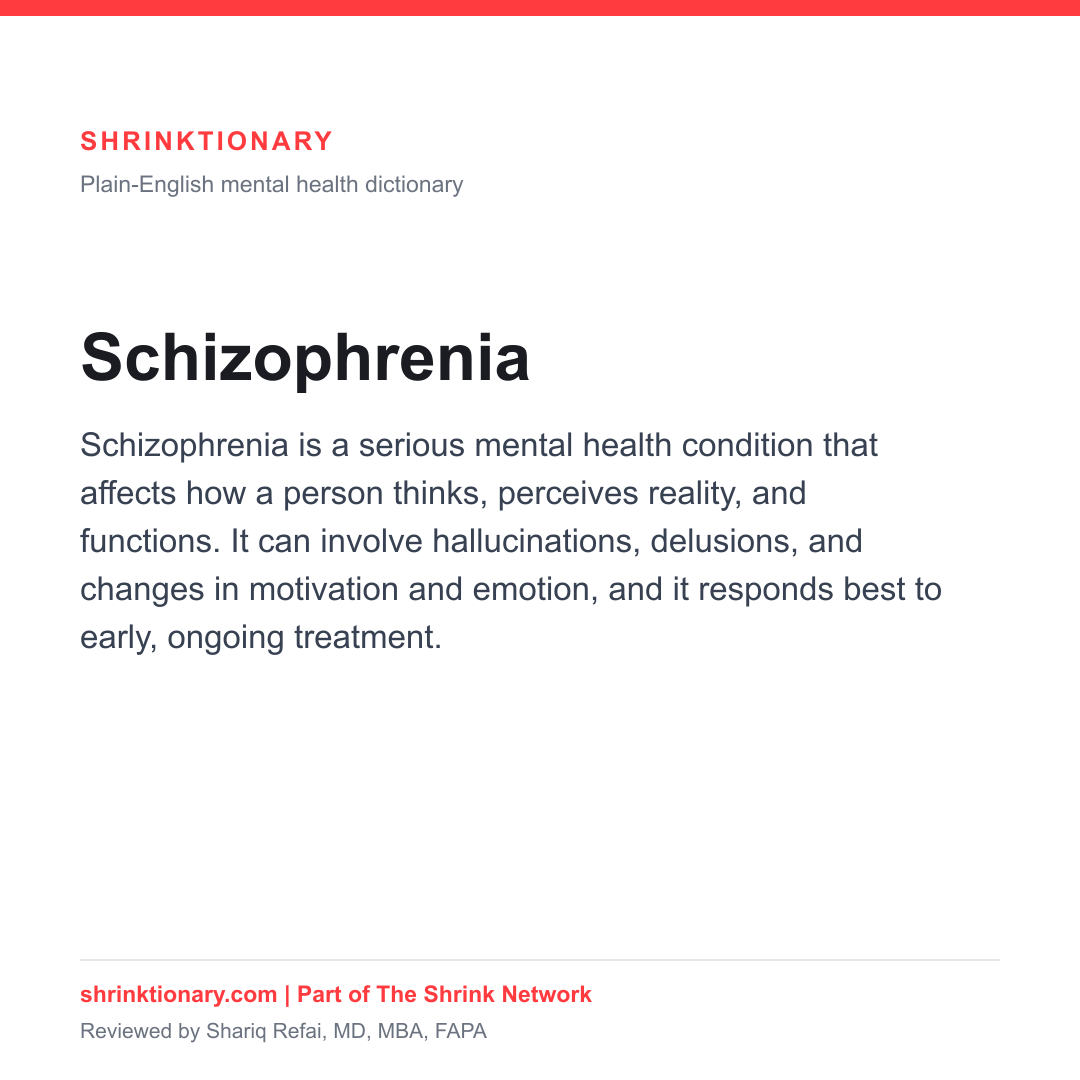
Schizophrenia is a serious mental health condition that affects how a person thinks, perceives the world, and relates to reality. It sits on what clinicians call the psychosis spectrum, a group of conditions where the line between what’s real and what isn’t can blur.
Doctors often group its symptoms into two types. Positive symptoms are experiences added to a person’s reality, like hallucinations (hearing or seeing things others don’t) and delusions (firmly held beliefs that aren’t true). Negative symptoms are things that get taken away, like motivation, emotional expression, or the drive to connect with others. Thinking and memory can also be affected.
Schizophrenia usually emerges in the late teens to early thirties. It’s a treatable condition, and early treatment makes a real difference in long-term outcomes.
What schizophrenia can feel like
During psychosis, the experiences feel completely real to the person having them. A voice that no one else hears is as convincing as any other sound. A belief that doesn’t match reality can feel certain and obvious from the inside, which is part of why insight can be so hard in the moment.
Outside of acute episodes, many people describe the negative symptoms as the harder part to live with. Flat motivation, social withdrawal, and a sense of emotional distance can quietly shrink a person’s world even when the dramatic symptoms have eased.
What schizophrenia isn’t
Schizophrenia isn’t a “split personality.” That’s a common mix-up with a different condition. The word refers to a split from reality, not multiple identities.
It also isn’t a sign that someone is dangerous. Most people with schizophrenia are not violent and are far more likely to be victims of harm than to cause it. And it isn’t caused by personal weakness or bad parenting. It’s a brain-based illness shaped by genetics and other biological factors.
Related terms you’ll see next
When to seek professional care
Schizophrenia needs professional care, and the timing matters. The earlier treatment begins after symptoms appear, the better the long-term outlook tends to be. Warning signs can include new or worsening suspiciousness, hearing or seeing things others don’t, disorganized thinking, or a sharp pullback from friends, school, or work.
If you or someone you care about is having these experiences, reaching out to a psychiatrist or doctor is an important step. If there are thoughts of suicide or self-harm, this is an emergency. If you’re in crisis, call or text 988 in the United States.
When evaluation may help
Not everyone reading about schizophrenia needs treatment. If it's getting in the way of your day, your sleep, your work, or your relationships, or if it isn't easing on its own, a professional evaluation is a reasonable next step. Most people start with their primary care doctor or a therapist. A psychiatrist is the right call when medication may be involved or the picture is complicated, though waits can be long.
We keep an honest, no-commission rundown of the options, from primary care to telepsychiatry to crisis lines, on one page.
If you're in crisis or thinking about suicide, call or text 988 in the US, or go to the nearest emergency room.
When this word matters
It's a serious condition affecting thought, perception, and functioning, and it responds best to early, ongoing treatment, so recognizing the difference between it and similar conditions guides care. People often confuse it with split or multiple personalities, which it is not.
Commonly confused with
Frequently asked questions
Does schizophrenia mean having a split personality?
No. That's a common mix-up with a different condition. The word refers to a split from reality, not multiple identities.
Are people with schizophrenia dangerous?
Most people with schizophrenia are not violent and are far more likely to be victims of harm than to cause it. It's a brain-based illness shaped by genetics and other biological factors, not personal weakness.
Is schizophrenia treatable?
Yes, it's a treatable condition, and the earlier treatment begins after symptoms appear, the better the long-term outlook tends to be. Warning signs can include new suspiciousness, hearing or seeing things others don't, disorganized thinking, or a sharp pullback from friends, school, or work.
Related terms
Compare
Sources
- Schizophrenia , National Institute of Mental Health
- Schizophrenia , MedlinePlus
- Diagnostic and Statistical Manual of Mental Disorders, Fifth Edition, Text Revision (DSM-5-TR) , American Psychiatric Association
Use or cite this definition
Free to reuse with attribution. Paste the block into your own page, or grab a citation.
Embed on your site
<blockquote>
<p><strong>Schizophrenia:</strong> Schizophrenia is a serious mental health condition that affects how a person thinks, perceives reality, and functions. It can involve hallucinations, delusions, and changes in motivation and emotion, and it responds best to early, ongoing treatment.</p>
<p>— <a href="https://shrinktionary.com/terms/schizophrenia/">Shrinktionary</a>, a plain-English mental health dictionary, medically reviewed by a board certified psychiatrist.</p>
</blockquote>Cite (APA)
Refai, S. (2026). Schizophrenia. Shrinktionary. https://shrinktionary.com/terms/schizophrenia/
Cite (MLA)
"Schizophrenia." Shrinktionary, https://shrinktionary.com/terms/schizophrenia/. Accessed September 29, 2026.
Your next step in The Shrink Network
You are here: Shrinktionary, the language layer of The Shrink Network.
Each site in the network has one job. No matter where you enter, we help you find the next step that makes sense.
Want to understand more first?
See how this connects to everything else in the Term Web →
Take it with you
Free printable references you can save or share. For education, not medical advice.