What neuroplasticity actually is
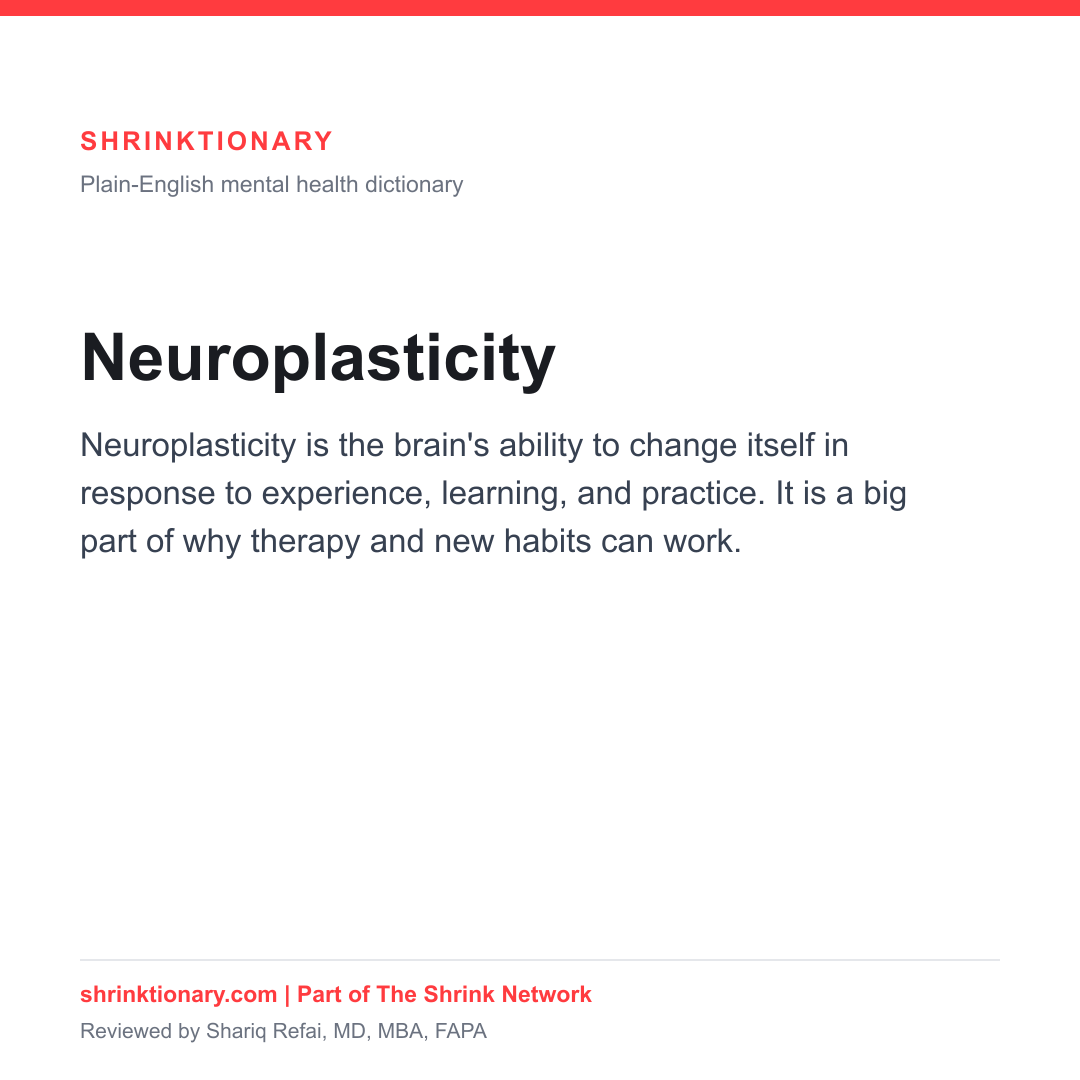
Neuroplasticity is the brain’s ability to reorganize and adapt. The brain is not a fixed piece of hardware. Its cells, called neurons, form connections with each other, and those connections can strengthen, weaken, or rewire based on what a person experiences, learns, and practices.
The word combines “neuro,” meaning related to the nervous system, and “plasticity,” meaning the capacity to be shaped. Put together, it describes a brain that keeps changing throughout life, not just in childhood.
How neuroplasticity works
When you learn something or repeat a behavior, the connections between the neurons involved tend to get stronger. Pathways that get used often become more efficient, a bit like a trail that gets clearer the more it is walked. Connections that go unused tend to fade. This is why practice makes skills feel more automatic over time.
This adaptability is general. It applies to learning a language, recovering some function after a brain injury, and changing patterns of thought and emotion. It is also why unhelpful habits can be stubborn, since they too are reinforced through repetition. The full picture involves many neurons, chemicals, and systems working together, so it is far more complex than a single switch or substance.
What neuroplasticity isn’t
Neuroplasticity is not unlimited or instant. The brain can change, but meaningful change usually takes consistent effort and time, not a single session or a quick trick.
It is also not only for the young. Adults retain real capacity to learn and rewire, even if some changes come more slowly than in childhood. And it does not mean you can think your way out of any condition. Plasticity is a mechanism that supports change, not a guarantee that willpower alone fixes everything.
Related terms you’ll see next
Why it matters for mental health
Neuroplasticity is part of the reason therapy and skill practice can help. When someone practices new ways of thinking in cognitive behavioral therapy, or faces fears gradually in exposure therapy, they are using the brain’s capacity to learn and rewire. This offers real hope. Patterns that feel stuck are not necessarily permanent, and steady practice can help shape healthier ones over time.
If you’re wondering how long that rewiring actually takes, see how long it takes the brain to change on shrinkMD. shrinkMD is part of The Shrink Network, founded by Shariq Refai, MD.
When this word matters
The concept matters when explaining why therapy, practice, and new habits can produce lasting change, since it describes the brain reshaping itself with experience rather than being fixed for life.
Commonly confused with
Frequently asked questions
What is neuroplasticity in simple terms?
It's the brain's ability to reorganize and adapt in response to experience, learning, and practice. The connections between neurons can strengthen, weaken, or rewire, so the brain keeps changing throughout life.
Can adults still rewire their brains?
Yes. Neuroplasticity isn't only for the young, and adults keep real capacity to learn and rewire, even if some changes come more slowly than in childhood.
How does neuroplasticity relate to therapy?
It's part of why therapy and skill practice can help. When someone practices new ways of thinking in CBT or faces fears gradually in exposure therapy, they're using the brain's capacity to learn, though meaningful change usually takes consistent effort over time.
Related terms
Sources
- Brochures and Fact Sheets , National Institute of Mental Health
- Brain Health Information , National Institute of Neurological Disorders and Stroke
Use or cite this definition
Free to reuse with attribution. Paste the block into your own page, or grab a citation.
Embed on your site
<blockquote>
<p><strong>Neuroplasticity:</strong> Neuroplasticity is the brain's ability to change itself in response to experience, learning, and practice. It is a big part of why therapy and new habits can work.</p>
<p>— <a href="https://shrinktionary.com/terms/neuroplasticity/">Shrinktionary</a>, a plain-English mental health dictionary, medically reviewed by a board certified psychiatrist.</p>
</blockquote>Cite (APA)
Refai, S. (2026). Neuroplasticity. Shrinktionary. https://shrinktionary.com/terms/neuroplasticity/
Cite (MLA)
"Neuroplasticity." Shrinktionary, https://shrinktionary.com/terms/neuroplasticity/. Accessed September 29, 2026.
Your next step in The Shrink Network
You are here: Shrinktionary, the language layer of The Shrink Network.
Each site in the network has one job. No matter where you enter, we help you find the next step that makes sense.
Want to understand more first?
See how this connects to everything else in the Term Web →
Take it with you
Free printable references you can save or share. For education, not medical advice.