What stimulant actually is
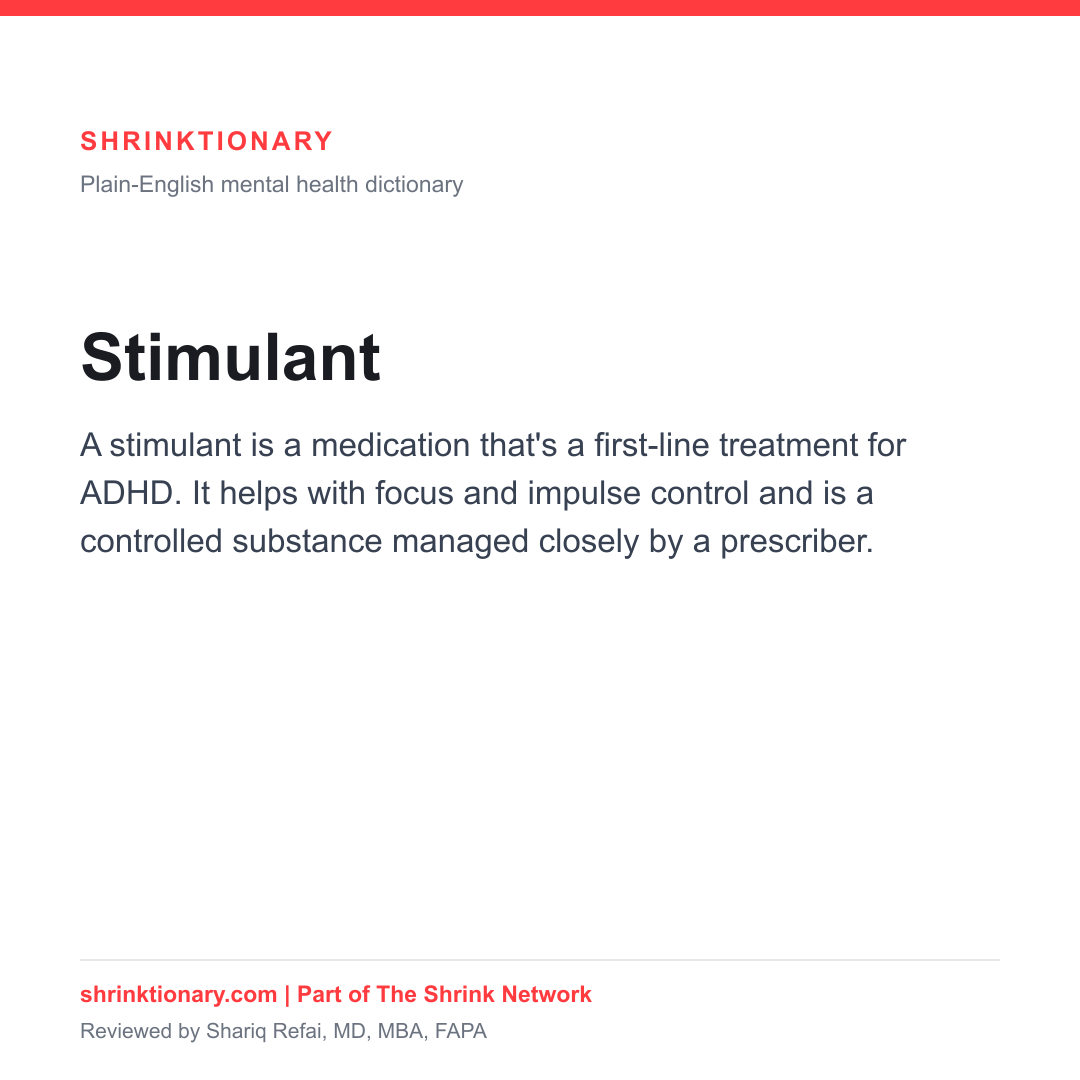
A stimulant is a type of medication that’s the first-line treatment for attention-deficit/hyperactivity disorder. The name sounds backward, since people often assume a stimulant would make someone more revved up. In ADHD, though, these medicines tend to do the opposite. They increase activity of dopamine and norepinephrine in the brain, the chemicals that help with attention and self-control, so a person can focus more steadily and act less impulsively.
Stimulants come in a couple of main families and in short-acting and long-acting forms. They’re controlled substances, which means they’re regulated more tightly than most medications because of their potential for misuse. That’s part of why they’re prescribed and monitored closely. The decision to use one, and how to use it, belongs with a prescriber.
See it in action: see an ADHD stimulant at the synapse.
What to expect
Unlike antidepressants, stimulants often work quickly, sometimes within the first day or two of taking them. People may notice it’s easier to start tasks, stay on track, and sit with their own thoughts without bouncing away. Long-acting versions are built to last most of the day, while short-acting ones wear off faster and may be dosed more than once.
Prescribers usually check in regularly, including on things like sleep, appetite, heart rate, and blood pressure. Because stimulants are controlled, refills and prescriptions tend to involve more oversight than other medicines. People shouldn’t adjust their own dose or stop suddenly without checking in. Any change to start, switch, or stop should go through the prescriber.
What stimulant isn’t
A stimulant isn’t a smart pill that boosts a person beyond their natural ability. In ADHD, it helps bring focus closer to a typical baseline rather than supercharging it.
It also isn’t a guaranteed sign of addiction. When taken as prescribed and monitored, stimulants are an established, evidence-based treatment. Misuse is a real risk, which is exactly why prescribers watch them closely. And medication isn’t the whole picture. Many people do best with stimulants combined with skills, structure, and sometimes therapy.
Related terms you’ll see next
When to seek professional care
Anyone struggling with focus, organization, restlessness, or impulsivity that gets in the way of work, school, or relationships should talk with a doctor or mental health professional. A proper evaluation matters, since other conditions can look like ADHD. A prescriber can decide whether a stimulant fits, choose a form, and handle the monitoring that controlled medications require. Anyone with chest pain, a racing heart, or troubling mood changes on a stimulant should contact their prescriber promptly.
When this word matters
Stimulants are a first-line treatment for ADHD and often work within a day or two, so the distinction matters when weighing them against non-stimulant options. Because they're controlled substances, they're managed closely by a prescriber who watches for effects on sleep, appetite, heart rate, and mood.
Commonly confused with
Frequently asked questions
Why are stimulants used to treat ADHD?
In ADHD, stimulants tend to do the opposite of revving someone up. They increase activity of dopamine and norepinephrine, the chemicals that help with attention and self-control, so a person can focus more steadily and act less impulsively.
How quickly do stimulants work?
Unlike antidepressants, stimulants often work quickly, sometimes within the first day or two. People may notice it's easier to start tasks, stay on track, and sit with their own thoughts without bouncing away.
Are ADHD stimulants addictive?
Stimulants are controlled substances and misuse is a real risk, which is exactly why prescribers monitor them closely. When taken as prescribed and monitored, they're an established, evidence-based treatment rather than a guaranteed sign of addiction.
Related terms
In these language clusters
Sources
- Attention-Deficit/Hyperactivity Disorder (ADHD) , National Institute of Mental Health
- Mental Health Medications , National Institute of Mental Health
Use or cite this definition
Free to reuse with attribution. Paste the block into your own page, or grab a citation.
Embed on your site
<blockquote>
<p><strong>Stimulant:</strong> A stimulant is a medication that's a first-line treatment for ADHD. It helps with focus and impulse control and is a controlled substance managed closely by a prescriber.</p>
<p>— <a href="https://shrinktionary.com/terms/stimulant/">Shrinktionary</a>, a plain-English mental health dictionary, medically reviewed by a board certified psychiatrist.</p>
</blockquote>Cite (APA)
Refai, S. (2026). Stimulant. Shrinktionary. https://shrinktionary.com/terms/stimulant/
Cite (MLA)
"Stimulant." Shrinktionary, https://shrinktionary.com/terms/stimulant/. Accessed September 29, 2026.
Your next step in The Shrink Network
You are here: Shrinktionary, the language layer of The Shrink Network.
Each site in the network has one job. No matter where you enter, we help you find the next step that makes sense.
Want to understand more first?
See how this connects to everything else in the Term Web →
Take it with you
Free printable references you can save or share. For education, not medical advice.