What titration actually is
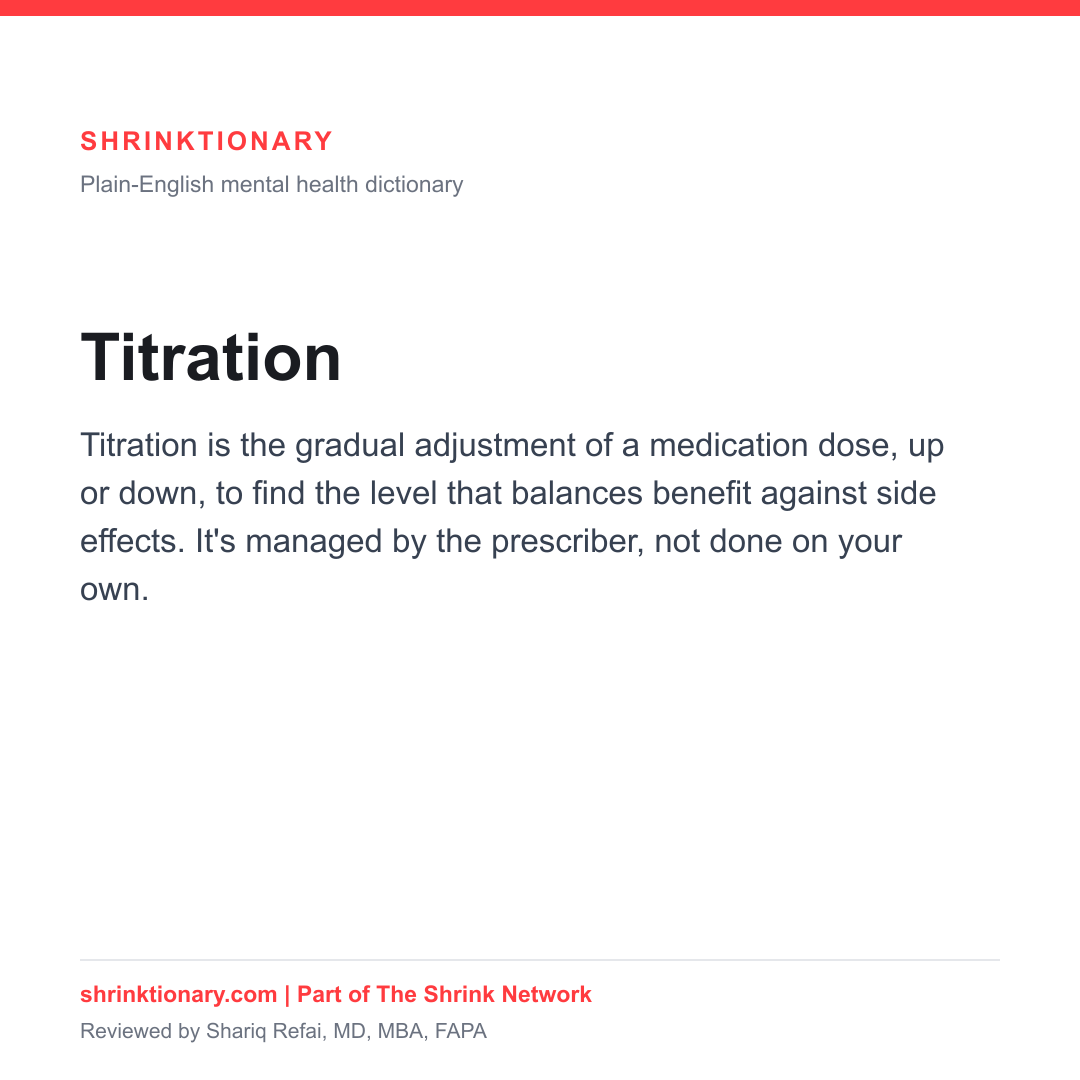
Titration is the process of adjusting a medication dose in steps to reach the right amount for a given person. Instead of starting at a full dose right away, a prescriber often begins low and raises the dose gradually. This is sometimes described as titrating up. When it’s time to stop or reduce a medication, the dose is often lowered in steps too, which is titrating down or tapering.
The aim is to find the dose that gives the most benefit with the fewest side effects. Because people respond differently, the same medication can need very different doses from one person to the next, so titration is a way of dialing in to that individual response.
How titration works in practice
A typical titration starts with a low dose, gives the body time to adjust, and then increases on a schedule the prescriber sets. Going slowly often reduces side effects that are most likely early on, and it lets the prescriber see how a person responds before moving higher. Some medications also need lab checks or symptom monitoring along the way.
Titrating down matters just as much. Stopping certain medications abruptly can cause uncomfortable effects or a return of symptoms, so doses are usually stepped down over time. Throughout, titration is a prescriber-managed process. Changing a dose on your own, raising it, lowering it, or stopping, can cause side effects or other problems, so dose changes should go through the prescriber.
What titration isn’t
Titration isn’t a sign that a medication is dangerous or that something went wrong. Starting low and going slow is a standard, careful way to use many medications, not a red flag.
It also isn’t the same as the medication failing. A dose that’s too low to help yet doesn’t mean the drug won’t work. It often just means titration hasn’t reached the effective level, and a fair trial usually takes time at an adequate dose.
Related terms you’ll see next
Antidepressants are a common example of medications that are titrated. SSRIs are frequently started low and increased gradually. Discontinuation syndrome is one reason doses are tapered rather than stopped suddenly.
Where you’ll see it
You’ll encounter titration whenever you start, change, or stop a psychiatric medication. It helps to know your dose schedule, what side effects to watch for, and when the next adjustment is planned. If side effects are hard to tolerate or the medication doesn’t seem to be helping, that’s information for the prescriber rather than a cue to adjust the dose yourself.
Titration is going up in steps. The starting dose usually isn't the dose that will work. It's the dose your body can meet without being knocked over, and the steps that follow give it time to adjust. This is why the first weeks can feel like nothing is happening. Nothing is supposed to be happening yet.
When this word matters
Titration matters because a prescriber often starts a medication low and raises it in steps to find the dose that balances benefit against side effects, and reductions are usually stepped down too. It's managed by the prescriber, not adjusted on your own, since changing doses suddenly can cause problems.
Commonly confused with
Frequently asked questions
What does titrating a medication mean?
Titration is adjusting a medication dose in steps to reach the right amount for a given person. A prescriber often begins low and raises the dose gradually, and lowers it in steps when it's time to stop or reduce.
Why do doctors start medications at a low dose?
Starting low and going slow often reduces side effects that are most likely early on, and it lets the prescriber see how a person responds before moving higher. It's a standard, careful approach, not a sign the medication is dangerous.
Can I adjust my own medication dose?
No. Titration is a prescriber-managed process, and changing a dose on your own by raising it, lowering it, or stopping can cause side effects or other problems. If side effects are hard to tolerate or the medication doesn't seem to help, that's information for the prescriber.
Related terms
In these language clusters
Sources
- Mental Health Medications , National Institute of Mental Health
- Drugs, Herbs and Supplements , MedlinePlus (U.S. National Library of Medicine)
Use or cite this definition
Free to reuse with attribution. Paste the block into your own page, or grab a citation.
Embed on your site
<blockquote>
<p><strong>Titration:</strong> Titration is the gradual adjustment of a medication dose, up or down, to find the level that balances benefit against side effects. It's managed by the prescriber, not done on your own.</p>
<p>— <a href="https://shrinktionary.com/terms/titration/">Shrinktionary</a>, a plain-English mental health dictionary, medically reviewed by a board certified psychiatrist.</p>
</blockquote>Cite (APA)
Refai, S. (2026). Titration. Shrinktionary. https://shrinktionary.com/terms/titration/
Cite (MLA)
"Titration." Shrinktionary, https://shrinktionary.com/terms/titration/. Accessed September 29, 2026.
Your next step in The Shrink Network
You are here: Shrinktionary, the language layer of The Shrink Network.
Each site in the network has one job. No matter where you enter, we help you find the next step that makes sense.
Want to understand more first?
See how this connects to everything else in the Term Web →
Take it with you
Free printable references you can save or share. For education, not medical advice.