What coping actually is
Coping is everything a person does to handle stress, hard emotions, and challenging situations. It’s the mind and body’s toolkit for getting through difficulty, and everyone uses it, often without naming it.
Coping comes in many shapes. Some strategies aim to solve the problem itself, like making a plan or asking for help. Others aim to manage the feelings the problem stirs up, like taking a breath, talking it out, or finding a way to see things differently. Both kinds matter, and which one fits depends on whether the situation is something a person can change.
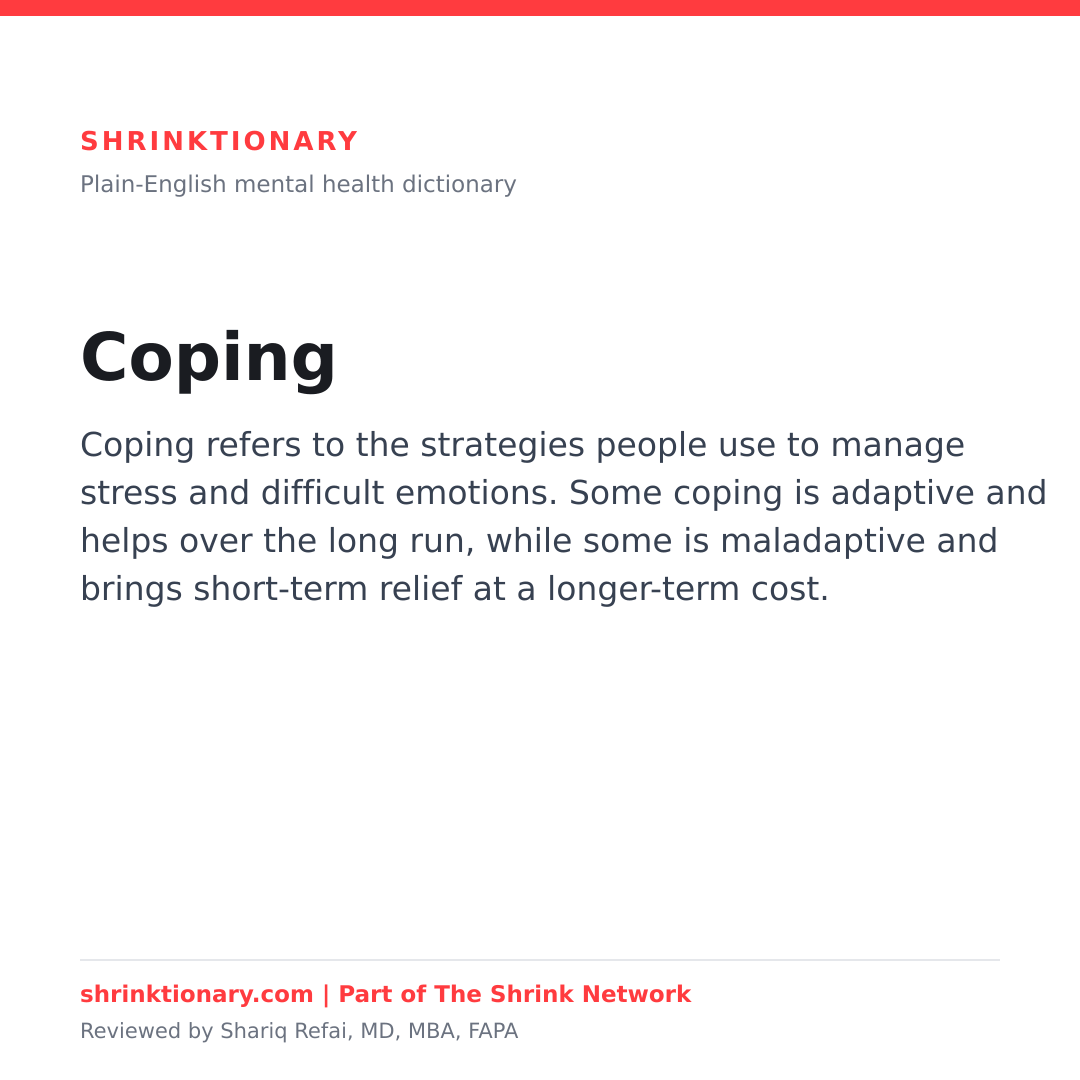
The key distinction people draw is between adaptive and maladaptive coping. Adaptive coping tends to help over time. Maladaptive coping brings relief in the moment but tends to create new problems or keep old ones going.
What coping can look like
Adaptive coping might look like exercising, reaching out to a friend, breaking a big task into smaller steps, getting enough sleep, journaling, or asking for support. These approaches tend to leave a person steadier once the dust settles.
Maladaptive coping might look like drinking or using substances to numb out, avoiding problems until they pile up, overworking, lashing out, or endlessly replaying worries. These can feel like relief in the short term, which is exactly why they’re easy to lean on, but they often deepen stress over time. Most people use a mix of both, and the same strategy can be helpful in one dose and harmful in another.
What coping isn’t
Coping isn’t a fixed trait or a measure of how strong a person is. It’s a set of learnable skills, and people can build healthier ones with practice and support.
Maladaptive coping also isn’t a moral failing. It usually starts as an understandable attempt to feel better, and it makes sense given what a person was facing at the time. The goal isn’t to judge it but to notice when a coping habit is costing more than it’s giving, and to swap it for something that helps more.
Related terms you’ll see next
When to seek professional care
Everyone struggles to cope sometimes. It’s worth reaching out to a professional when stress feels unmanageable, when coping habits like drinking, avoidance, or overworking start causing harm, or when difficult emotions get in the way of daily life. Therapies such as cognitive behavioral therapy and dialectical behavior therapy can help a person build a stronger, healthier set of coping skills. If you’re coping with thoughts of self-harm or suicide, reach out right away. In the United States, you can call or text 988.
When this word matters
It matters when sorting strategies that help over the long run from those that bring short-term relief at a longer-term cost, like avoidance or substance use. The distinction comes up across stress, anxiety, and recovery from most conditions.
Commonly confused with
Frequently asked questions
What is the difference between adaptive and maladaptive coping?
Adaptive coping tends to help over time, like exercising, reaching out to a friend, or breaking a task into steps. Maladaptive coping brings relief in the moment but tends to create new problems or keep old ones going, like drinking to numb out or avoiding problems.
Is maladaptive coping a sign of weakness?
No. It usually starts as an understandable attempt to feel better and makes sense given what a person was facing. Coping is a set of learnable skills, not a fixed trait or a measure of strength.
How can I build better coping skills?
Healthier coping can be learned with practice and support. Therapies such as cognitive behavioral therapy and dialectical behavior therapy can help a person build a stronger set of coping skills.
Related terms
Sources
- Caring for Your Mental Health , National Institute of Mental Health
- Coping With Traumatic Events , National Institute of Mental Health
Use or cite this definition
Free to reuse with attribution. Paste the block into your own page, or grab a citation.
Embed on your site
<blockquote>
<p><strong>Coping:</strong> Coping refers to the strategies people use to manage stress and difficult emotions. Some coping is adaptive and helps over the long run, while some is maladaptive and brings short-term relief at a longer-term cost.</p>
<p>— <a href="https://shrinktionary.com/terms/coping/">Shrinktionary</a>, a plain-English mental health dictionary, medically reviewed by a board certified psychiatrist.</p>
</blockquote>Cite (APA)
Refai, S. (2026). Coping. Shrinktionary. https://shrinktionary.com/terms/coping/
Cite (MLA)
"Coping." Shrinktionary, https://shrinktionary.com/terms/coping/. Accessed September 29, 2026.
Your next step in The Shrink Network
You are here: Shrinktionary, the language layer of The Shrink Network.
Each site in the network has one job. No matter where you enter, we help you find the next step that makes sense.
Want to understand more first?
See how this connects to everything else in the Term Web →
Take it with you
Free printable references you can save or share. For education, not medical advice.