What emotional regulation actually is
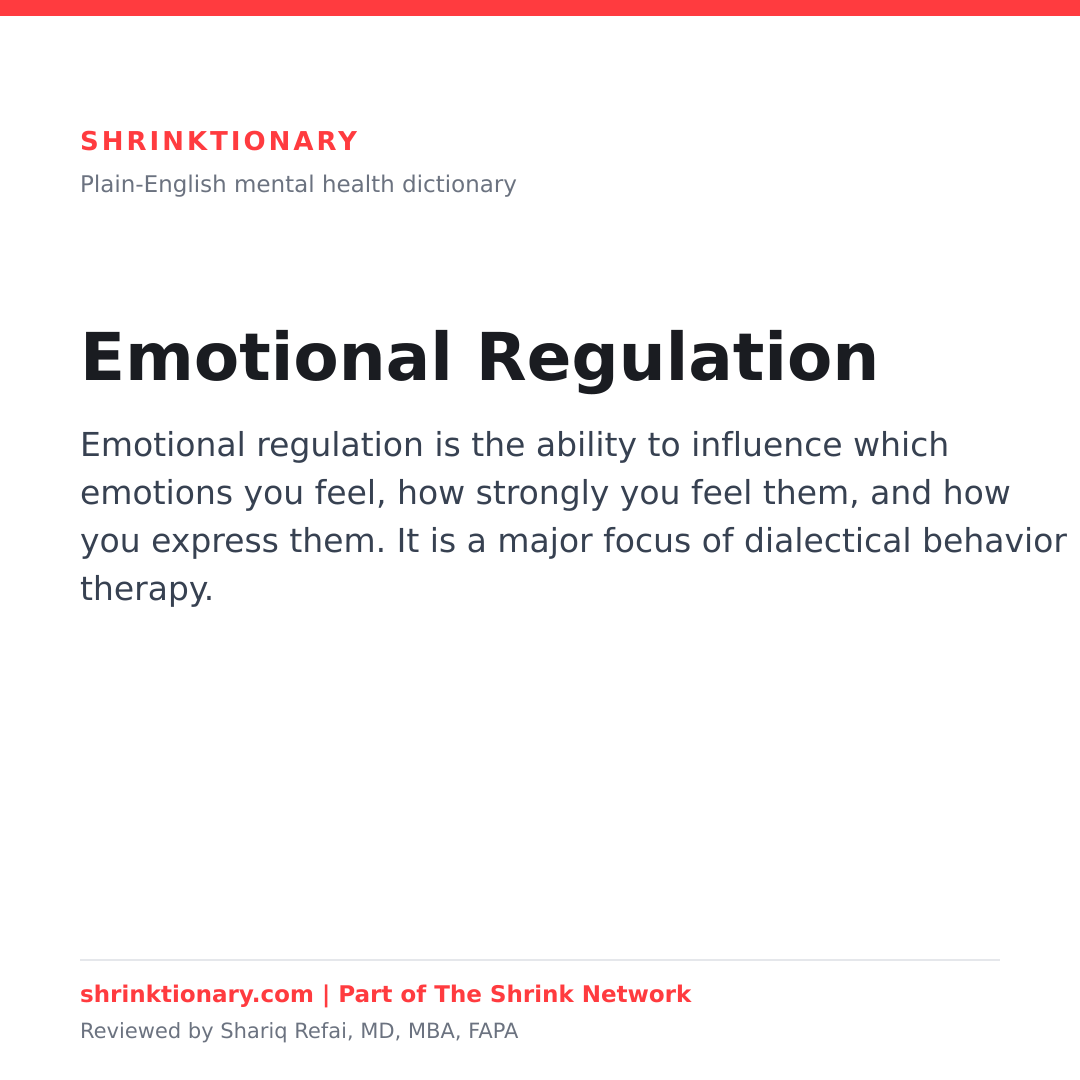
Emotional regulation is the set of skills and habits people use to manage their feelings. It covers which emotions come up, how intense they get, how long they last, and how a person shows them. It does not mean shutting feelings off. It means having some influence over them instead of being completely swept away.
Everyone does this all the time, often without noticing. Taking a breath before responding to a rude email, choosing to step outside when frustration builds, or reminding yourself that a setback is temporary are all forms of emotional regulation. The skill is learnable, and it tends to grow with practice and age.
How emotional regulation works
Emotions start fast, often before conscious thought catches up. The brain’s threat detector, the amygdala, can fire quickly. Regulation involves other regions, including the prefrontal cortex behind the forehead, that help with reflection, perspective, and choosing a response. The interplay between these systems is complex and involves much more than any single brain area or chemical.
People regulate in many ways. Some strategies work well, like reframing a situation, slowing the breath, or reaching out for support. Others bring short-term relief but cause problems later, like avoidance, lashing out, or substance use. A big part of therapy is building more of the helpful strategies and leaning less on the costly ones.
What emotional regulation isn’t
Emotional regulation is not the same as suppressing or hiding emotions. Pushing feelings down tends to backfire and can make them stronger. Good regulation usually means feeling emotions and still being able to act with some intention.
It is also not about being calm all the time or never getting upset. Strong emotions are healthy and useful. And it is not a fixed trait you either have or do not. It is a skill that can be strengthened.
Related terms you’ll see next
Why it matters for mental health
Trouble with emotional regulation shows up across many mental health conditions, from depression to anxiety to borderline personality disorder. That is why dialectical behavior therapy, or DBT, devotes a whole skill module to it. Building these skills can lower the intensity of emotional storms and give a person more steady ground to stand on. The encouraging part is that regulation improves with practice, so progress is genuinely possible.
When this word matters
Emotional regulation matters as a learnable skill and a major focus of dialectical behavior therapy, and difficulty with it shows up across many conditions. It isn't suppressing or hiding feelings, which tends to backfire, and it isn't a fixed trait you either have or don't.
Commonly confused with
Frequently asked questions
Is emotional regulation the same as suppressing your feelings?
No. Pushing feelings down tends to backfire and can make them stronger. Good regulation usually means feeling emotions and still being able to act with some intention.
Can emotional regulation be improved?
Yes. It isn't a fixed trait you either have or don't. It's a learnable skill that tends to grow with practice and age, which is why therapies like DBT teach it directly.
Why does emotional regulation matter for mental health?
Trouble with emotional regulation shows up across many conditions, from depression to anxiety to borderline personality disorder. Building these skills can lower the intensity of emotional storms and give a person steadier ground to stand on.
Related terms
Compare
Sources
- Psychotherapies , National Institute of Mental Health
- Emotion , American Psychological Association
Use or cite this definition
Free to reuse with attribution. Paste the block into your own page, or grab a citation.
Embed on your site
<blockquote>
<p><strong>Emotional Regulation:</strong> Emotional regulation is the ability to influence which emotions you feel, how strongly you feel them, and how you express them. It is a major focus of dialectical behavior therapy.</p>
<p>— <a href="https://shrinktionary.com/terms/emotional-regulation/">Shrinktionary</a>, a plain-English mental health dictionary, medically reviewed by a board certified psychiatrist.</p>
</blockquote>Cite (APA)
Refai, S. (2026). Emotional Regulation. Shrinktionary. https://shrinktionary.com/terms/emotional-regulation/
Cite (MLA)
"Emotional Regulation." Shrinktionary, https://shrinktionary.com/terms/emotional-regulation/. Accessed September 29, 2026.
Your next step in The Shrink Network
You are here: Shrinktionary, the language layer of The Shrink Network.
Each site in the network has one job. No matter where you enter, we help you find the next step that makes sense.
Want to understand more first?
See how this connects to everything else in the Term Web →
Take it with you
Free printable references you can save or share. For education, not medical advice.