What double-blind actually is
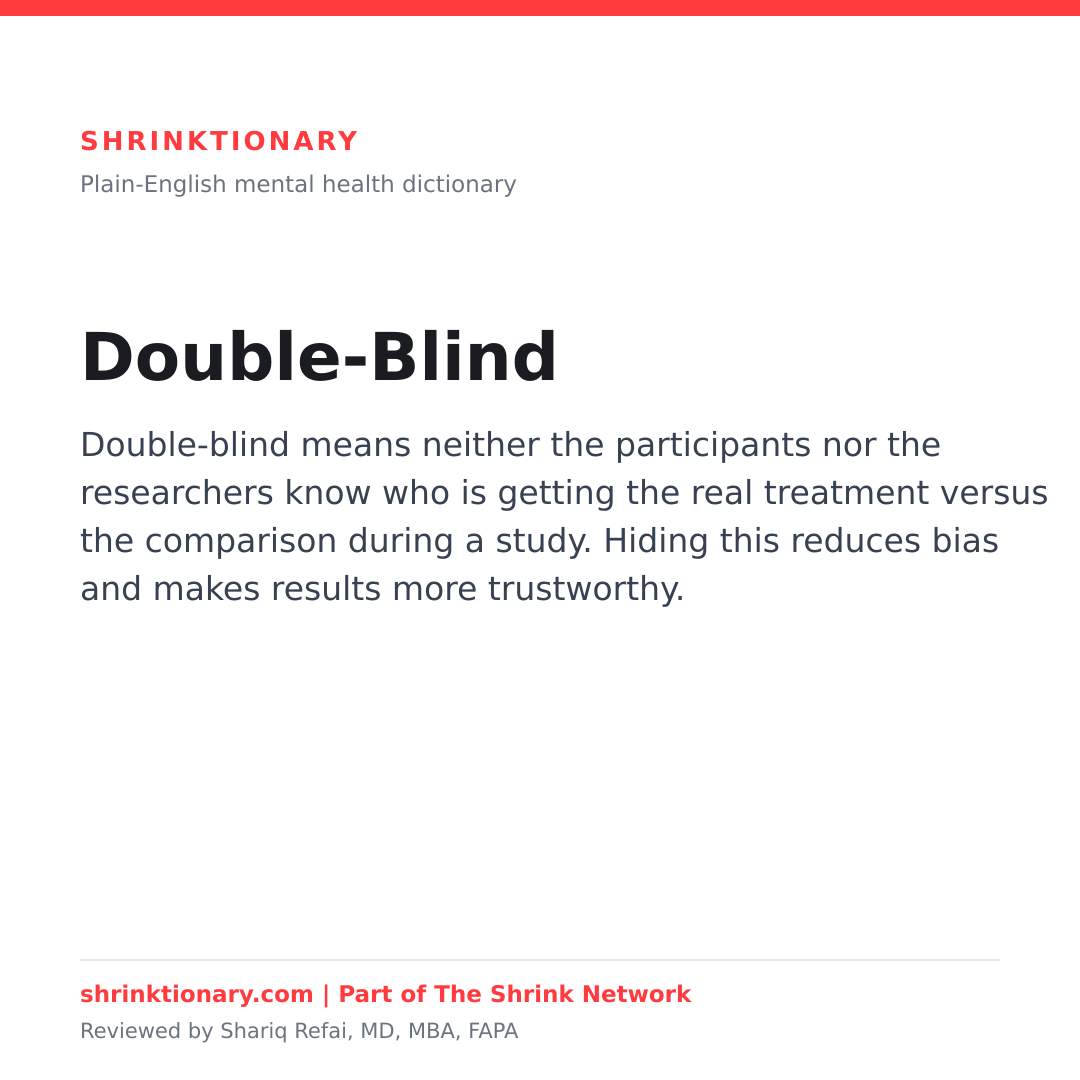
Double-blind describes a study setup where two groups of people are kept in the dark about who is getting what. Participants don’t know whether they’re receiving the real treatment or the comparison, like a placebo. The researchers who interact with them and measure the results don’t know either. A separate system, often a code held by someone not involved in the day to day work, tracks the assignments until the study ends.
The word blind refers to this hidden knowledge. In a single-blind study, only the participants are kept unaware. In a double-blind study, both sides are, which is why it’s considered a stronger design.
Why double-blind matters
The point of blinding is to reduce bias, the small ways that expectations can quietly shape results. If a participant knew they were getting the real drug, they might report feeling better partly because they expected to. If a researcher knew, they might unconsciously look harder for improvement in that group, ask leading questions, or rate symptoms more generously. These effects are rarely deliberate, but they can be large enough to distort findings.
By hiding the assignments from both sides, a double-blind design keeps these influences from favoring one group. That’s why double-blinding is a hallmark of high quality trials, especially for treatments where outcomes are judged in part by how people feel. When you see that a study was double-blind, it’s a sign the researchers took real steps to keep bias out of the results.
What double-blind isn’t
Double-blind isn’t always possible. Some treatments, like surgery or talk therapy, are hard or impossible to disguise, so researchers use other methods to limit bias instead. The absence of blinding doesn’t automatically make a study worthless, but it does mean its results deserve a closer look.
It also isn’t the same as randomization. Randomization decides who goes into each group by chance. Blinding decides who knows about those assignments. Strong trials usually use both, but they’re separate features.
Related terms you’ll see next
Placebo is the inactive comparison that double-blinding helps keep hidden. Randomized controlled trials often combine randomization with double-blinding. Peer review is the expert check a study passes through before it’s published.
How to use this
When weighing a study, check whether it was double-blind. For treatments where the outcome depends on how people feel, double-blinding adds a lot of confidence that the results aren’t just expectation at work. If a study couldn’t be blinded, that’s not a dealbreaker, but it’s worth asking how the researchers handled bias and treating a single unblinded study as a starting point rather than the final word.
When this word matters
Double-blinding matters most for treatments judged by how people feel, where expectations can quietly shape results, which is why it's a hallmark of high-quality trials. It's separate from randomization, and some treatments like surgery or therapy can't be blinded.
Commonly confused with
Frequently asked questions
What is the difference between single-blind and double-blind?
In a single-blind study, only the participants don't know who is getting what. In a double-blind study, both the participants and the researchers measuring results are kept unaware, which is why it's considered a stronger design.
Why does double-blinding matter?
It reduces bias, the small ways expectations can shape results. If participants or researchers knew the assignments, they might report or look for improvement more readily, and double-blinding keeps these influences from favoring one group.
Is a study worthless if it isn't double-blind?
No. Some treatments, like surgery or talk therapy, are hard to disguise, so researchers use other methods to limit bias. The absence of blinding doesn't make a study worthless, but its results deserve a closer look.
Related terms
Sources
- Clinical Trials , National Institute of Mental Health
- Clinical Trials , MedlinePlus (U.S. National Library of Medicine)
Use or cite this definition
Free to reuse with attribution. Paste the block into your own page, or grab a citation.
Embed on your site
<blockquote>
<p><strong>Double-Blind:</strong> Double-blind means neither the participants nor the researchers know who is getting the real treatment versus the comparison during a study. Hiding this reduces bias and makes results more trustworthy.</p>
<p>— <a href="https://shrinktionary.com/terms/double-blind/">Shrinktionary</a>, a plain-English mental health dictionary, medically reviewed by a board certified psychiatrist.</p>
</blockquote>Cite (APA)
Refai, S. (2026). Double-Blind. Shrinktionary. https://shrinktionary.com/terms/double-blind/
Cite (MLA)
"Double-Blind." Shrinktionary, https://shrinktionary.com/terms/double-blind/. Accessed September 29, 2026.
Your next step in The Shrink Network
You are here: Shrinktionary, the language layer of The Shrink Network.
Each site in the network has one job. No matter where you enter, we help you find the next step that makes sense.
Want to understand more first?
See how this connects to everything else in the Term Web →
Take it with you
Free printable references you can save or share. For education, not medical advice.