What peer review actually is
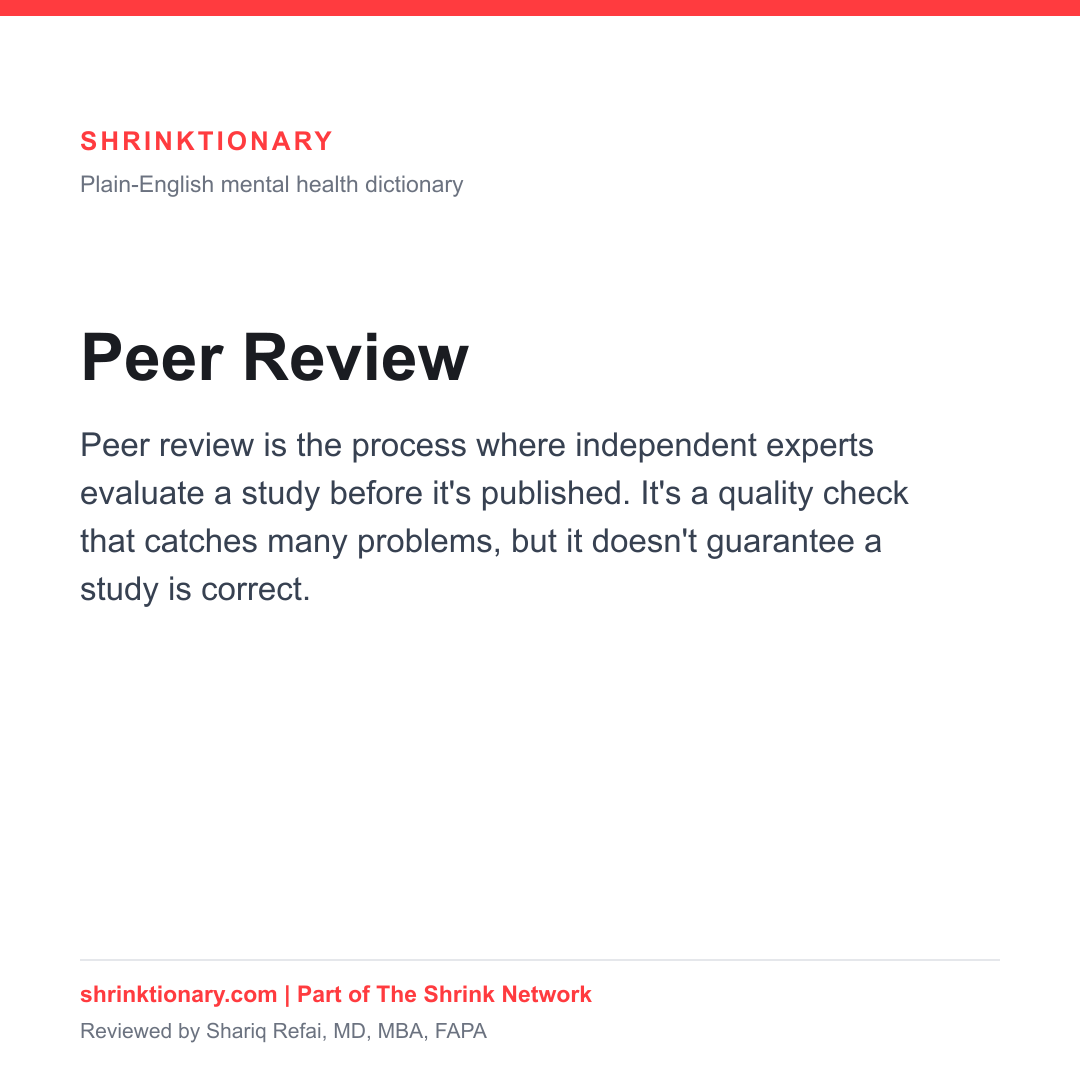
Peer review is the process where a piece of research is evaluated by independent experts in the same field before a journal publishes it. When researchers submit a study, the journal sends it to several reviewers who weren’t involved in the work. They read it closely and judge whether the methods are sound, the analysis holds up, and the conclusions actually follow from the results.
Reviewers can recommend that a study be accepted, revised, or rejected. Often they ask the authors to fix problems, run extra analyses, or temper claims that go beyond the data. Only after the study clears this back and forth does it usually get published. The phrase peer-reviewed signals that a study has been through this kind of expert scrutiny.
Why peer review matters
Peer review acts as a filter. It catches many errors, flags weak methods, and pushes authors to support their claims before the work reaches the public. A study published in a reputable peer-reviewed journal has cleared a bar that a blog post, press release, or preprint hasn’t. That’s a meaningful difference when you’re trying to judge how much to trust a finding.
It also adds a layer of accountability. Because experts who understand the field have examined the work, obvious mistakes and overstated conclusions are less likely to slip through. This is part of why clinicians and researchers lean on peer-reviewed sources when deciding what the evidence really shows.
What peer review isn’t
Peer review isn’t a guarantee that a study is correct. Reviewers usually work from what the authors report and can’t redo the experiments or detect deliberate fraud. Flawed and later disproven studies have passed peer review, and good studies have been wrongly rejected. It raises the average quality of published work, but it doesn’t make any single paper the final truth.
It also isn’t the same as replication or consensus. One peer-reviewed study is a starting point, not a settled conclusion. Confidence grows when multiple independent studies point the same way, not from a single paper clearing review.
Related terms you’ll see next
Randomized controlled trials are a study type whose quality peer reviewers assess. Meta-analyses combine many studies and also go through peer review. Double-blind design is one of the features reviewers look for in a strong trial.
How to use this
When you come across a health claim, check whether it points to peer-reviewed research or just to a single source you can’t verify. Peer review is a reason to take a finding more seriously, but treat it as one signal among several. Look for whether the result has been repeated in other studies, how large and well designed the study was, and whether the conclusions match the actual data rather than the headline.
When this word matters
The distinction matters when judging how much to trust a study, since peer review is a quality check by independent experts before publication but doesn't guarantee the findings are correct or will hold up.
Commonly confused with
Frequently asked questions
What does peer-reviewed mean?
It means a study was evaluated by independent experts in the same field before a journal published it. Those reviewers, who weren't involved in the work, judge whether the methods are sound, the analysis holds up, and the conclusions follow from the results.
Does peer review guarantee a study is correct?
No. Reviewers usually work from what the authors report and can't redo the experiments or detect deliberate fraud, so flawed studies have passed review and good ones have been wrongly rejected. It raises the average quality of published work but doesn't make any single paper the final truth.
Why is peer review important when judging health claims?
It acts as a filter that catches many errors and pushes authors to support their claims, so a study in a reputable peer-reviewed journal has cleared a bar a blog post or press release hasn't. Confidence still grows most when several independent studies point the same way, not from a single paper.
Related terms
Sources
- Understanding Medical Research , MedlinePlus (U.S. National Library of Medicine)
- PubMed , National Library of Medicine
Use or cite this definition
Free to reuse with attribution. Paste the block into your own page, or grab a citation.
Embed on your site
<blockquote>
<p><strong>Peer Review:</strong> Peer review is the process where independent experts evaluate a study before it's published. It's a quality check that catches many problems, but it doesn't guarantee a study is correct.</p>
<p>— <a href="https://shrinktionary.com/terms/peer-review/">Shrinktionary</a>, a plain-English mental health dictionary, medically reviewed by a board certified psychiatrist.</p>
</blockquote>Cite (APA)
Refai, S. (2026). Peer Review. Shrinktionary. https://shrinktionary.com/terms/peer-review/
Cite (MLA)
"Peer Review." Shrinktionary, https://shrinktionary.com/terms/peer-review/. Accessed September 29, 2026.
Your next step in The Shrink Network
You are here: Shrinktionary, the language layer of The Shrink Network.
Each site in the network has one job. No matter where you enter, we help you find the next step that makes sense.
Want to understand more first?
See how this connects to everything else in the Term Web →
Take it with you
Free printable references you can save or share. For education, not medical advice.