What a placebo actually is
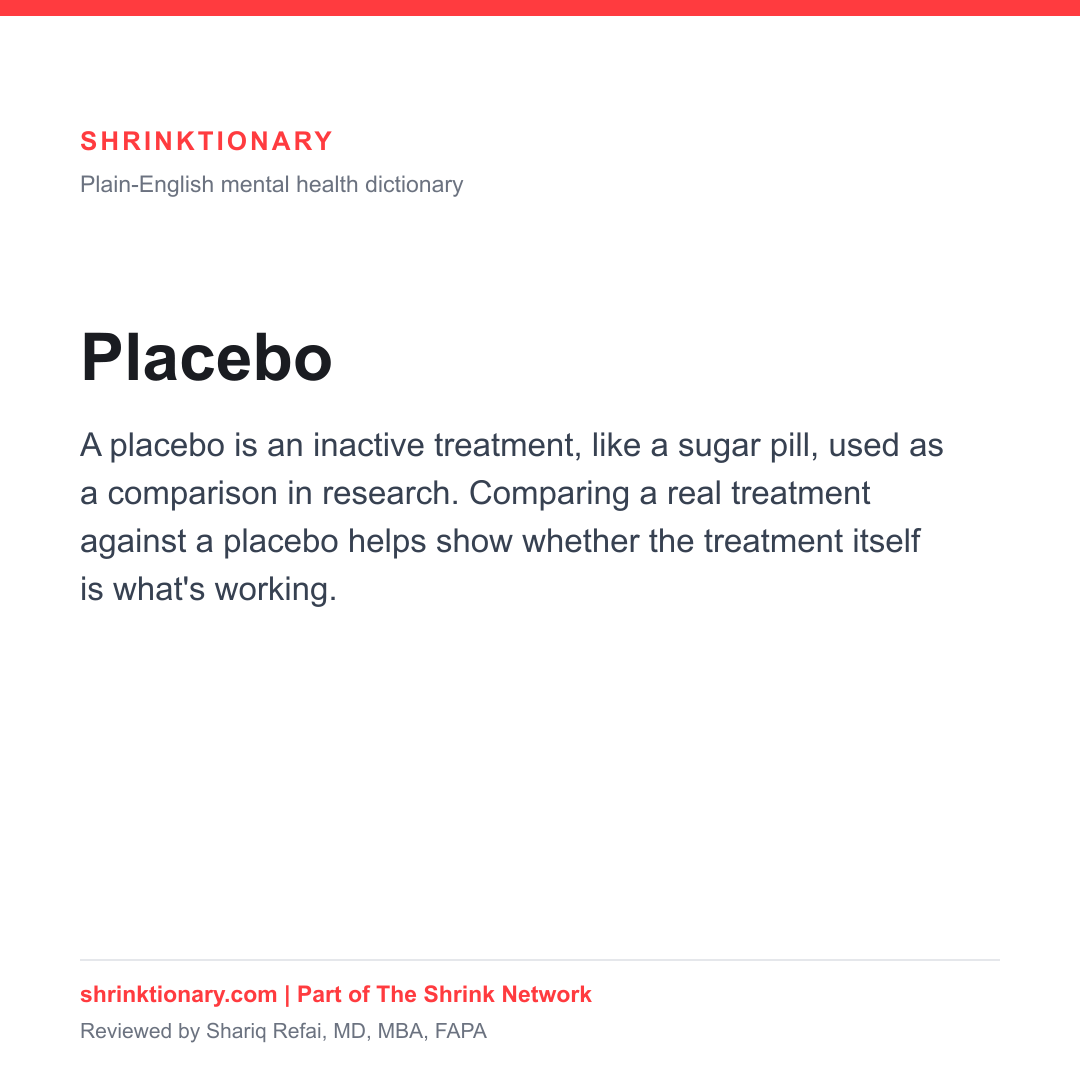
A placebo is a treatment with no active ingredient, made to look just like the real one. In a drug study it might be a pill with no medicine in it. In other studies it can be an inactive injection or a sham procedure. The point is that it looks and feels like the real treatment so participants can’t tell which one they’re getting.
Researchers use placebos as a comparison. One group receives the real treatment and another receives the placebo, and the study looks at whether the two groups end up different. That comparison is what lets researchers separate the effect of the treatment from everything else that can change how people feel.
Why placebos matter
People often improve after getting a placebo, a pattern called the placebo effect. Symptoms can ease simply because someone expects to feel better, gets attention and care, or because the condition would have improved on its own anyway. This is a real, well documented response, and it shows up across many kinds of health conditions.
That’s exactly why a comparison group matters. If a study only gave everyone the real treatment and people improved, there’d be no way to know whether the treatment did the work or whether the improvement would have happened regardless. By measuring how much better the treatment group does compared with the placebo group, researchers can estimate the treatment’s true added benefit. A treatment that beats placebo by a meaningful margin is doing something the placebo isn’t.
What a placebo isn’t
A placebo isn’t a fake result or a trick on participants. People in trials are told they might receive a placebo, and the placebo effect is a genuine response, not imaginary. The improvement people feel is real, even if the pill itself is inactive.
It also isn’t proof that a treatment is useless when results are close. A treatment that barely beats placebo may still help some people. The placebo comparison measures added benefit, but interpreting that benefit takes more than a single number.
Related terms you’ll see next
Double-blind studies hide who gets the placebo from both participants and researchers. Randomized controlled trials use placebo or other comparison groups as a core part of their design. Peer review is the check that happens before such studies are published.
How to use this
When you read about a study, look for whether the treatment was compared against a placebo and by how much it beat it. A result that’s only slightly better than placebo is weaker evidence than one with a clear gap. If a claim about a treatment doesn’t mention any comparison group, that’s a reason to be cautious about how much the treatment itself is really doing.
When this word matters
The distinction matters when reading trial results, since comparing a treatment against a placebo helps show whether the treatment itself is doing the work rather than expectation, attention, or natural improvement.
Commonly confused with
Frequently asked questions
What is a placebo in a clinical trial?
A placebo is a treatment with no active ingredient, made to look just like the real one, such as a pill with no medicine or a sham procedure. Researchers use it as a comparison group so they can separate the treatment's effect from everything else that can change how people feel.
Is the placebo effect real?
Yes, it's a real and well documented response. People can improve after getting a placebo because they expect to feel better, get attention and care, or because the condition would have improved on its own, and the improvement they feel is genuine even though the pill is inactive.
What does it mean when a treatment beats placebo?
It means the treatment group did better than the placebo group, which estimates the treatment's true added benefit. A result only slightly better than placebo is weaker evidence than one with a clear gap, though a treatment that barely beats placebo may still help some people.
Related terms
Sources
- Clinical Trials , National Institute of Mental Health
- Clinical Trials , MedlinePlus (U.S. National Library of Medicine)
Use or cite this definition
Free to reuse with attribution. Paste the block into your own page, or grab a citation.
Embed on your site
<blockquote>
<p><strong>Placebo:</strong> A placebo is an inactive treatment, like a sugar pill, used as a comparison in research. Comparing a real treatment against a placebo helps show whether the treatment itself is what's working.</p>
<p>— <a href="https://shrinktionary.com/terms/placebo/">Shrinktionary</a>, a plain-English mental health dictionary, medically reviewed by a board certified psychiatrist.</p>
</blockquote>Cite (APA)
Refai, S. (2026). Placebo. Shrinktionary. https://shrinktionary.com/terms/placebo/
Cite (MLA)
"Placebo." Shrinktionary, https://shrinktionary.com/terms/placebo/. Accessed September 29, 2026.
Your next step in The Shrink Network
You are here: Shrinktionary, the language layer of The Shrink Network.
Each site in the network has one job. No matter where you enter, we help you find the next step that makes sense.
Want to understand more first?
See how this connects to everything else in the Term Web →
Take it with you
Free printable references you can save or share. For education, not medical advice.