What seasonal affective disorder actually is
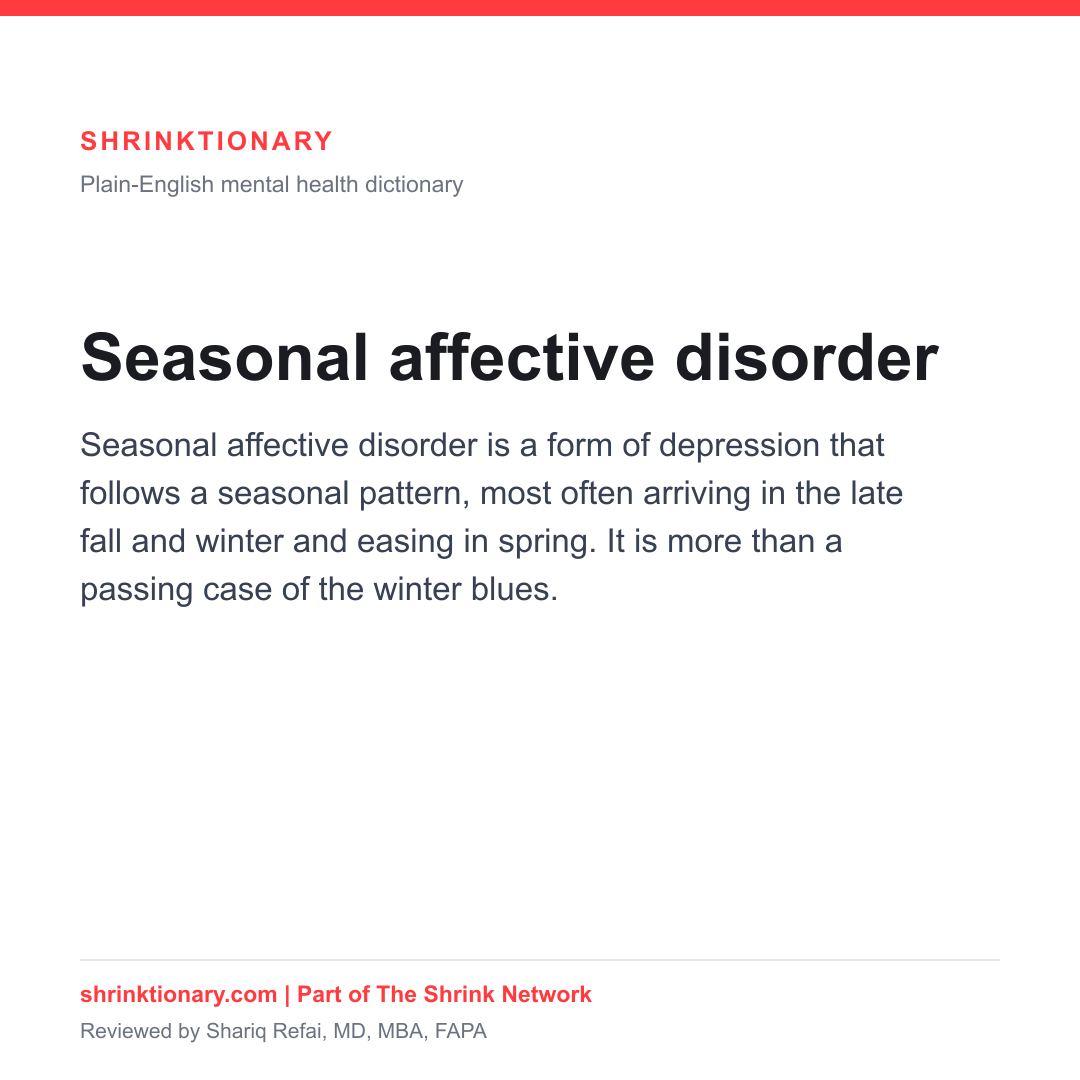
Seasonal affective disorder is a type of depression that comes and goes with the seasons. In clinical terms, it’s a major depressive disorder with a seasonal pattern, meaning the episodes reliably show up at a particular time of year and lift at another. The most common form begins in the late fall or winter and improves in spring and summer.
The symptoms are those of depression, including low mood, loss of interest, and fatigue. The winter pattern often brings some distinctive features, such as sleeping more than usual, craving carbohydrates, gaining weight, and feeling low on energy or sluggish. A less common summer pattern exists too, sometimes with more agitation and trouble sleeping.
Shorter days and reduced sunlight in the darker months are thought to play a role, affecting the body clock and brain chemistry. The key point is that the timing repeats year after year rather than being random.
What seasonal affective disorder can feel like
For many people, it feels like a switch flips as the days grow shorter. Energy drains, getting out of bed gets harder, and activities that felt good in summer lose their appeal. Some describe wanting to hibernate, sleeping long hours and still feeling tired.
The predictability can be its own burden. People who experience it often start to dread the approaching season, knowing what tends to come. Recognizing the pattern, though, can also help, because it makes the condition easier to plan for and treat.
What seasonal affective disorder isn’t
Seasonal affective disorder isn’t just the winter blues or a normal dip in mood when the weather turns. It’s a clinical depression that meaningfully interferes with daily life and follows a clear seasonal rhythm.
It also isn’t simply a matter of needing to toughen up. The seasonal changes affect biological systems, which is why treatments such as light therapy, talk therapy, and medication can make a real difference rather than just waiting it out.
Related terms you’ll see next
Depression is the broader condition this falls under. Major depressive disorder is the diagnosis seasonal pattern attaches to. Anhedonia describes the loss of pleasure that often appears. Behavioral activation is one treatment approach used during low-mood seasons.
When to seek professional care
If your mood, energy, and interest reliably drop with a particular season and the change interferes with your life, an evaluation is worthwhile. A clinician can confirm whether the pattern fits seasonal affective disorder and discuss options such as light therapy, talk therapy, or medication. Help is available, and planning ahead for the hard season can make a real difference. If you’re having thoughts of suicide or self-harm, seek help right away. If you’re in crisis, call or text 988 in the United States.
When evaluation may help
Not everyone reading about seasonal affective disorder needs treatment. If it's getting in the way of your day, your sleep, your work, or your relationships, or if it isn't easing on its own, a professional evaluation is a reasonable next step. Most people start with their primary care doctor or a therapist. A psychiatrist is the right call when medication may be involved or the picture is complicated, though waits can be long.
We keep an honest, no-commission rundown of the options, from primary care to telepsychiatry to crisis lines, on one page.
If you're in crisis or thinking about suicide, call or text 988 in the US, or go to the nearest emergency room.
When this word matters
It crosses from the winter blues into clinically meaningful territory when depression follows a clear seasonal pattern year after year, most often arriving in late fall or winter and easing in spring, and interferes with daily life. It's understood as a seasonal form of major depression rather than a separate mild mood dip.
Commonly confused with
Frequently asked questions
Is seasonal affective disorder just the winter blues?
No. It's a clinical depression that meaningfully interferes with daily life and follows a clear seasonal rhythm, not a normal dip in mood when the weather turns.
What causes seasonal affective disorder?
Shorter days and reduced sunlight in the darker months are thought to play a role, affecting the body clock and brain chemistry. The key feature is that the timing repeats year after year rather than being random.
How is seasonal affective disorder treated?
Treatments such as light therapy, talk therapy, and medication can make a real difference. If your mood, energy, and interest reliably drop with a particular season and interfere with your life, an evaluation is worthwhile.
Related terms
In these language clusters
Sources
- Publications About Seasonal Affective Disorder , National Institute of Mental Health
- Seasonal Affective Disorder , MedlinePlus
- Diagnostic and Statistical Manual of Mental Disorders, Fifth Edition, Text Revision (DSM-5-TR) , American Psychiatric Association
Use or cite this definition
Free to reuse with attribution. Paste the block into your own page, or grab a citation.
Embed on your site
<blockquote>
<p><strong>Seasonal affective disorder:</strong> Seasonal affective disorder is a form of depression that follows a seasonal pattern, most often arriving in the late fall and winter and easing in spring. It is more than a passing case of the winter blues.</p>
<p>— <a href="https://shrinktionary.com/terms/seasonal-affective-disorder/">Shrinktionary</a>, a plain-English mental health dictionary, medically reviewed by a board certified psychiatrist.</p>
</blockquote>Cite (APA)
Refai, S. (2026). Seasonal affective disorder. Shrinktionary. https://shrinktionary.com/terms/seasonal-affective-disorder/
Cite (MLA)
"Seasonal affective disorder." Shrinktionary, https://shrinktionary.com/terms/seasonal-affective-disorder/. Accessed September 29, 2026.
Your next step in The Shrink Network
You are here: Shrinktionary, the language layer of The Shrink Network.
Each site in the network has one job. No matter where you enter, we help you find the next step that makes sense.
Want to understand more first?
See how this connects to everything else in the Term Web →
Take it with you
Free printable references you can save or share. For education, not medical advice.