If you are thinking about suicide, you are not alone and help is available right now. In the United States, you can call or text 988 to reach the Suicide and Crisis Lifeline, any time, day or night. If you or someone else is in immediate danger, call 911.
What suicidal ideation actually is
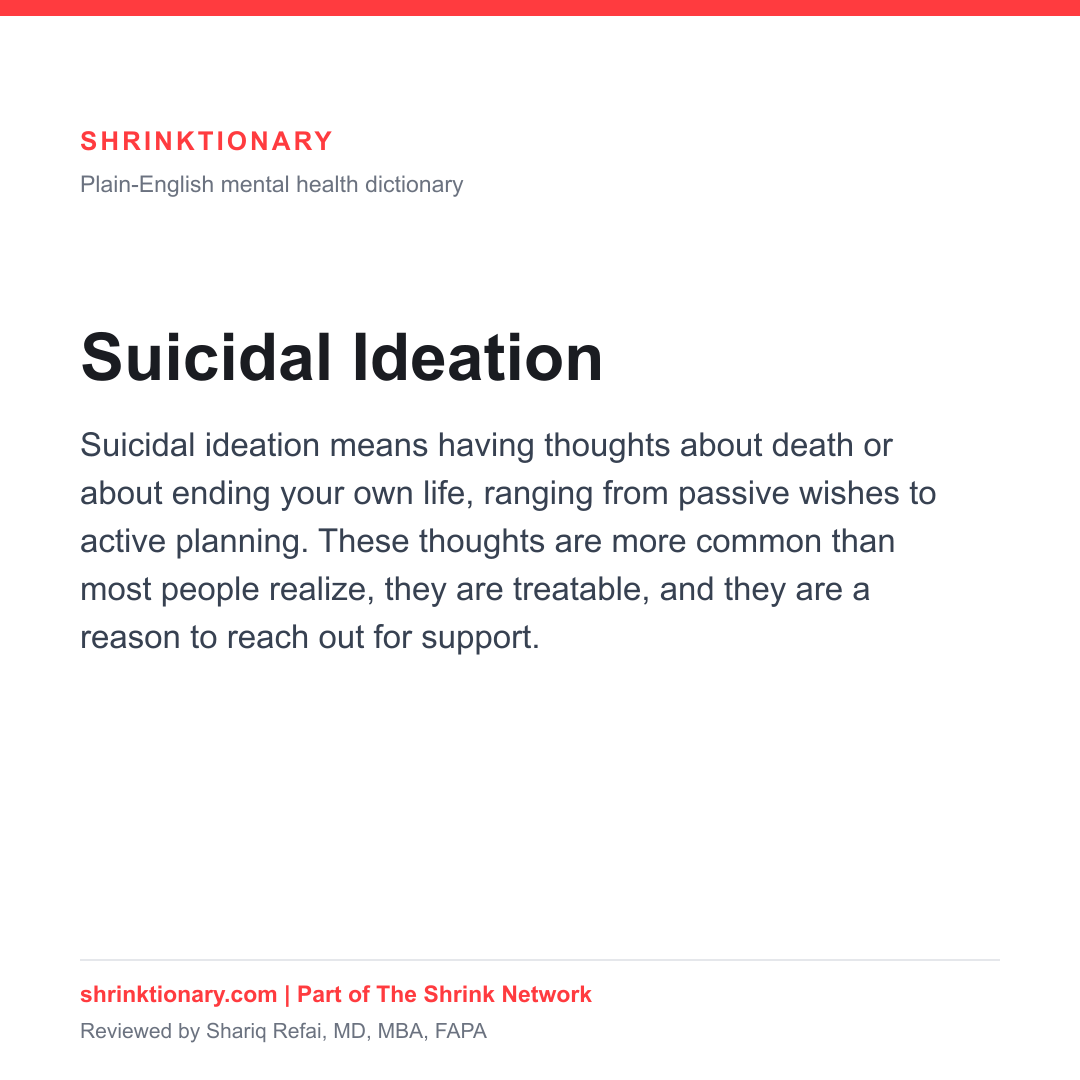
Suicidal ideation is the term clinicians use for thoughts about death or about ending one’s own life. These thoughts cover a wide range. At one end are passive thoughts, like wishing you could fall asleep and not wake up, or feeling that others would be better off without you. At the other end are active thoughts that involve a plan or intent.
These thoughts often show up during periods of deep pain, hopelessness, or exhaustion, and they frequently travel with conditions like depression, bipolar disorder, and PTSD. They can also follow major losses or overwhelming stress. The thoughts are the mind’s distorted way of trying to make unbearable pain stop, not a true reflection of what a person wants.
Crucially, having these thoughts does not mean a person will act on them, and it does not mean they are broken. It means they are suffering and deserve support.
What suicidal ideation can feel like
People describe it in different ways. Some feel a quiet, aching wish to disappear. Others feel trapped, like there is no way out of their pain. Some are frightened by their own thoughts and don’t want to act on them at all. The thoughts can come in waves, feel intrusive, and be accompanied by guilt or shame, which can make people hesitant to tell anyone.
That silence is part of why these thoughts can feel so isolating. Saying them out loud to someone safe, a friend, a clinician, or a crisis counselor, often brings relief and a sense that the pain can be shared and survived.
What suicidal ideation isn’t
Suicidal ideation isn’t a personal failing, a sign of weakness, or something to be ashamed of. It is a symptom of pain that has become overwhelming, and like other symptoms it can be treated.
It also isn’t a guarantee of action, and it isn’t permanent. Many people who have lived through intense suicidal thoughts go on to feel very differently once they get support and the underlying pain eases. Talking about suicide with a caring person does not plant the idea or make things worse. It opens a door to help.
Related terms you’ll see next
When to seek professional care
Any thoughts of suicide are a reason to reach out, even passive ones, and even if part of you isn’t sure you want help. You don’t have to be in crisis to deserve support. In the United States, you can call or text 988 to reach the Suicide and Crisis Lifeline at any time, or call 911 if you or someone else is in immediate danger. A clinician can help treat what’s driving the thoughts, and effective treatments exist. Reaching out is a sign of strength, not failure, and these thoughts are common, treatable, and a reason to connect with someone, not to suffer alone.
When this word matters
Any thoughts of suicide deserve attention now, whether they're passive wishes to not wake up or active thoughts with a plan, and reaching out is a sign of strength, not weakness. In the US you can call or text 988 anytime to talk with someone, and these thoughts are common and treatable.
Commonly confused with
Frequently asked questions
What should I do if I'm having suicidal thoughts?
You are not alone and help is available right now. In the United States, you can call or text 988 to reach the Suicide and Crisis Lifeline any time, day or night, and if you or someone else is in immediate danger, call 911.
Does having suicidal thoughts mean I will act on them?
No. Suicidal ideation isn't a guarantee of action, and it isn't permanent. The thoughts often reflect overwhelming pain rather than what a person truly wants, and many people who have lived through intense suicidal thoughts go on to feel very differently once they get support.
Does talking about suicide make it worse?
No. Talking about suicide with a caring person does not plant the idea or make things worse, and saying the thoughts out loud to someone safe often brings relief. It opens a door to help, and effective treatments exist. In the United States you can call or text 988 any time.
Related terms
In these language clusters
Sources
- 988 Suicide and Crisis Lifeline , 988 Suicide and Crisis Lifeline
- Find Help , National Institute of Mental Health
- Depression , National Institute of Mental Health
Use or cite this definition
Free to reuse with attribution. Paste the block into your own page, or grab a citation.
Embed on your site
<blockquote>
<p><strong>Suicidal Ideation:</strong> Suicidal ideation means having thoughts about death or about ending your own life, ranging from passive wishes to active planning. These thoughts are more common than most people realize, they are treatable, and they are a reason to reach out for support.</p>
<p>— <a href="https://shrinktionary.com/terms/suicidal-ideation/">Shrinktionary</a>, a plain-English mental health dictionary, medically reviewed by a board certified psychiatrist.</p>
</blockquote>Cite (APA)
Refai, S. (2026). Suicidal Ideation. Shrinktionary. https://shrinktionary.com/terms/suicidal-ideation/
Cite (MLA)
"Suicidal Ideation." Shrinktionary, https://shrinktionary.com/terms/suicidal-ideation/. Accessed September 29, 2026.
Your next step in The Shrink Network
You are here: Shrinktionary, the language layer of The Shrink Network.
Each site in the network has one job. No matter where you enter, we help you find the next step that makes sense.
Want to understand more first?
See how this connects to everything else in the Term Web →
Take it with you
Free printable references you can save or share. For education, not medical advice.