What acceptance and commitment therapy actually is
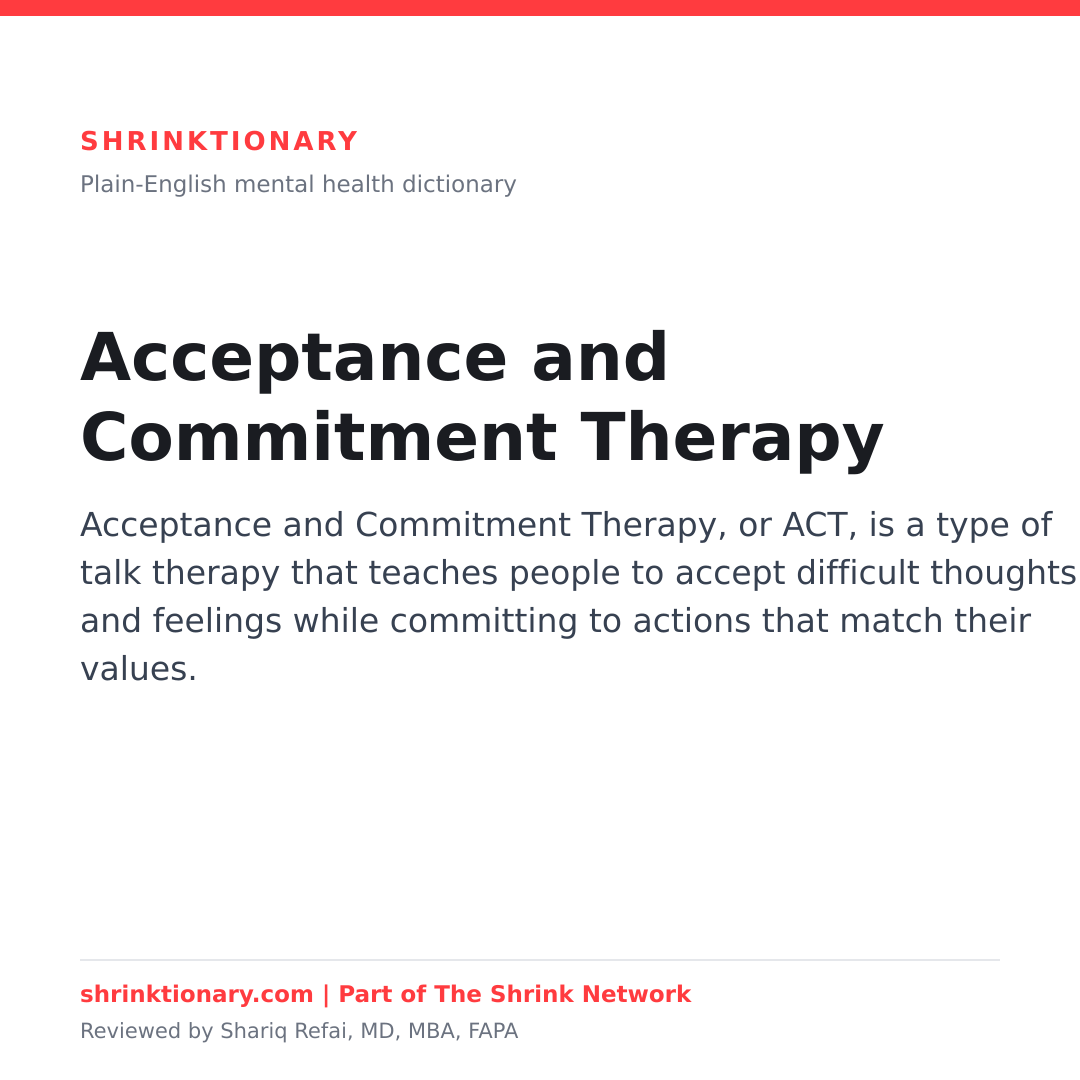
Acceptance and Commitment Therapy, usually shortened to ACT and said as one word, “act,” is a form of talk therapy in the broader cognitive behavioral family. Its core idea is simple but counterintuitive. Instead of fighting painful thoughts and feelings or trying to argue them away, ACT teaches people to make room for them and then keep moving toward what matters to them anyway.
The “acceptance” part is about letting uncomfortable inner experiences be there without being run by them. The “commitment” part is about clarifying personal values and taking real action in line with those values, even when fear or sadness shows up. The aim isn’t to feel good all the time. It’s to live a meaningful life while carrying whatever feelings come along.
What acceptance and commitment therapy looks like in practice
In session, a therapist might help someone notice how much energy goes into avoiding or suppressing anxiety, and how that struggle can shrink a person’s life. From there, they practice skills that loosen the grip of difficult thoughts. One common skill is treating thoughts as passing mental events rather than facts, so “I’m going to fail” becomes “I’m having the thought that I’m going to fail.”
A lot of ACT centers on values. A person figures out what they actually care about, like being a present parent or doing honest work, and then sets concrete steps toward it. Mindfulness exercises show up often, helping people stay in the present moment instead of getting tangled in worry about the future. The work is active and practical, not just talking about problems.
What acceptance and commitment therapy isn’t
ACT isn’t about giving up or resigning yourself to a bad situation. Acceptance here means dropping the pointless struggle against feelings, not accepting harm or staying stuck.
It also isn’t about forcing positive thinking. ACT doesn’t try to swap bad thoughts for cheerful ones. And it isn’t only for one diagnosis. It’s used across anxiety, depression, chronic pain, and more, and it can stand on its own or work alongside other approaches.
Related terms you’ll see next
When to seek professional care
Anyone who feels stuck fighting their own thoughts and feelings, or who notices their life narrowing because of anxiety, low mood, or avoidance, may benefit from working with a trained therapist. ACT is delivered by licensed mental health professionals who can tailor it to a person’s goals. If distress feels overwhelming or a person has thoughts of harming themselves, reach out for help right away by calling or texting 988 in the US to reach the Suicide and Crisis Lifeline.
When this word matters
ACT matters when someone has been fighting hard to control or get rid of painful thoughts and feelings without success, and that struggle itself is keeping them stuck. It's used for anxiety, depression, chronic pain, and many other conditions where acceptance plus values-based action can help.
Commonly confused with
Frequently asked questions
What's the difference between ACT and CBT?
Both belong to the cognitive behavioral family, but they focus on different things. CBT often works to change or reframe unhelpful thoughts, while ACT teaches you to make room for difficult thoughts and feelings and keep acting on your values anyway.
What does ACT actually treat?
ACT is used across many concerns, including anxiety, depression, and chronic pain. It can stand on its own or work alongside other approaches.
Does acceptance in ACT mean giving up?
No. Acceptance here means dropping the pointless struggle against your own feelings, not accepting harm or staying stuck. The commitment part is about taking real action toward what matters to you.
Related terms
In these language clusters
Compare
Sources
- Psychotherapies , National Institute of Mental Health
- What Is Cognitive Behavioral Therapy? , American Psychological Association
Use or cite this definition
Free to reuse with attribution. Paste the block into your own page, or grab a citation.
Embed on your site
<blockquote>
<p><strong>Acceptance and Commitment Therapy:</strong> Acceptance and Commitment Therapy, or ACT, is a type of talk therapy that teaches people to accept difficult thoughts and feelings while committing to actions that match their values.</p>
<p>— <a href="https://shrinktionary.com/terms/acceptance-and-commitment-therapy/">Shrinktionary</a>, a plain-English mental health dictionary, medically reviewed by a board certified psychiatrist.</p>
</blockquote>Cite (APA)
Refai, S. (2026). Acceptance and Commitment Therapy. Shrinktionary. https://shrinktionary.com/terms/acceptance-and-commitment-therapy/
Cite (MLA)
"Acceptance and Commitment Therapy." Shrinktionary, https://shrinktionary.com/terms/acceptance-and-commitment-therapy/. Accessed September 29, 2026.
Your next step in The Shrink Network
You are here: Shrinktionary, the language layer of The Shrink Network.
Each site in the network has one job. No matter where you enter, we help you find the next step that makes sense.
Want to understand more first?
See how this connects to everything else in the Term Web →
Take it with you
Free printable references you can save or share. For education, not medical advice.