What generalized anxiety disorder actually is
Generalized anxiety disorder, or GAD, is a condition marked by persistent and excessive worry that spreads across many areas of life at once. Someone might worry about work, money, health, family, and everyday responsibilities, often jumping from one concern to the next. The worry feels hard to switch off, and it shows up most days rather than only in response to a specific trigger.
By clinical definition, the worry lasts for at least six months and is paired with symptoms like restlessness, feeling on edge, fatigue, trouble concentrating, irritability, muscle tension, or sleep problems. The worry is also out of proportion to the actual situation.
What sets GAD apart isn’t the presence of worry, since everyone worries. It’s that the worry is excessive, difficult to control, and gets in the way of daily life.
What generalized anxiety disorder can feel like
Many people describe a constant background hum of dread, a sense that something bad is about to happen even when nothing is wrong. The mind often runs through worst-case scenarios on a loop. This can look like rumination, where thoughts circle the same fears, or like overthinking small decisions.
The body usually comes along for the ride. Tense shoulders, a clenched jaw, a racing mind at bedtime, and a stomach that won’t settle are common. People with GAD often say they can’t remember the last time they felt truly relaxed.
What generalized anxiety disorder isn’t
GAD isn’t simply being a worrier or having a cautious personality. It’s a diagnosable condition with a defined pattern and duration, and it tends to interfere with work, relationships, and rest.
It also isn’t the same as panic disorder. Panic disorder centers on sudden surges of intense fear, while GAD is a steadier, more spread-out worry. The two can occur together, but they’re distinct.
Related terms you’ll see next
Anxiety is the broader experience that GAD intensifies and prolongs. Rumination describes the repetitive worry loops that are common in GAD. Catastrophizing is the thinking pattern that jumps to worst-case outcomes. CBT is a well-studied treatment that targets these patterns directly.
When to seek professional care
If worry is excessive, hard to control, and has been interfering with daily life for several weeks or more, an evaluation is worthwhile. A clinician can rule out medical causes, confirm whether the pattern fits GAD, and discuss options like therapy or medication. Effective, evidence-based treatments exist, and most people improve with care.
When evaluation may help
Not everyone reading about generalized anxiety disorder (gad) needs treatment. If it's getting in the way of your day, your sleep, your work, or your relationships, or if it isn't easing on its own, a professional evaluation is a reasonable next step. Most people start with their primary care doctor or a therapist. A psychiatrist is the right call when medication may be involved or the picture is complicated, though waits can be long.
We keep an honest, no-commission rundown of the options, from primary care to telepsychiatry to crisis lines, on one page.
If you're in crisis or thinking about suicide, call or text 988 in the US, or go to the nearest emergency room.
When this word matters
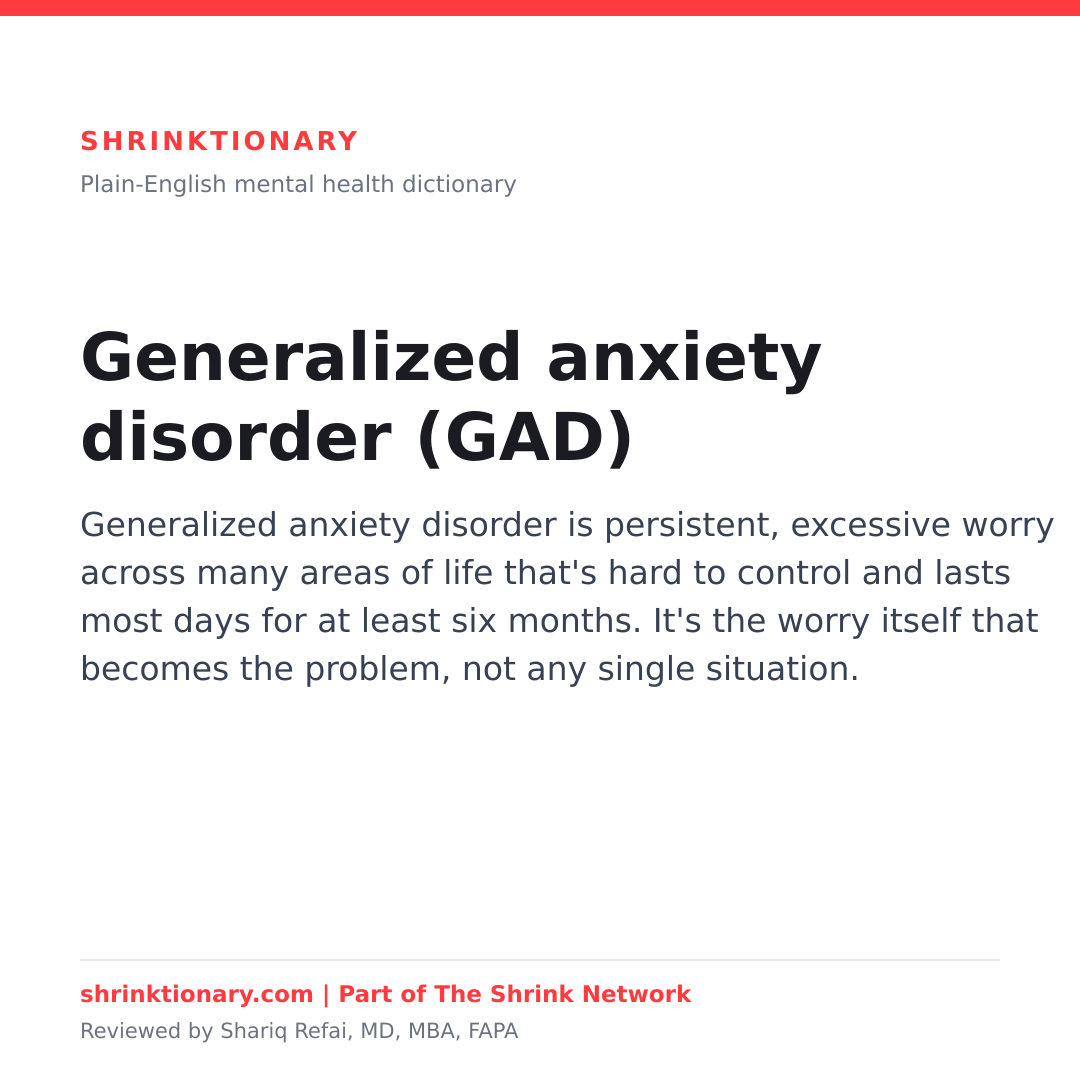
Everyday worry crosses into GAD when it's excessive, hard to control, spreads across many areas of life, and lasts most days for at least six months with symptoms like restlessness, fatigue, and muscle tension. It differs from panic disorder and ordinary stress because the worry itself, not any single situation, becomes the problem.
Commonly confused with
Frequently asked questions
How is GAD different from normal worrying?
Everyone worries, but in GAD the worry is excessive, hard to control, spreads across many areas of life, and gets in the way of daily life. By clinical definition it shows up most days for at least six months.
What's the difference between GAD and panic disorder?
Panic disorder centers on sudden surges of intense fear, while GAD is a steadier, more spread-out worry. The two can occur together, but they're distinct conditions.
How is generalized anxiety disorder treated?
Effective, evidence-based treatments exist, including therapy such as CBT and, in some cases, medication. Most people improve with care, and a clinician can confirm the pattern and discuss options.
Related terms
In these language clusters
Compare
Sources
- Anxiety Disorders , National Institute of Mental Health
- Anxiety , MedlinePlus
- Diagnostic and Statistical Manual of Mental Disorders, Fifth Edition, Text Revision (DSM-5-TR) , American Psychiatric Association
Use or cite this definition
Free to reuse with attribution. Paste the block into your own page, or grab a citation.
Embed on your site
<blockquote>
<p><strong>Generalized anxiety disorder (GAD):</strong> Generalized anxiety disorder is persistent, excessive worry across many areas of life that's hard to control and lasts most days for at least six months. It's the worry itself that becomes the problem, not any single situation.</p>
<p>— <a href="https://shrinktionary.com/terms/generalized-anxiety-disorder/">Shrinktionary</a>, a plain-English mental health dictionary, medically reviewed by a board certified psychiatrist.</p>
</blockquote>Cite (APA)
Refai, S. (2026). Generalized anxiety disorder (GAD). Shrinktionary. https://shrinktionary.com/terms/generalized-anxiety-disorder/
Cite (MLA)
"Generalized anxiety disorder (GAD)." Shrinktionary, https://shrinktionary.com/terms/generalized-anxiety-disorder/. Accessed September 29, 2026.
Your next step in The Shrink Network
You are here: Shrinktionary, the language layer of The Shrink Network.
Each site in the network has one job. No matter where you enter, we help you find the next step that makes sense.
Want to understand more first?
See how this connects to everything else in the Term Web →
Take it with you
Free printable references you can save or share. For education, not medical advice.