What imposter syndrome actually is
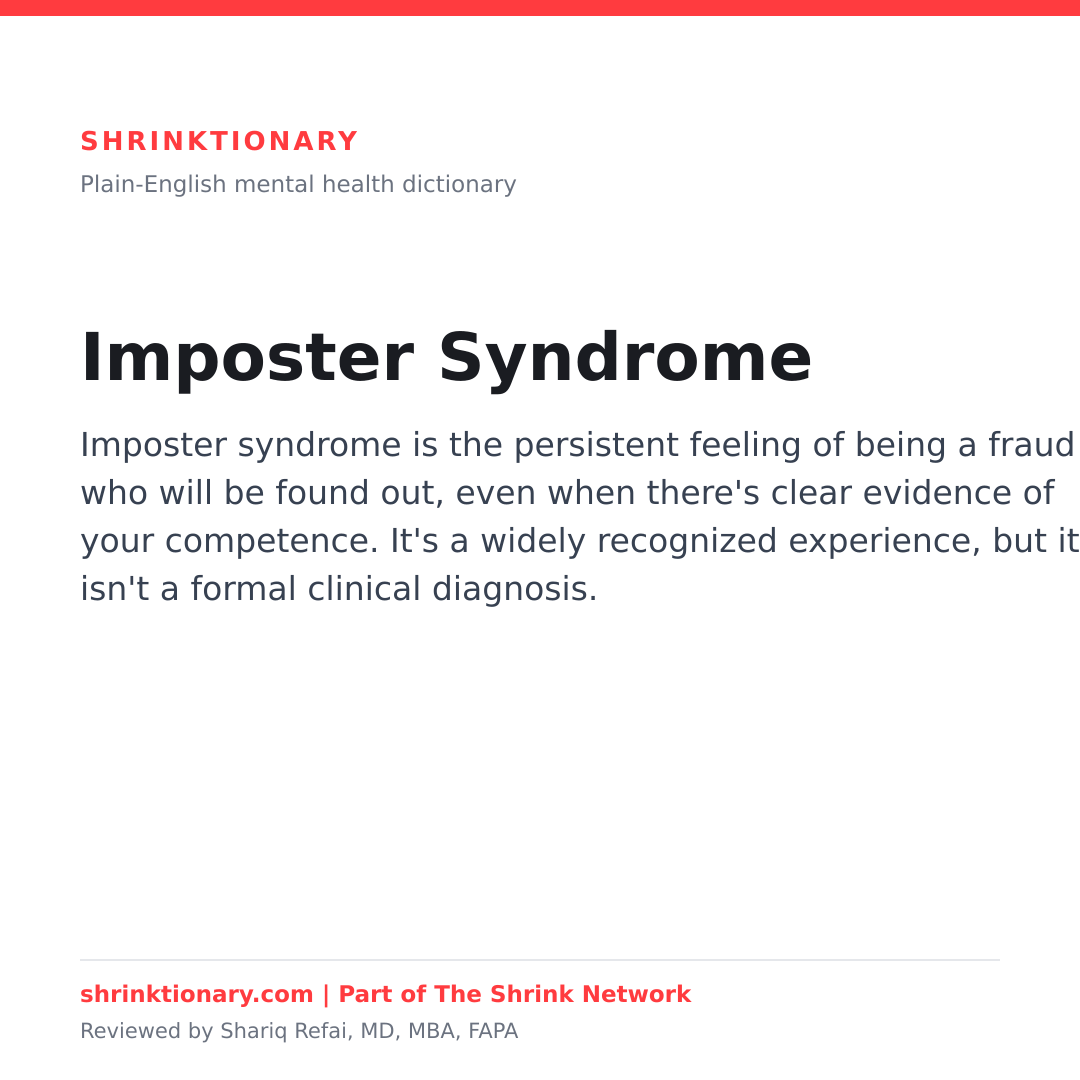
Imposter syndrome is the nagging belief that your success is undeserved and that, sooner or later, everyone will discover you’re a fraud. People who experience it tend to chalk up their achievements to luck, timing, or fooling others, rather than to their own ability.
The idea was first described by psychologists studying high-achieving people who, despite clear accomplishments, couldn’t internalize their own success. It often goes hand in hand with anxiety, self-doubt, and a habit of holding yourself to impossible standards. The more someone achieves, the louder the worry of being exposed can become.
It’s worth being clear: imposter syndrome is a useful, relatable description of an experience, not a diagnosis you’ll find in the manuals clinicians use.
What imposter syndrome can feel like
People with imposter syndrome often feel a gap between how others see them and how they see themselves. From the outside, they look capable and accomplished. On the inside, they feel like they’re winging it and about to be caught out.
Common patterns include downplaying praise, over-preparing or overworking to avoid being exposed, avoiding new challenges out of fear of failure, and comparing yourself unfavorably to others. A single mistake can feel like proof of being a fraud, while genuine successes barely register. It can be exhausting, and it often thrives in quiet, because people assume they’re the only one who feels this way.
What imposter syndrome isn’t
Imposter syndrome isn’t a clinical disorder, and calling it a “syndrome” can make it sound more medical than it is. It’s a common pattern of thinking and feeling, not a formal diagnosis.
It also isn’t the same as ordinary humility or realistic self-assessment. Knowing you have room to grow is healthy. Imposter syndrome is the distorted sense that you’re a fake despite real evidence to the contrary. And it isn’t rare. Many capable, accomplished people experience it at some point, which is part of why the term resonates so widely.
Related terms you’ll see next
When to seek professional care
Feeling like a fraud now and then is a common human experience. It’s worth talking to a professional when these feelings are persistent, weigh heavily on your mood, fuel anxiety, or hold you back from opportunities you’d otherwise pursue. Approaches like cognitive behavioral therapy can help a person notice and reshape the distorted thoughts that keep imposter feelings going. Reaching out isn’t an overreaction, it’s a practical way to feel more at home in your own success.
When this word matters
Imposter feelings matter when they're persistent, weigh on your mood, fuel anxiety, or hold you back from opportunities. It's a relatable description of an experience, not a formal clinical diagnosis.
Commonly confused with
Frequently asked questions
Is imposter syndrome a real mental health diagnosis?
No. It's a widely recognized and relatable experience, but it isn't a formal clinical diagnosis you'll find in the manuals clinicians use. It's a common pattern of thinking and feeling.
What does imposter syndrome feel like?
People feel a gap between how others see them and how they see themselves. They may downplay praise, overwork to avoid being exposed, avoid new challenges, and treat a single mistake as proof of being a fraud.
How can you deal with imposter syndrome?
It's worth talking to a professional when the feelings are persistent, weigh on your mood, or hold you back. Approaches like cognitive behavioral therapy can help a person notice and reshape the distorted thoughts that keep imposter feelings going.
Related terms
Sources
- Anxiety Disorders , National Institute of Mental Health
- Caring for Your Mental Health , National Institute of Mental Health
Use or cite this definition
Free to reuse with attribution. Paste the block into your own page, or grab a citation.
Embed on your site
<blockquote>
<p><strong>Imposter Syndrome:</strong> Imposter syndrome is the persistent feeling of being a fraud who will be found out, even when there's clear evidence of your competence. It's a widely recognized experience, but it isn't a formal clinical diagnosis.</p>
<p>— <a href="https://shrinktionary.com/terms/imposter-syndrome/">Shrinktionary</a>, a plain-English mental health dictionary, medically reviewed by a board certified psychiatrist.</p>
</blockquote>Cite (APA)
Refai, S. (2026). Imposter Syndrome. Shrinktionary. https://shrinktionary.com/terms/imposter-syndrome/
Cite (MLA)
"Imposter Syndrome." Shrinktionary, https://shrinktionary.com/terms/imposter-syndrome/. Accessed September 29, 2026.
Your next step in The Shrink Network
You are here: Shrinktionary, the language layer of The Shrink Network.
Each site in the network has one job. No matter where you enter, we help you find the next step that makes sense.
Want to understand more first?
See how this connects to everything else in the Term Web →
Take it with you
Free printable references you can save or share. For education, not medical advice.