What social anxiety disorder actually is
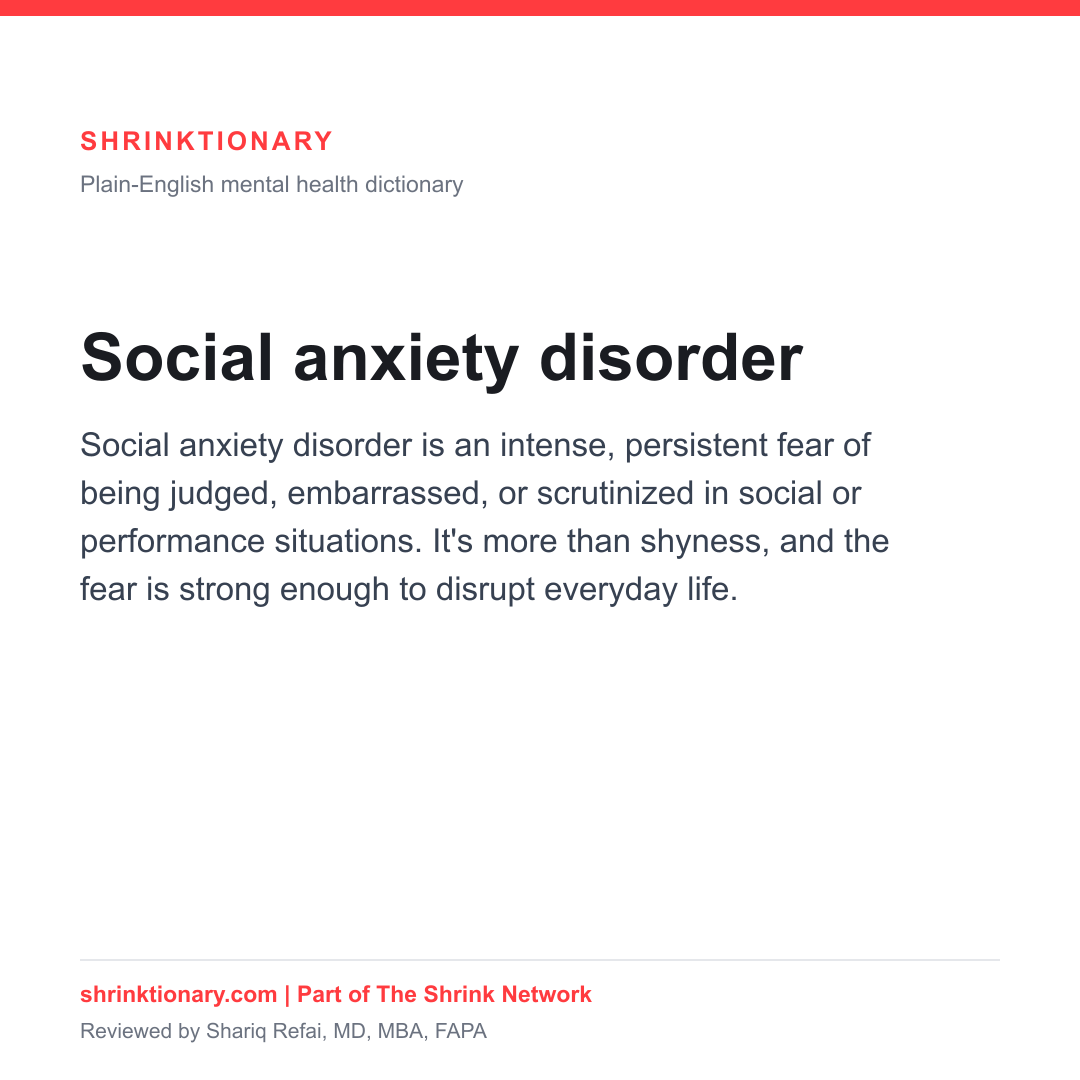
Social anxiety disorder is marked by an intense, lasting fear of social or performance situations where a person might be watched, judged, or embarrassed. The fear isn’t about the activity itself but about how others might perceive them, with worries like being seen as awkward, boring, anxious, or incompetent.
Common triggers include speaking in meetings, eating in front of others, making small talk, using public restrooms, or being the center of attention. By clinical definition, the fear is out of proportion to the actual threat, tends to last six months or more, and leads to avoidance or significant distress.
Because of that fear, many people avoid the situations entirely, or endure them with a great deal of anxiety. Over time this can affect school, work, and relationships.
What social anxiety disorder can feel like
People often describe a sense of being on stage and judged the moment others are around. Before an event, the mind may run through everything that could go wrong, a pattern related to catastrophizing. During the event, attention turns inward, monitoring blushing, a shaky voice, sweating, or trembling hands.
Afterward comes the replay. Many people spend hours dissecting what they said and how they came across, a form of rumination. That cycle of anticipation, self-monitoring, and review can be exhausting and tends to reinforce the fear.
What social anxiety disorder isn’t
Social anxiety disorder isn’t the same as being shy or introverted. Plenty of people are quiet or prefer small gatherings without any distress. The disorder involves fear that’s intense enough to cause real suffering or to push people away from situations they’d otherwise want to be part of.
It also isn’t a fixed personality trait someone is stuck with. It’s a recognized condition with treatments that have strong evidence behind them.
Related terms you’ll see next
Anxiety is the broader experience this disorder focuses onto social situations. Catastrophizing describes the worst-case thinking that often precedes social events. Rumination is the after-the-fact replay that’s common in social anxiety. Exposure therapy is a core, evidence-based treatment.
When to seek professional care
If fear of being judged is leading you to avoid social or work situations, or causing significant distress over several weeks or more, an evaluation is worthwhile. A clinician can confirm whether the pattern fits social anxiety disorder and discuss therapy and medication options. Effective treatments exist, and many people improve with care.
When evaluation may help
Not everyone reading about social anxiety disorder needs treatment. If it's getting in the way of your day, your sleep, your work, or your relationships, or if it isn't easing on its own, a professional evaluation is a reasonable next step. Most people start with their primary care doctor or a therapist. A psychiatrist is the right call when medication may be involved or the picture is complicated, though waits can be long.
We keep an honest, no-commission rundown of the options, from primary care to telepsychiatry to crisis lines, on one page.
If you're in crisis or thinking about suicide, call or text 988 in the US, or go to the nearest emergency room.
When this word matters
Ordinary shyness or nerves before a presentation cross into social anxiety disorder when the fear of being judged is intense, lasts six months or more, and makes someone avoid school, work, or relationships. It often shows up alongside depression, panic disorder, and other anxiety conditions.
Commonly confused with
Frequently asked questions
What is the difference between social anxiety disorder and being shy?
Social anxiety disorder isn't the same as being shy or introverted. Plenty of people are quiet without any distress, while the disorder involves fear intense enough to cause real suffering or push people away from situations they'd otherwise want to be part of.
What are common triggers for social anxiety disorder?
Common triggers include speaking in meetings, eating in front of others, making small talk, using public restrooms, or being the center of attention. The fear is about how others might perceive you rather than the activity itself.
Can social anxiety disorder be treated?
Yes. It isn't a fixed personality trait someone is stuck with, and it's a recognized condition with treatments that have strong evidence behind them, such as exposure therapy. Many people improve with care.
Related terms
In these language clusters
Sources
- Social Anxiety Disorder: What You Need to Know , National Institute of Mental Health
- Social anxiety disorder , MedlinePlus Medical Encyclopedia
- Diagnostic and Statistical Manual of Mental Disorders, Fifth Edition, Text Revision (DSM-5-TR) , American Psychiatric Association
Use or cite this definition
Free to reuse with attribution. Paste the block into your own page, or grab a citation.
Embed on your site
<blockquote>
<p><strong>Social anxiety disorder:</strong> Social anxiety disorder is an intense, persistent fear of being judged, embarrassed, or scrutinized in social or performance situations. It's more than shyness, and the fear is strong enough to disrupt everyday life.</p>
<p>— <a href="https://shrinktionary.com/terms/social-anxiety-disorder/">Shrinktionary</a>, a plain-English mental health dictionary, medically reviewed by a board certified psychiatrist.</p>
</blockquote>Cite (APA)
Refai, S. (2026). Social anxiety disorder. Shrinktionary. https://shrinktionary.com/terms/social-anxiety-disorder/
Cite (MLA)
"Social anxiety disorder." Shrinktionary, https://shrinktionary.com/terms/social-anxiety-disorder/. Accessed September 29, 2026.
Your next step in The Shrink Network
You are here: Shrinktionary, the language layer of The Shrink Network.
Each site in the network has one job. No matter where you enter, we help you find the next step that makes sense.
Want to understand more first?
See how this connects to everything else in the Term Web →
Take it with you
Free printable references you can save or share. For education, not medical advice.